Lesson

Effective CRO tactics for personalized exit popups

Follow these proven behavioral exit popup strategies to maximize conversion rate and minimize site abandonments.

Yaniv Navot profile photo

Yaniv Navot

Senior Vice President, Commercialization,

Consumer Acquisition & Engagement,

Mastercard

Fact: most visitors will abandon your site and landing pages without converting. It happens. Maybe they got distracted. Maybe your unique value proposition wasn't strong enough. Maybe they didn’t find what they were looking for. Whatever the reason may be, the question is this: What can be done to convert those abandoning visitors? 

Many successful e-commerce brands are employing exit intent technology to reduce cart abandonments, recapture sales, increase conversion rates and generate more leads. This post breaks down the most effective tactics for exit popups (also known as exit intent overlays) with detailed personalization examples you can implement into any revenue-driven e-commerce strategy. 

What are exit popups? 

Exit intent technology is an algorithm that detects and reacts to site abandonment in real-time. Upon noticing exit intent (such as aggressive mouse movement to x-out of the page), the algorithm automatically triggers an incentivized popup to convince the abandoning visitor to take the desired action. 

Why they work 

Exit popups boil down your offering into a simple and concentrated version of whatever you’re promoting. They narrow down the analysis required to make a decision. If done right, exit popups can provide significant uplift and fulfill multiple revenue-based goals. But before we get into powerful exit popup tactics, let’s quickly highlight some all-too-common mistakes to avoid. 

How not to do exit popups 

Your exit popup should fulfill one goal. Only one goal. It should not be crammed with tons of content, multiple navigation mechanisms or too many calls to action. One goal: compel the user to make a simple decision.


The paradox of choice 

There’s a common misconception that people appreciate many choices. In fact, the opposite is true, especially in sales. Providing too many choices can lead to analysis paralysis, overwhelming your visitor and resulting in a see-ya-later instead of a conversion.

Putting too many call to action (CTA)'s or decisions in your popup is a recipe for user confusion. Your message must make one point clearly and explicitly. If your goal is to capture newsletter signups, don’t also invite users to ‘check out our new arrivals’ or include another call to action that’s unrelated to the goal at hand.

Additionally, any call to action on an exit popup should state exactly what will happen if the user clicks on it. Instead of saying “yes,” “no,” “cancel,”or “ok,” on a call to action button, explicitly state your goal: “Yes, sign me up” or “Send me all the latest updates.” Keep it simple: one popup, one clear decision.


Poor design 

A poorly designed exit popup spells disaster for decision making and conversions. UI issues and bugs aside, some have so much content that they require a scroll bar or feature anchor links for other pages to send users to. 

Scrolling and anchor links make sense for lengthy web pages, not exit popups. 

Placing multiple navigation mechanisms or tons of text within a popup is an outdated approach that will distract the user from the decision you’re trying to convince them to make. A good rule to follow: if it’s valuable info but needs a scroll, it should be its own page, not an exit popup. 

Now let’s take a good look at how to use exit popups to engage visitors who are keen on leaving your website. 

Six steps to developing a strong exit popup strategy 

To produce the most effective exit popup campaigns, follow our unique SPROUT

framework: Segment, Personalize, Recommend, Optimize, Urgency, Test. If you do, you may see a 267% conversion uplift like one of our clients did.


1. Segment 

You need to ask yourself the following two questions when creating a tailored offer using an exit popup: Who am I reaching? What action do I want to influence?

What audience am I trying to reach?

The more personalized your popup is, the better your chances are of stopping site abandonment dead in its tracks. Instead of taking a one-size-fits-all approach, you can make your messaging segment- or context-specific. This entails making a conscious decision of what will work best for specific audience groups or pages rather than all your users and site in general.

  • By  Cohort: Before you craft your copy, consider whom the offer is geared toward. Are you connecting with first-time visitors? Cart abandoners? Price-sensitive shoppers? Paid traffic? Registered users? Use your analytics data insights to get a good sense of your visitor's identity and then leverage audience segmentation accordingly. Taking the time to differentiate between patterns, referral sources and intent of individual audience groups will help you deliver a far more powerful and relevant message.

  • By Context: Instead of taking a user-centric approach, you can take a context-centric one. Landing pages, homepages, blog pages, checkout pages, product pages and category pages can all feature exit popups unique to that page. If a user is abandoning the homepage, for example, chances are they haven’t interacted much with your brand or products. Triggering a welcome offer to homepage abandoners, for example, can provide the necessary encouragement to engage further with your site. 

It’s important to note that contextual targeting isn’t only limited to pages. Tailoring your message according to geo-location, device type or local weather forecast are especially effective methods of creating relevant messages that resonate.


What action do I want to influence?

Typically, exit popups aim to get users to view content, complete a form or direct them to a specific or underlying page. Which desired action is the right one? It depends.

If your goal is for the user to take in a short message (max two sentences), then having the user either choose to convert on or dismiss the message makes sense. If your goal is to gain a subscription, then providing a bug-free form with one clear call to action is essential.


2. Personalize 

A bonafide method of reigniting engagement is to layer personalization into your exit popups according to each user’s interests and site engagement patterns. You might consider tailoring and personalizing your message with dynamic variables such as:

  • The user’s name
  • Product affinities
  • Real-time intent
  • Subscription status

Making a personalized reference reinforces the connection between the user and your brand, demonstrates that you understand their needs and can greatly increase your chances of re-engagement.


3. Recommend 

A very effective yet underused tactic is to use exit popups to cross-sell and upsell products. Featuring personalized product recommendations in your exit popups is a proven way to improve recirculation and reduce exit rates. Do this by first implementing automated recommendation widgets into the popup. Then, customize the widget’s conditions to recommend according to the products the user viewed or interacted with right before the abandonment. 


4. Optimize 

Popups that feel easy and simple to users are usually not the result of a quick and simple process. In order to create compelling exit popups, you need to be constantly testing design, calls-to-action and content. Continuous iteration and ongoing A/B testing and optimization is key to presenting the right message in the right context or to the right cohort. 

A powerful approach to exit intent optimization is to push multiple variations simultaneously and dynamically optimize the best performing combinations according to specific objectives or KPIs. Exit popups can be optimized according to goals—whether that goal is to improve click-through rate (CTR), generate more leads or increase revenue, for instance, is up to you. 


5. Create urgency 

Creating a sense of urgency is a great way to call visitors to action and encourage immediate decisions. Creating urgency with an exit popup means placing the user in a situation where they will feel they are giving up on something valuable by choosing to navigate away. 

You can create urgency by putting attention-grabbing keywords (e.g. % off, now, new, best, sellers, most popular etc.) within a given time frame (by midnight, today only, last call, only 3 hours left, etc.) Doing so will induce a fear of missing out and intrigue your shopper to seize the opportunity at hand rather than run from it. 


6. Test 

Organizations that deliver the most effective popups are the ones that continuously iterate and analyze. Pay close attention to your data insights to see what’s working and what isn’t. 

Just because a page can technically have an exit popup, doesn’t mean it should. Just because a message worked for one segment, doesn't mean it will work for another. Just because an exit-intent tactic worked for your competitor, doesn't mean it will work for you. 

The only way to deliver the most effective exit popups is through constant analysis, testing and using data insights to gain a better understanding of your user base. 


Five common exit popup examples 

1. Capture immediate sales 

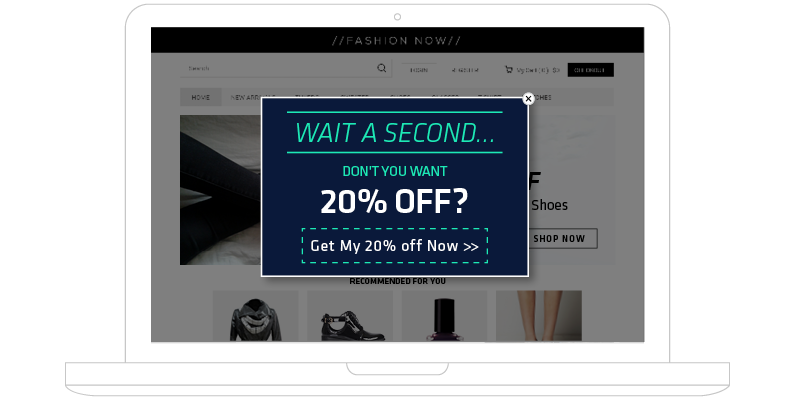
One of the most compelling and popular ways to convert an abandoning visitor is by offering a discount or coupon. Don’t be afraid to go for it here. Be confident. Be direct. Be bold. While 75% of abandoning visitors intend to return to your site to continue the purchasing process, less than one-third of them actually do, according to CXL.1 You can treat your offer as if it’s now or never. 

A good portion of abandonments happen if the price isn’t right or shipping costs are unexpectedly high. Offering a discount on the order, or providing a limited-time incentive to complete the order now rather than later, can empower you to secure a last-second purchase. 

Discount example

Keep in mind that while discounts can be attractive, you still need to keep your brand’s best interests in mind. Don’t offer a discount that’s so steep that it will compromise the value of your product. If you’re providing a limited-time or exclusive discount, only offer it once. Remember, you’re providing an incentive for the shopper to stay, not conditioning the customer to be rewarded for leaving your site.


2. Generate leads

Getting leads via exit popups can be surprisingly simple. The idea is to offer something valuable in exchange for something quick and small: the visitor’s email. There are many approaches you can take to generate subscriptions: newsletters, discounts and gated content are three great things to offer. 

How to get more newsletter subscribers

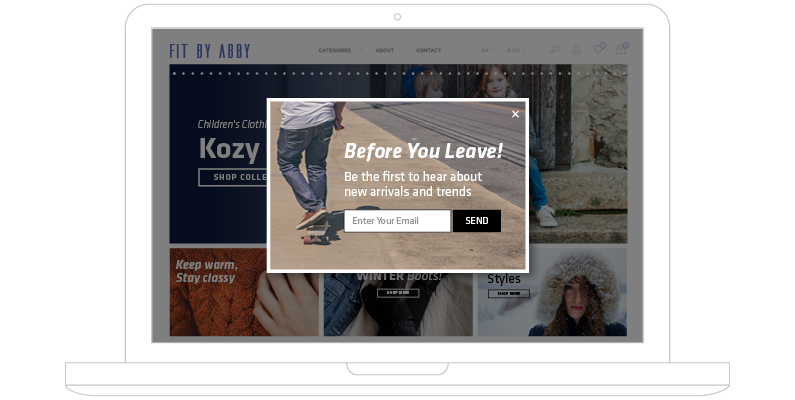
Asking visitors to sign up for a newsletter using an exit popup assumes they are already interested in your offering and are somewhat loyal to your brand. These should therefore only be delivered to frequent shoppers or customers that have arrived from social media sites.


Newsletter subscription example


Offer discounts

Offering first-time users a welcome discount upon email subscription is an effective way to reduce hesitation, initiate a relationship and encourage further engagement within your site. Since you’re gaining a warm lead, you can afford to make the discount a bit steeper than usual. Be careful not to offer this kind of option every time, as customers will learn to expect it and move to exit the page just to get a discount.

Promote gated content

Giving valuable information in return for a visitor’s email is a great way to expose them to your top and most useful content. E-books and case studies are both fair game. Courses and webinars can be especially useful since you can deliver them step-by-step to keep your prospects interested and coming back for more. With gated content, rather than having a single form field and call to action, provide a lead-gen form with a few fields that must be filled entirely before the content can be downloaded.

Keep forms as short as you can. 3-5 fields is the sweet spot.


3. Reduce cart abandonment 

Cart abandoners with an exit popup can dramatically reduce shopping cart abandonment rates, maximize conversions and recapture lost revenue. 

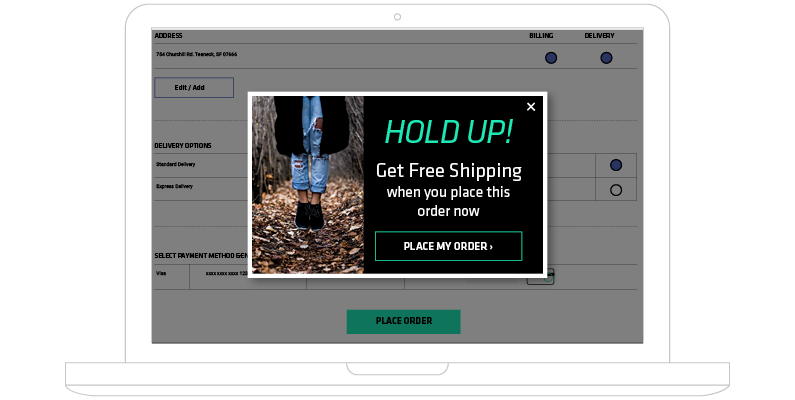
When creating an exit popup for cart abandoners, it can be helpful to differentiate between cart abandonment and checkout abandonment. Shoppers that added an item to their cart but haven’t proceeded to checkout (aka ‘cart abandoners’) can be served with a popup featuring personalized product recommendations or an inducement to sign up to a newsletter. Shoppers that have already begun the checkout process (aka ‘checkout abandoners’) can be sent limited-time discounts, free shipping, free returns or money back guarantees. 

Reducing cart abandonment example

4. Cross-sell and upsell 

Exit intent presents a unique opportunity to cross-sell and upsell. Brands can take advantage by recommending products, pages or information that the visitor has already displayed an interest in.

Products

Display products similar or frequently bought with the products or categories that the user has shown interest in. Doing this will enable you to expose shoppers to products they were previously unaware of and can pique their interest to explore them further.


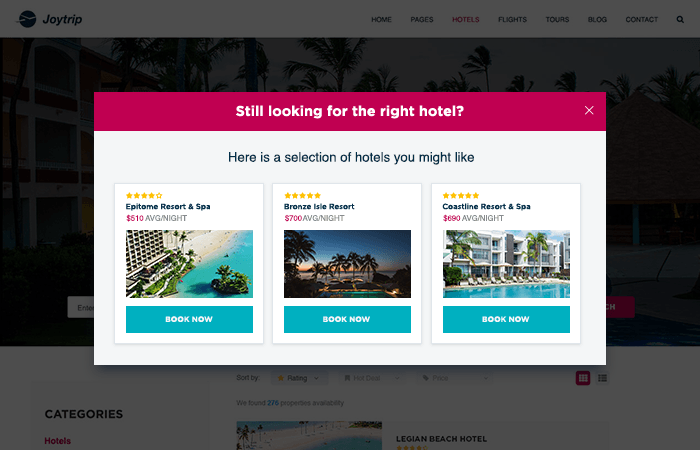
Similar or frequently bought together products example

An example from a hotel reservation portal leveraging exit intent popups with personalized travel recommendations. Read more about exit-intent recommendations here. 


Pages and information

Show a list of related pages from your website that the user has already visited or interacted with. If your popup is on a blog page, for example, display a list of related posts that the user has already commented on or read through.


5. Minimize bounce rate on landing pages 

There’s been pushback to putting exit popups on landing pages since the goal of a landing page is almost exactly the same: to focus the visitor on one offering and make it easy for them to make a decision. However, in spite of this, putting exit popups on landing pages has proven valuable and will help you sweeten whatever you’re trying to promote on the page. If your landing page is selling flights, for example, offering booking assistance and support in your overlay can help sway the minds of indecisive customers. 


Exit intent popups example

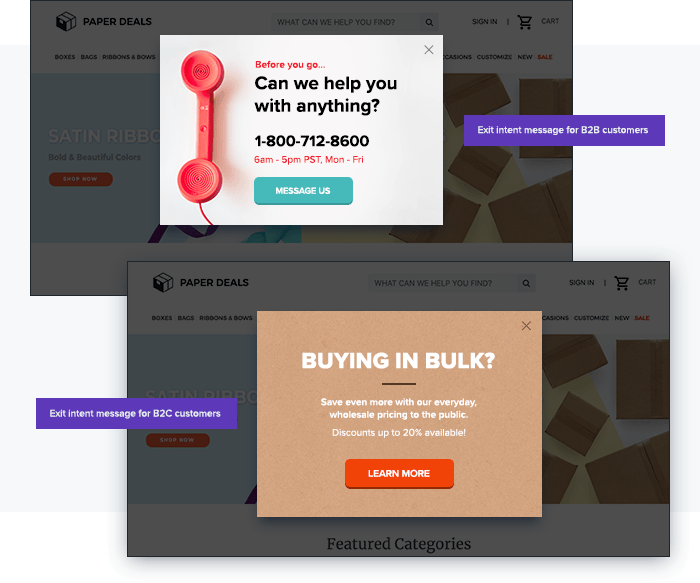
A real example from global wholesale company products who served personalized account-based exit intent popups to decrease site abandonment. Read more about account-based popups here


Another effective tactic to find the most relevant benefit on the landing page and re-present it on the popup: Most landing pages already highlight a number of benefits that should entice people in a specific market to convert. Reframing the most important benefit from the landing page with an added statistic can help validate your offering and compel the visitor to revisit their options. 


Conclusion

Exit-intent technology is an extremely effective way to induce conversions, leads and recapture lost revenue. If done right, exit popups will appeal to multiple user segments in multiple contexts. No matter your objective, however, it’s important to keep in mind that your goal is never to try and to force the visitor to take an unwanted action. Exit popups must entice the visitor to easily make one simple decision. The only way to deliver the most effective exit-intent messages is through constant analysis, testing and using data insights to gain a better understanding of your user base. 

Contact sales

Talk to an expert to learn how Mastercard can enhance your business through our products and services.

Mastercard