An introduction to the process of real-time website personalization, including strategies to implement, challenges to consider and examples to get started.
Published: September 04, 2024 | Updated: September 05, 2024
At one time, businesses venturing into digital needed only but to build a good-looking website, publish fresh content and make smart investments in search, paid media and email to attract and engage visitors online. As the internet landscape became more saturated, rising customer acquisition costs gave way to A/B testing, whereby a healthy influx of conversions could be generated by optimizing the site’s various elements to determine the best performing experience and serve it across traffic.
But in a world with billions of websites and an increasing number of online channels being folded into the customer journey, the stakes are even higher. Today, if brands want to influence decision-making, they’ll need to invest in personalization as a discipline. In this lesson, we’ll dive into website personalization and how you can use it to resonate with visitors on an individual level.
While early efforts were often plagued by poor management of data insights, resulting in subpar experiences, website personalization has evolved beyond a mere tactic.
Today, the landscape of website personalization has expanded dramatically and is now a full-fledged discipline encompassing various channels, strategies and teams.
The focus has shifted from generic “one-size-fits-all” experiences and segmented messaging to dynamically responding to customer needs and crafting one-to-one interactions. This requires going beyond basic demographics and group correlations, and instead, prioritizing real-time tailoring of website content and offers based on unique characteristics and engagement across your customer base.
This evolution reflects the growing awareness of personalization’s potential to enhance user engagement, drive conversions and foster stronger customer relationships. By delivering relevant and personalized experiences across a website (and beyond it), businesses can create a competitive advantage and achieve significant marketing success.
While some may operate under the assumption that personalization is just some new fad in an ever-changing landscape of digital marketing tactics, consumers place a high value on being acknowledged as an individual and tend to buy more from companies that tailor their experiences.
More than just a buzzword, online visitors are diverse and each one of them comes with their own distinct interests, desires and motivations. Therefore, serving the default website experience or even one built for a broader audience isn’t the most effective way to drive action or conversions.
For this reason, marketers are turning to website personalization to better anticipate and respond to consumer needs — a practice that has quickly become an industry standard.
It would be disingenuous to say that personalization is easy to implement, which is largely why it carries so much weight as a key differentiator and advantage against competitors.
However, personalization has undergone remarkable evolutions amid the proliferation of emerging technologies. And the real challenges that plagued marketing practitioners only a few years ago can now be remedied:
Silos that exist within many technology stacks can now be eliminated for the creation and actioning of a unified understanding of the customer.
While personalization relies heavily on developers, templating engines and improved workflows for campaign design have reduced the burden on key stakeholders.
With a host of permutations and combinations, picking a winning variation in the face of a constantly changing customer base was nearly impossible.
The dissipation of these barriers to entry, as well as many others, has not only made personalization attainable for all but also incredibly powerful.
As highlighted above, taking an individualized approach to marketing involves several moving parts, requiring brands to connect, consolidate, analyze and activate their data insights for the delivery of highly relevant interactions. Though, this can only happen when the following technological components are present at a personalization provider’s (also called “personalization engine“) core:
Unified dataset. Ingestion of data insights from multiple sources must be made available for the establishment of a cohesive dataset based on important events, actions and ways of engaging captured at every touchpoint. Businesses should, therefore, consider replacing several point solutions with that of a holistic, omnichannel personalization platform, allowing data insights to flow freely and be used for producing powerful, contextual experiences.
Open architecture. Integration with various tools from the marketing technology stack, no matter what the vendor, should happen seamlessly to enable powerful personalization use cases. A high level of flexibility can reduce engineering time and generate a significant amount of value in new profit by accelerating a business’ rate of deployment.
Decision logic. Automation of analysis and delivery are necessary to increase efficiencies, scale operations and ensure each customer receives the optimal experience. As the number of tests, variations and segments increases along an experimentation roadmap, assessing the impact becomes an incredibly process-heavy task, a feat that can only be scaled with machine learning.
Employing the right personalization provider is incredibly important, not only ensuring initial marketing dollars are well spent, but also that results are generated in a sustainable, scalable fashion.
A visitor should be targeted according to any available data source, and there are many conditions brands can use to ensure the right experience is delivered to the right user at the right time.
Broken out by high-level categories:
Audience Conditions | Description |
Location | The country, region, or city a user is located in. |
Technology | A user’s device-type (desktop, mobile, tablet), operating system, browser, and even screen solution. |
Traffic sources | The specific traffic source a user is visiting from, be it direct or paid, via referral search or social. |
3rd party data | Information about a user that has been collected from outside sources and aggregated by a DMP. |
Behavior | Important user interactions such as clicks, add-to-carts, or purchase events, as well as the number of page views, URLs visited, and so on. |
Explicit data | CRM data that has been collected about a user or has been provided intentionally through surveys and registration forms. |
Time | The select dates, days of the week, or time of day the experience is to be served to a user. |
Current page | The type of page a user lands on, whether its a specific URL, the homepage, a product detail page (PDP), or cart page. |
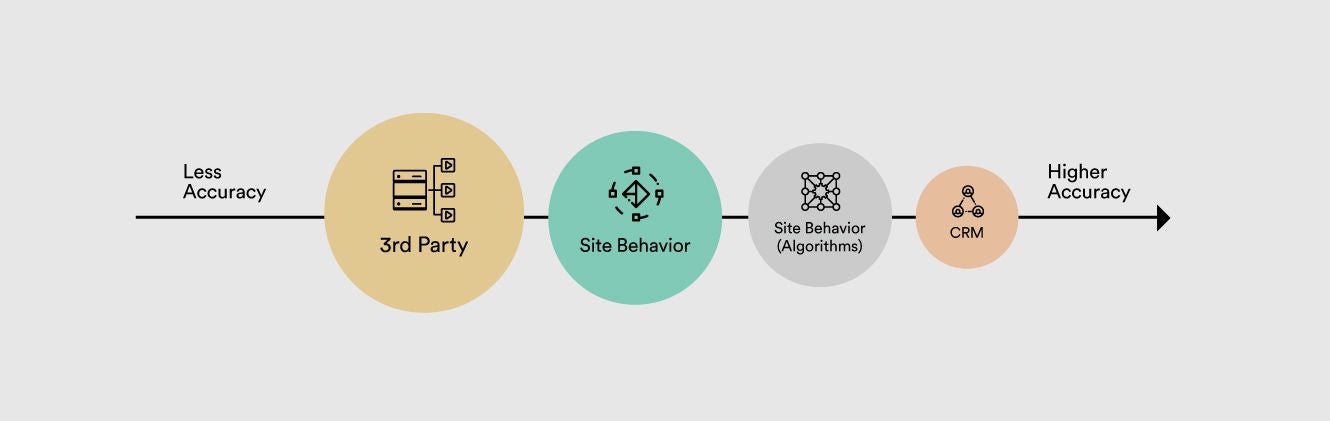
When ranking these sources, although 3rd party data insights represent the largest percentage of site traffic (~75%), it is the least accurate to personalize based on. Real time context represents the next largest share (~60%), with a medium degree of accuracy; it is, however, effective for understanding overall traffic patterns and can be leveraged to enhance first-time visitors’ time on-site.
Both site engagement captured by algorithms (~30%) and CRM data insights (~15%) are considered the most accurate, and while small in size, should make highly relevant interactions among returning and loyal visitors.
Site personalization comes in many different shapes and sizes, each use case designed with its own objective in mind. These experiences can be tested, optimized and personalized for each visitor — and together, are powerful tools for improving the entire funnel.
Experience Type | Use Case |
Dynamic Content | Replace on-site hero banners, call-to-action buttons, promotional modules or any other in-page element with dynamically generated content variations. |
Recommendations | Display content or products according to attributes in the data insights feed, visitor interactions and trends in visitor engagement. |
Overlays and popups | Highlight a particular offer using a large, prominent popup. |
Notifications and widgets | Serve a subtle, unobtrusive element in a corner of the screen or as floating bars and sliding drawers. |
Messaging | Tailor promotional, social proof, urgency or CTA-based copy across the site. |
Landing page | Personalize content variations across visitors instead of a single variation (one-size-fits-all). |
Menu personalization | Reorganize or change the order of the navigation bar based on visitors’ preferences or preferred categories. |
Search personalization | Populate search results according to visitor preferences and real-time context. |
And now, as the customer journey is no longer linear and includes multiple touchpoints, brands have even more opportunities to provide seamless, relevant experiences through personalization, whether they are online, in-store, accessing a site via desktop, opening an email or launching a mobile app.
Here are just a few ways those in the field are merging customer data insights for greater web content personalization.
To serve relevant product recommendations, a large retailer of precious metals created Audiences based on their own first-party data insights. Using a strategy based on preferences, visitors are exposed to the most relevant product recommendations at the top of the homepage.
To boost engagement and reduce both bounce rates, a large cosmetics retailer uses its CRM data insights to serve individualized communication around member loyalty status.
To deploy the best possible landing page experiences, a leading airline passenger protection company personalizes and optimizes all of its landing pages, serving variations based on users’ browsing history, geolocation, referring campaign time of day and more.
There are hundreds of website personalization examples available to increase conversion rates, average order value (AOV), gross profit and other imperative metrics.
Genuine concerns have arisen over whether serving dynamically generated content can negatively impact Search Engine Optimization (SEO) rankings. And while Google acknowledges the use of dynamic website personalization in improving the overall experience, from a technical point of view, there are four main risks that need to be taken into consideration when tailoring web pages.
Cloaking the content presented to the search engine spider
Using the wrong type of redirect
URL and content duplications
Web loading performance
A series of experiments conducted by Mastercard Dynamic Yield to determine how personalization affects a site’s SEO found that dynamic, JavaScript-based content is crawlable and indexable.
For a summary of the results as well as practical guidelines to help you avoid any unnecessary penalties from search engines, check out this post: The (real) impact of A/B testing and personalization on SEO.
There are a few practical tips brands can follow to ensure the greatest impact from their site personalization efforts, not only right out of the gate but also as they continue to scale.
You don’t need all the data insights in the world: A common misconception among companies is that many data insights are needed to personalize in a meaningful way, when, in fact, this isn’t the case. While the more robust the dataset, the better you understand your audience, simple online context can be easily collected and segmented to enhance on-site experiences. So marketers shouldn’t fall into the trap of trying to collect all available information, as this information will already provide a great starting point for effective website personalization.
Avoid boiling the ocean : Personalization is a journey, not a finish line and companies should start small by testing simple elements of the digital experience. For example, the banner on the homepage, images on Product Detail Pages (PDPs), recommendation strategies and so forth. Easy-to-deploy personalization use cases are critical to achieving executive buy-in, gaining trust in the program and accelerating your site personalization initiatives.
Dig into your audience data insights: Once you’ve run enough experiments, you can start analyzing the metrics collected for interesting correlations between groups such as intent-level, common traffic sources or certain demographic/psychographic attributes. Visitors can then be served experiences based on important events, actions and triggers over time.
AI can help with automation: Using algorithms that constantly collect all user data insights and signals, the best variation can be delivered to customers automatically, regardless of where they arrive from, what device they are using and so on. This can greatly accelerate the process of experience delivery as well as increase accuracy.
Your efforts must evolve as your audiences do: Visitors change over time, and therefore, continuously optimizing web personalization campaigns is absolutely critical to maximizing results over the long-term. New tests should be created and run based on all available data insights, and existing campaigns will need to be iterated on to ensure experiences resonate with individuals as their motivations evolve.
Success for any business looking to acquire and retain customers online is now predicated on the ability to tap into, understand and reflect the needs, wants and preferences customers demonstrate throughout the course of their relationship with a brand. Built to do just that, website personalization has gained a permanent place in the marketer’s tool belt.
If you are currently on the quest to find the platform best suited to execute on your digital customer experience vision, we’ve created a free Personalization RFP template designed for B2B and B2C companies to have a base set of questions to ask enterprise-class vendors as part of your company’s selection process.