Lesson

The opportunity cost associated with forgoing your personalization plans

Failing to adapt to increasing consumer expectations comes at the expense of data insights, knowledge, technology, teams, customers and most of all, revenue.

Shana Pilewski profile photo

Shana Pilewski

Vice President,

B2B Marketing ,

Mastercard

Over the past few years, we’ve seen once big-time brands all shutter operations, unable to keep up with innovative competitors better prepared to address the needs of a growing digital-first world.

Failing to adapt to changing consumer spending trends,  movie rental businesses succumbed to the superior experience of video streaming, and big-box retailers proved unsuccessful in matching the convenience and novelty of online shopping.

Sustainability in today’s consumer landscape means rethinking outdated approaches to the customer journey and continuously iterating upon them. Because as expectations rise, businesses can’t afford to maintain the status quo — it’s all about delivering on tomorrow, when shoppers have already come to normalize today’s offering. A harsh reality not guaranteed to even the most successful disruptors of our time.

It’s why we’re seeing tech giants not simply resting on their laurels but rather turning to strategies like personalization to better meet the unique needs of their customers.


Not your grandma’s marketing

Lorem ipsum dolor sit amet consectetur adipiscing elit. Quisque faucibus ex sapien vitae pellentesque sem placerat. In id cursus mi pretium tellus duis convallis. Tempus leo eu aenean sed diam urna tempor. Pulvinar vivamus fringilla lacus nec metus bibendum egestas. Iaculis massa nisl malesuada lacinia integer nunc posuere. Ut hendrerit semper vel class aptent taciti sociosqu. Ad litora torquent per conubia nostra inceptos himenaeos.

Lorem ipsum dolor sit amet consectetur adipiscing elit. Quisque faucibus ex sapien vitae pellentesque sem placerat. In id cursus mi pretium tellus duis convallis. Tempus leo eu aenean sed diam urna tempor. Pulvinar vivamus fringilla lacus nec metus bibendum egestas. Iaculis massa nisl malesuada lacinia integer nunc posuere. Ut hendrerit semper vel class aptent taciti sociosqu. Ad litora torquent per conubia nostra inceptos himenaeos.

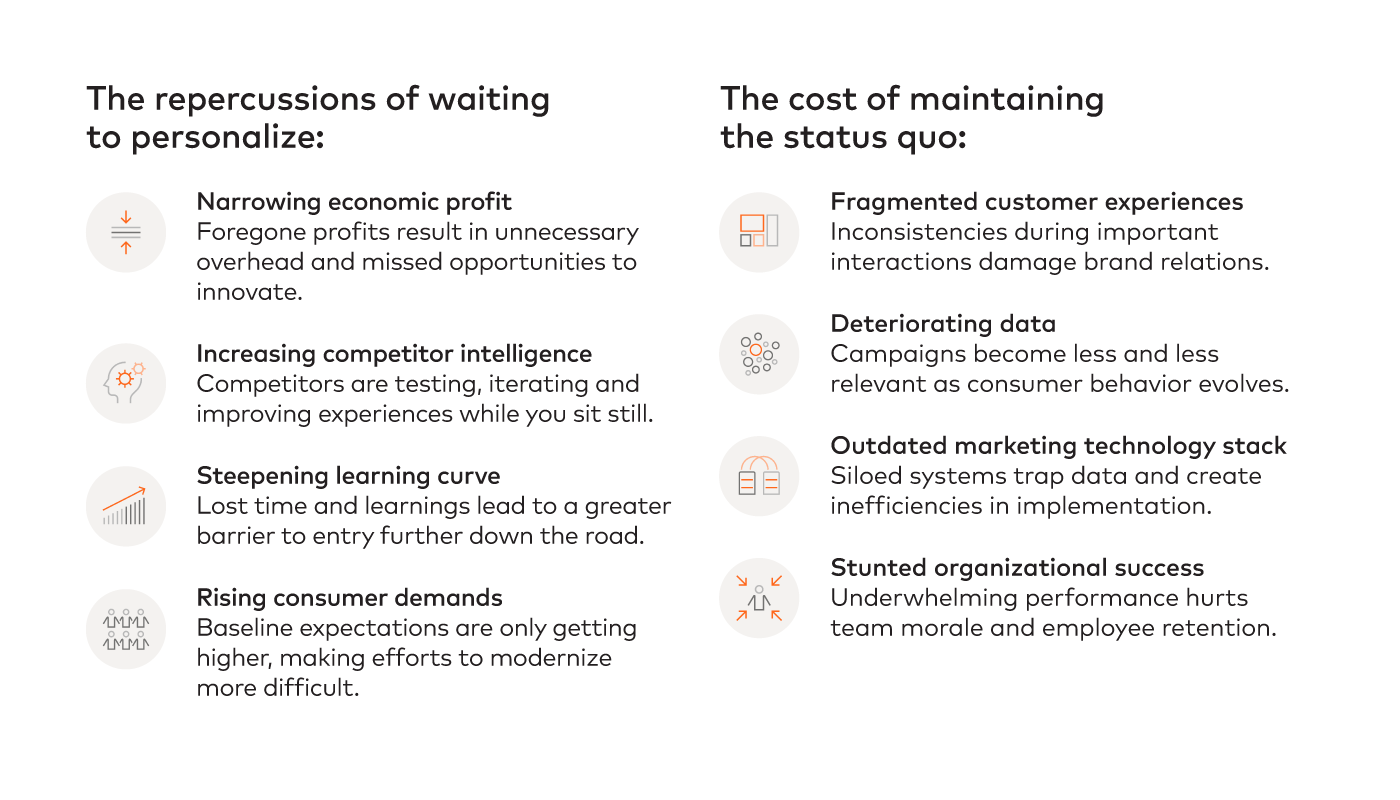
List of repercussions of waiting to personalize

The window of opportunity is closing

The marketing technology space has become so oversaturated, often making it difficult for decision-makers to discern the hype from the must-haves when it comes to prioritizing and applying new strategies.

But personalization is here to stay. It has already achieved significant validation in industries such as e-commerce, travel, grocery and financial services. And it will keep gaining commercial viability.

In fact, four in 10 shoppers now expect personalized marketing experiences, and say it increases their likelihood, according to a 2025 report from TransUnion. What’s more, traditional personalization is now table stakes — and AI-powered personalization has become the next frontier — especially as AI-driven interactions become commonplace, and consumer expectations for tailored experiences continue to rise.


The repercussions of waiting

Given what we know about the future of personalization, the more time passes, the greater the cost of not having committed — the impact of which can have serious repercussions. Here are a few areas where brands will end up paying, which will steadily compound over time.


Narrowing economic profit

When contemplating whether to invest in personalization, it’s easy to let the cost of entry overshadow the benefits that come with adoption — continuing to produce at the same rate reduces the amount of unknown risk. However, the payoffs of a more individualized approach are not uncertain. The tradeoff of not personalizing experiences increases the cost of doing business, with foregone profits resulting in unnecessary overhead and missed opportunities to innovate. And as competition in the field grows, these potential profits will soon begin to erode, reducing the gains associated with early adoption.


Increasing competitor intelligence

With every moment spent not innovating and revamping strategies from the top down, businesses leave space for other organizations to step up and take the reins. As competitors integrate personalization more deeply into their workflows, the potential for positive results increases. They will have the ability to test, perform, fail, learn and iterate, constantly improving experiences and witnessing the impact of their efforts in real time. And with each successful experiment, they will relentlessly lunge forward, leaving you in the dust. However, choosing to capitalize on this moment will allow organizations to close the competitive gap and regain their respective market share.


Steepening learning curve

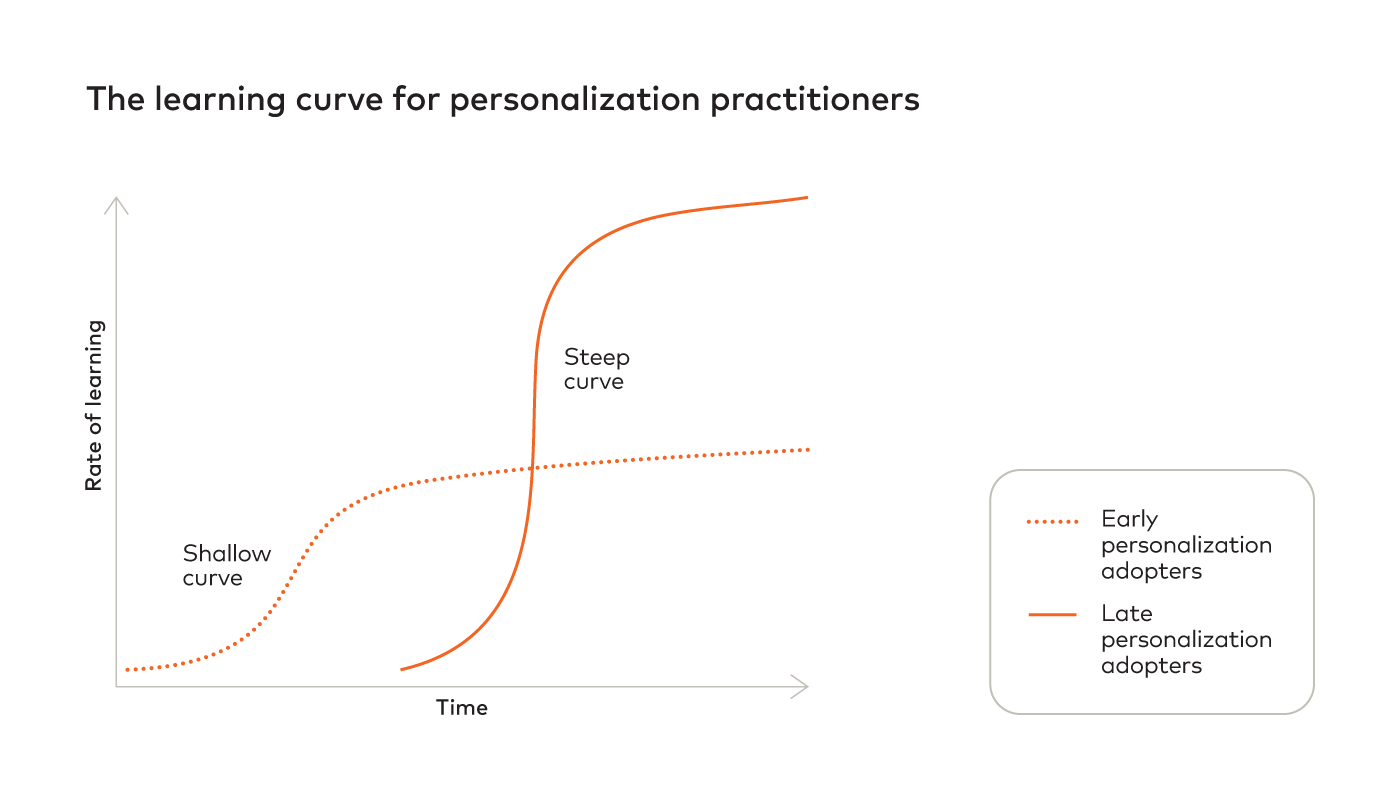
As with most investments, deferring contributions will only force you to make payments at a higher rate later in the game in an attempt to catch up. Even with a massive investment, you can’t make up for lost time and the learnings that come with it. A steeper learning curve will still create greater barriers to entry. However, choosing to invest in personalization before competitors enter the mainstream will give an organization the time and space for experimentation, from which you can then derive learnings that shape and mold a stronger overall strategy.

Delaying investments in personalization will only steepen the learning curve, increasing the likelihood for error and requiring more time, effort  and resources as time goes on.

Delaying investments in personalization will only steepen the learning curve, increasing the likelihood for error and requiring more time, effort  and resources as time goes on.

Rising consumer demands

Businesses who are just beginning to tailor experiences are likely being met with some frustration upon realizing the bar for every digital interaction continues to rise despite their sincere efforts to modernize. And those already delivering an amazing CX know that to satiate a customer who grows more demanding by the minute, the innovation never ends.

While implementing these experiences can’t happen overnight, the faster brands move, the faster they’ll be able to reduce the number of consumers exposed to generic, underwhelming and dissatisfactory experiences with your brand. Even marginal improvements can have a significant influence on the customer journey. 


Costs dig deeper than just into your pockets

While the cost of forgoing personalization can be detrimental to economic profit, businesses pay consequences that extend far beyond revenue; the negative effects trickle down to the tech stack, data, team and your customers.


Fragmented customerexperiences

Choosing to not personalize perpetuates the delivery of fragmented experiences. One of the biggest benefits afforded by a unified personalization platform is its ability to create a cohesive customer journey based on all available data insights. Without an omnichannel vantage point, businesses will have to accept poor customer engagement and even the loss of once-loyal customers.


Deteriorating data-driven insights

With more touchpoints than ever, these days, businesses sit atop mountains of data insights. But the difference between executing average versus stellar experiences is the ability to effectively use these insights. Without a personalization platform to leverage it in real time, campaigns built to serve audiences’ wants and needs become less and less relevant as preferences evolve, producing low-yielding results while driving up acquisition and retention costs.


Outdated marketing technology stack

For many, the tech stack includes an abundance of point solutions. These are often black boxes, rendering data insights (entirely) useless in improving the customer experience, a major challenge marketers face in their day-to-day. A disjointed marketing stack can also create silos among teams, creating inefficiencies in workflows and making it nearly impossible to launch new campaigns and initiatives or experiment with different  personalization examples. However, investment in the right personalization solution can help organizations more easily control the customer experience with a more cohesive and nimbler tech stack.


Stunting organizational success

In a highly competitive market, acquiring and retaining new customers has become all the more difficult. Without the power of personalization, e-commerce teams are put under increasing pressure to hit goals — turning to other, less impactful strategies for achieving results. Met with underwhelming performance, not only does team morale drop, but also the ability to forecast a bright future. A fresh digital strategy helps invigorate current employees, and can also attract new, high-quality talent to the mission of winning and nurturing customers. Plus, training a team on the latest in marketing tech can lead to long term benefits, including the ability to spot other emerging opportunities to take the business to the next level.


Don’t march backward into the future

Businesses need to learn how to adapt if they hope to sustain success, and that simply can’t happen if they aren’t able or refuse to see what’s right in front of them. The personalization opportunity of today will soon become a requirement for tomorrow, which is why it is so important to get started now. Not doing so comes at the expense of so much — data, knowledge, edge, technology, teams, customers and most of all, revenue.


1. Gartner®, “3 Steps to Drive Loyalty With a Customer-First, Channel-Second Strategy,” 2025.
GARTNER is a trademark of Gartner, Inc. and/or its affiliates.

2. TransUnion. “Four in 10 Consumers Now Expect Personalized Marketing Experiences,” May 2025.

Contact sales

Talk to an expert to learn how Mastercard can enhance your business through our products and services.

Mastercard