Lesson

Turning personas into data-driven profiles for segmentation

In order to create real value, personas must go beyond mere generalizations, stitching together different sets of data insights for a more grounded understanding of each audience segment.

Shana Pilewski profile photo

Shana Pilewski

Vice President,

B2B Marketing ,

Mastercard

Personas have been a helpful tool for supporting user experience design for some time, allowing brands to identify the needs, goals and problems of an audience segment in order to better meet their wants and needs along the customer journey.

Often though, these fictional characters meant to represent different segments of users within a customer base are simply too abstract, lacking the rich information necessary for teams to truly adopt or drive any real meaning from them. Left untouched, personas become a fading reference point within the org, never fully influencing the decision-making process.

In order to create real value, personas must go beyond mere generalizations, stitching together different data sets for a more grounded understanding of each customer group. Only then can they be effectively used for aligning on and powering the delivery of truly personalized experiences.

The problem with traditional personas

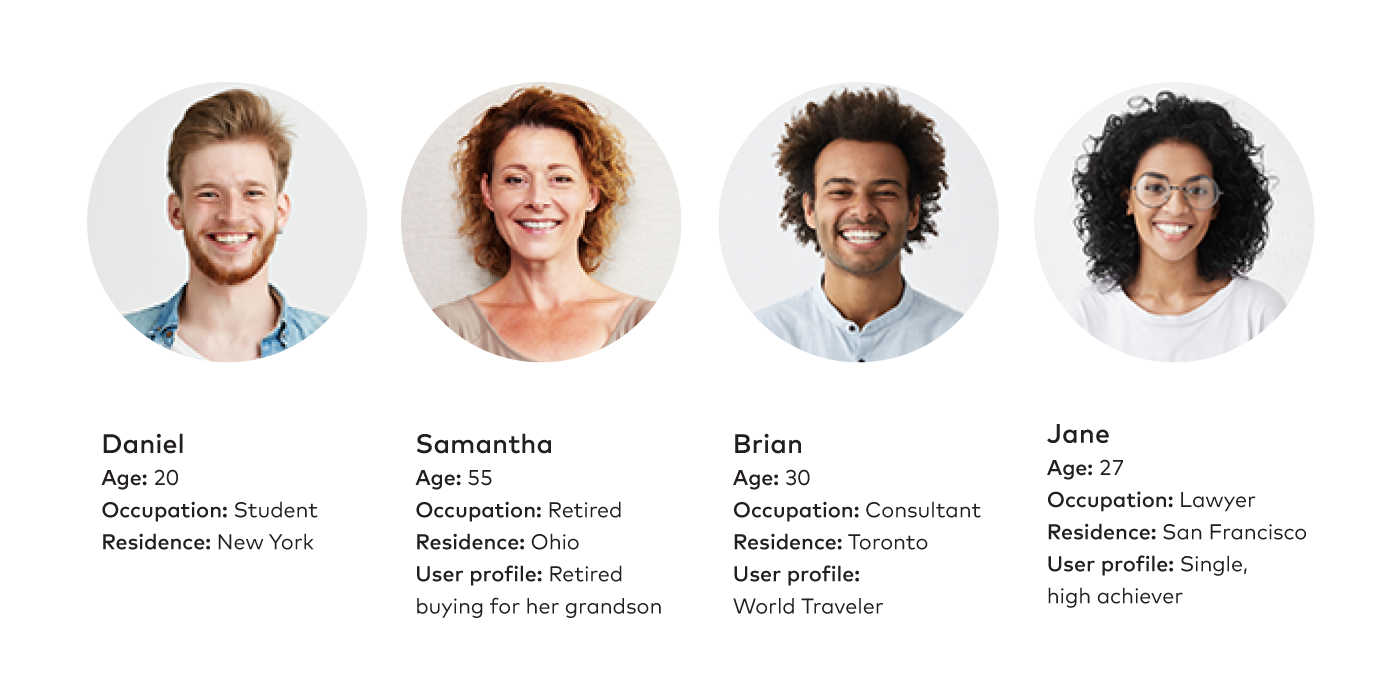
Largely derived from preconceived notions of who we think our customers might be based on our own personal contexts, typically, personas end up looking a bit like this…

While it might look nice and attempt to humanize outreach, these oversimplifications provide very little insight into what kind of experience a business should deliver to these audience types aside from some very general demographic information.

What actually makes users different from one another has a lot more to do with just age, gender and geo, incorporating device specific information, motivations and interests.

Let’s get a little more granular with Daniel, diving into his background, potential preferences, time on site and what the most ideal experience for him to receive might be:

Daniel

Characteristics background:
Daniel just recently moved to New York to study design. He’s still getting used to an urban lifestyle. Trying to establish his own style, he’s always looking to be different from the average. Daniel likes all things digital. His smartphone is his best friend.

Age: 20

Shopping preferences and purchase patterns:
Daniel is visiting your shop to look for clothes and accessories. He came there because a friend recommended your shop to him for some exclusive styles.

Occupation:

Student

Possible bounce / exit reasons:
Daniel wants to find things that are unique, or at least eccentric, yet he’s running on a tight budget. He usually browses the site without finding what he’s looking for and ends up leaving because he’s distracted with something else.

Residence:

New York

What would be the ideal end-to-end experience for this user?
Daniel usually has a short attention span when visiting their site. He wants quick access to unique styles and things that differ from average while meeting his budget. Narrowing down selection to meet his preferences and offering a seamless mobile experience for him are key to making him happy.


Consider this the hypothesis portion of your persona building. Not concrete truth, it’s an exercise in fleshing out specific audience theories for validation later on while analyzing the impact of an audience on conversions and revenue.


From basic persona to deeper understanding

Even with the context above, it’s still too difficult to create an audience for the purpose of delivering unique experiences. While it forces a brand to put itself in the user’s shoes, it lacks truth and is grounded entirely upon imagination. This is when data insights must come into play, defining the persona and his or her actual motivations.

Using the following scale, information can be tapped at varying degrees of accuracy to better serve the needs and wants of your customers — the more sources of data insights, the better.

The options to create accurate and interesting audiences are endless, and any combination between sources can lead to a meaningful segment.

Here’s an official breakdown of each source ranked by accuracy and size:

Info

Third-party data

Algorithms

Site engagement

CRM data

Accuracy

Low

High

Medium

High

% of site traffic with data insights

~75%

~30%

~60%

~15%

User type

New

Anonymous Returning

Anonymous

Loyal


Ideally, a balanced combination of each source of data will produce maximum relevance in proportion to its size and accuracy.

From there, a persona’s character can be truly defined for use as a segment. Based on Daniel’s original description, we can confirm the following information about him:


Character definition

How to capture

New York

Geo

Gender

Third-party

Student – Design at Parsons

CRM

Interested in music

 Third-party

Urban lifestyle

Geo

Social and digital

Traffic source social media

Uses smartphone

Device category

Clothes and accessories

Preferences

Cost / benefit shopper

Third-party

Tight budget

Visits low cost

Distracted – 18-24, heavy browser

CRM


With a complete picture, each persona created becomes the center of an experiences’ design, allowing brands to more effectively navigate what touchpoints to influence, when and how. Based on real information and not just pure assumption, these data-driven personas or macro segments provide a stable jumping off point for potential experiences along a personalization testing roadmap.


Macro to micro segmentation

Upon tailoring experiences for these larger subgroups of visitors, smaller audience groups will emerge, providing additional opportunities for experience creation, optimization and revenue generation. And while moving from a macro approach based on the persona work above to micro segmentation requires a lot more time, effort and resources, the output of doing so is even higher-yielding results.

By analyzing trends within these data insights, brands can identify and define smaller, finely tuned customer segments who are contributing the most value, a huge step towards achieving revenue growth. Now, with a great deal of information about their buyer’s preferences, context and intent, serving these users becomes much easier. The hard part is then customizing messages and content for each small segment and thinking carefully about how to optimize the user experience and flow being created.

However, with the right tool, this process can be made simpler. Using predictive targeting, brands can lean on machine learning to analyze the performance of an experience and it’s collective variations or treatments across different audience segments in real time to identify the best possible one for any audience, large or small. Able to deploy with confidence, brands can begin executing on a truly individualized approach — and it all started with a few basic personas. 

This post was co-written by David Ochman.

Contact sales

Talk to an expert to learn how Mastercard can enhance your business through our products and services.

Mastercard