Lesson

Tactics for sending high-impact triggered emails

Useful information on some of the strategies, tactics, and examples you can implement to ensure your triggered email campaigns are as high-impact as possible.

Shana Pilewski profile photo

Shana Pilewski

Vice President,

B2B Marketing ,

Mastercard

When it comes to email marketing, triggered emails are a powerful tool that every marketer should have in their arsenal. Falling under the umbrella of marketing automation, triggered emails are automatically sent based on an individual’s patterns of engagement or other signals.

These emails deliver content that is both timely and relevant to the recipient, and because of this, can drive significant results for businesses who utilize them.

Triggered emails are incredibly flexible in their setup and usage, and marketers can use them in a wide variety of ways. That’s why it’s important to make sure you set your triggered email campaigns up for success in order to reap the benefits of their power.

Below, you’ll find information on some of the strategies, best practices and examples you can implement to ensure your triggered emails are as high-impact as possible. 

Trigger events for valuable uplifts

An event triggered email is sent to a subscriber based on a pre-defined event or condition that has been met by an individual.

Some common use cases include:

  • Product view abandonment

  • Cart abandonment 

  • Order confirmation

Because the actual trigger event for these emails can be based on a wide variety of customer data insights, it’s incredibly important to employ a unified marketing platform so that your email tools can access the available data insights across the rest of your marketing stack. This enables triggered emails to be sent according to things like website activity, purchases from a mobile app or any other data insights found in within your respective marketing stack.

The making of a good triggered email

Map out the user journey

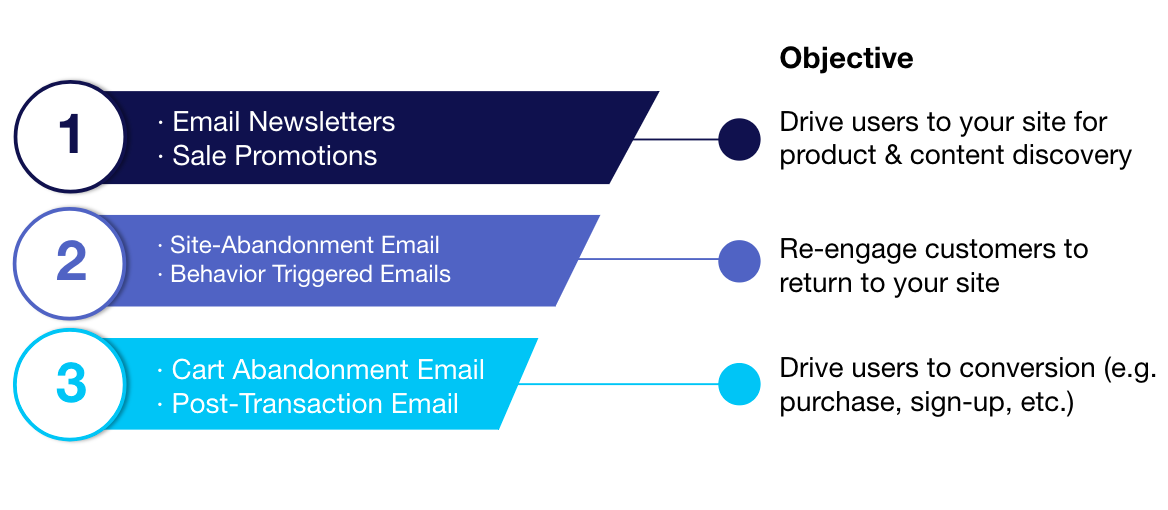
It can be helpful to map out the customer journey to see how visitors interact with your business across all of the major touchpoints. After doing this, you can identify the most valuable points in the user journey and then trigger emails to engage with your customer base, driving them further down the conversion funnel and closer to action.

Image showing a 3 step user journey

For example, shopping cart abandonment is a serious issue for many retailers wherein a customer adds items to their shopping cart but leaves without completing a purchase. You can trigger an email upon abandonment to encourage them to complete their checkout process and reduce shopping cart abandonment rates.

Ensure email content is relevant to the user

Evaluate each of your triggered emails from the context of the recipient.

  • Does the content and messaging make sense given the triggering condition?

  • Would the recipient find your email valuable and engaging in that moment?

  • Is there a clear objective for the email? 

You should be able to answer all of these questions with certainty for each of your triggered emails.

For instance, if a customer places an order and an email confirmation is triggered, it should be sent in a timely fashion and include all relevant order information, shipping details and any other pertinent content.

Leverage the data insights in your marketing stack

When it comes to triggered emails, data insights are key. The more you understand your customers, the better you’ll be able to tailor your emails based on their engagement patterns, preferences, past purchase history, affinities and more. 

With it, you can create granular, valuable triggers for your campaigns. Depending on the tools you employ and channels leveraged, utilize data insights from across your CRM, website, mobile app or other sources to directly supercharge your email campaigns.

If a customer browses a particular item on a mobile app but ultimately doesn’t purchase, a triggered email highlighting the viewed product (and recommended items based on user affinities gleaned online) could be used to re-engage them after exiting the mobile app.

Tailor email content to each recipient

While triggered emails are inherently personalized because they’re sent to an individual based on the ways they interact with your brand, you can still further customize your triggered emails to each customer or customer segment.

Try incorporating personalization by varying the content and messaging of your triggered emails based on audience segments, such as:

  • New user

  • Existing user 

  • VIP or repeat purchaser

  • Price sensitive customer

  • And more

Additional micro-segmentations can be personalized depending on their value and priority. 

Test, optimize and repeat

As with all of your marketing campaigns, it’s important to test and see what actually sticks. You should be A/B testing all of your emails — everything from the subject line to the email content — to optimize for the highest performance and draw the best results.

Triggered tactics adopted by the best

Best practice #1: Delivering emails at the right point of the customer journey

A social platform that connects users to local events sends triggered emails after a user has just joined a new group. The email welcomes them and highlights upcoming events. The goal is to engage recipients right after they’ve shown interest in a group and help them get involved immediately.

These emails are incredibly successful because they’re short and to the point, while also being incredibly relevant and timely to the recipient. If someone has just joined a group, the brand understands the best window to engage participants is while they are still involved, and the content is top-of-mind.

Best practice #2: Use an engaging trigger that your recipients actually care about

One credit score app delivers triggered emails whenever there have been changes to a user’s credit score or updates to a credit report. The goal is to bring users back into the platform where they can elicit engagement with various personal finance resources and tools available.

These triggered emails are extremely effective due to the nature of their utility — recipients want to know of any underlying issues contributing to credit score changes and what updates have been made their account (especially in this era of growing data privacy concerns)

Best practice #3: Include relevant context and a clear call-to-action

When a customer places an order through this online pet food retailer, an email triggers requesting feedback on the order a week after the user receives their purchased items. Their goal is to encourage past purchasers to write and share reviews of products, which ultimately drives product sales from other users.

In this case, the business capitalizes on the point in the customer journey when users are most inclined to leave feedback on a purchase — right after they’ve made it. And to make it easier for recipients to deliver feedback, the company provides context by referencing the order items and then drives users directly to review each item via a clear call to action (CTA).


Contact sales

Talk to an expert to learn how Mastercard can enhance your business through our products and services.

Mastercard