Lesson

Shopping cart abandonment recovery strategy

Follow this proven strategy being used by some of the world's leading brands to reduce shopping cart abandonment throughout the customer journey. 

Yaniv Navot profile photo

Yaniv Navot

Senior Vice President, Commercialization,

Consumer Acquisition & Engagement,

Mastercard

In today’s e-commerce industry, shopping cart and checkout abandonment are all too common among online shoppers. As a result, many retailers have made abandonment reduction a primary goal and are devoting more and more resources towards achieving it. Fortunately, there are various tactics and personalization strategies that reduce cart abandonments to a minimum and induce greater returns.

To reduce cart abandonment and drive further sales and returns, e-commerce merchants should start by actively measuring and analyzing shopping cart abandonment KPIs. Many retailers find it effective to differentiate between checkout abandonment and cart abandonment. While cart abandonment refers to dropouts of customers with products left in their shopping carts and who had not yet begun the checkout process, checkout abandonment refers to customers who had abandoned the merchant’s site during the checkout process.


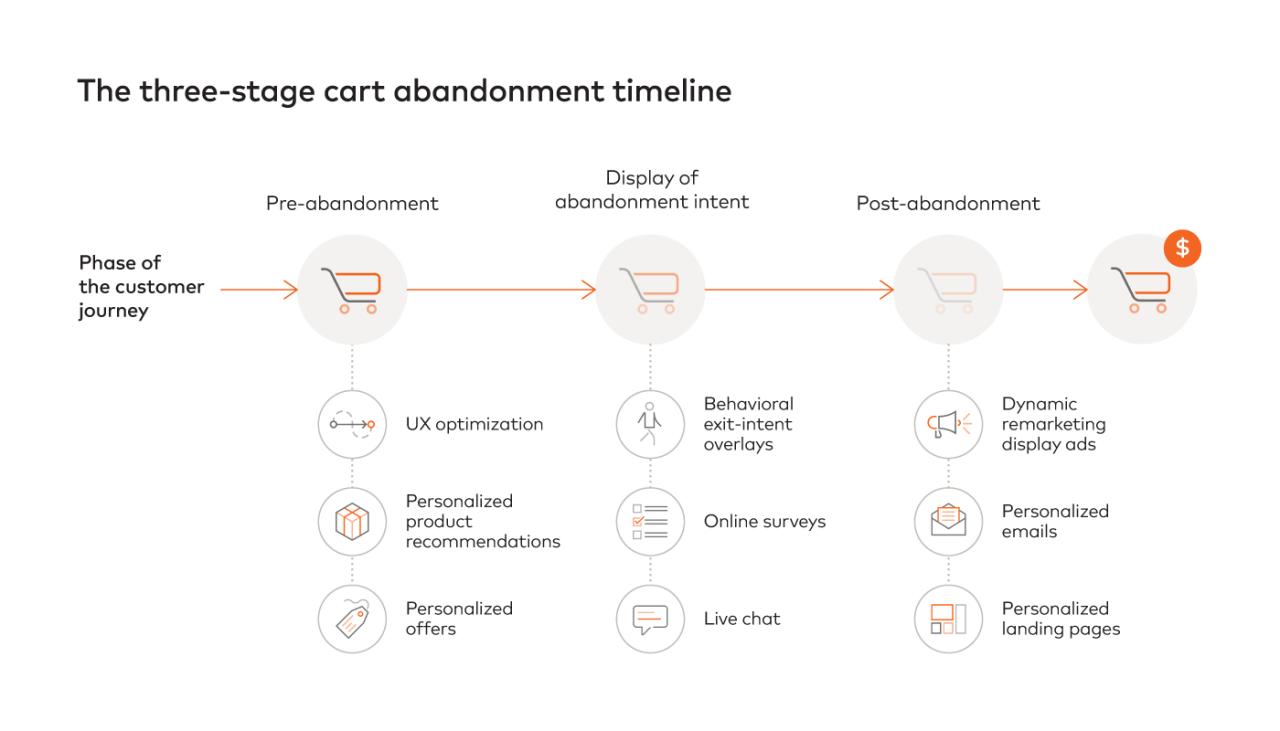
The three-stage shopping cart abandonment timeline 

By learning about the characteristics of each group of “abandoners,” merchants can tailor segmented experiences and execute personalized campaigns on the three stages of the abandonment “timeline,” i.e. pre-abandonment, display of abandonment intent and post-abandonment. 

The three-stage shopping cart abandonment timeline

Pre-abandonment 

It’s difficult to gauge visitor intent during the pre-abandonment phase (after all, your visitor may be just browsing your site without any true intention to buy) but it’s probable to assume that some of the causes for their eventual abandonment may come from a user-experience (UX) perspective. 

If your website seems untrustworthy or illegitimate then no one will buy from it. A trustworthy website can reduce hesitations and concerns and influence shoppers to check out. 

Trust may be affected by external factors, such as demographic variables or prior related experience, and by internal factors such as security seals, shipping policies, customer testimonials and more. 

By analyzing how each group of cart abandoners engages with their site, retailers can effectively tailor personalized experiences. 

Customers need to feel welcome and personally secure with the site they are purchasing from. Broken links, low-quality images, unresponsive pages and site timeouts can cause visitors to lose trust in your brand and lose confidence in their purchasing decisions. 

Displaying recognized verification seals and logos, allowing easy access to customer product reviews and providing full disclosure on security policies are three very effective ways to inspire trust in your brand and build confidence in your site. 

According to Statista, unexpected costs, such as high delivery charges or hidden fees, constitute the most common cause for abandonment1

Simplifying the checkout process and providing upfront prices, clear payment methods and transparent shipping costs can preempt customer inconveniences and dramatically reduce pre-abandonment dropouts. 

In addition, refraining from mandatory registration requirements prior to completion of checkout (i.e. enabling optional guest checkout) may also increase conversions among pre-abandonment visitors and lead them through the purchase funnel more quickly and efficiently. 

Simple, clear and convenient site usability can often make the difference in turning a comparison shopper into a loyal customer. 

Another powerful tactic to use pre-abandonment is to use the metadata you collect about your visitors to serve personalized product recommendations. Personalizing recommendations is not only a guaranteed strategy for improving recirculation, increasing monetization and reducing exit rates, but is essential to providing shoppers guidance, encouraging them to complete their purchases and refrain from abandoning their carts. Remember, 37% of shoppers buy more often due to personalized product recommendations, according to research from Salsify2


Display of abandonment intent 

There are a number of telling actions and intent signals on the shopper’s part that trigger the alarm for potential abandonment. However, there are effective, automated personalization and shopping cart abandonment solutions that enable you to recover in real-time and turn those potential abandonments into conversions. 

In a reality where most websites offer an overwhelming amount of content, shoppers may feel lost. Using sophisticated algorithms, e-commerce organizations can serve personalized and highly engaging messages to visitors upon display of exit intent. 

Upon display of this intent (such as an aggressive mouse movement to x-out of the page) triggering an incentivized overlay with limited-time offers, free shipping, money-back guarantees or an inducement to sign up to a newsletter, is a powerful way of keeping visitors engaged prior to returning to their referral source. 

Of course, that does not mean you should offer free shipping to anyone. Offer free shipping only when there’s a business justification for this. You can do it for product types, based on average order value (AOV), geographies, etc. 

To illustrate, let’s say your visitor was just hit with unexpected shipping costs and has now decided to leave your site rather than proceeding to checkout. Upon noticing your visitor’s exit intent, you can effectively re-engage by automatically triggering an exit-intent overlay or notification with a tailored promotion for completing the order now. 

One interesting strategy that is simple but yet effective in reducing shopping cart abandonment is to deploy flashing tab notifications that change the title of the abandoned browser’s tab in order to grab the user’s attention and drive them toward a purchase if they already have items in their cart: 

Another truly innovative use case for minimizing cart abandonment was deployed by one of Germany’s leading retailers in the household appliances category: In order to prevent abandonment, this brand identified customers who were highlighting the product name with their mouse cursor (likely with the intention of copy-pasting it in another tab in order to price-shop) — and then displayed a surprise coupon code that grabbed their attention and encouraged many of them to convert during the same session. 


Post-abandonment 

If your customer has abandoned their cart then there are a number of retargeting strategies and technologies you can leverage to encourage them to return. For example, merchants can re-engage abandoners through personalized display ads, reminding them that they still have items in their carts and offering exclusive deals upon returning to complete their purchases. Personalized ads make use of a user’s browsing cookies when they have visited a website to better serve these users with highly relevant promotions for products they have already displayed an interest in.

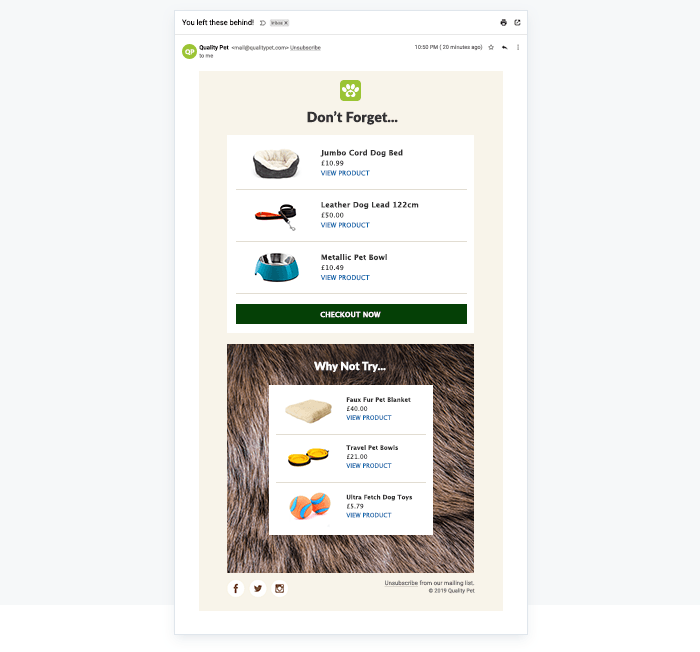
While online retargeting ads can be effective, marketers would be wise to invest in email campaigns that remain at the core of digital acquisition and customer retention. E-commerce brands can run personalized abandonment email campaigns notifying shoppers when out-of-stock items have been replenished or offer discounts urging shoppers to complete the purchases they left behind. According to Klaviyyo, abandoned cart emails flows average a 50.5% open rate and a 6.25% click-through rate3.

Shopping cart abandonment example from one of the world’s largest online grocery retailer: Sending time-based cart abandonment emails with recommendations. More on this use case →

While sending personalized marketing messages is an extremely effective strategy to encourage returns, soliciting feedback from customers can help reveal the factors which led to shopping cart abandonment. 

Regularly sending out surveys to your visitors and customers helps you stay on top of your customers’ expectations and informs you as to the most relevant and effective marketing strategies to employ in order to reduce future abandonments. 

Personalized shopping cart abandonment campaigns can be extremely effective for re-engaging customers. 

 
To conclude, shopping cart abandonment recovery solutions can be extremely effective for re-engaging customers throughout the various abandonment stages. Customer expectations are becoming increasingly demanding, and e-commerce merchants responsible for omnichannel retailing should embrace innovative new ways of meeting their needs on a personal level, across the customer journey. 

Sources

Mastercard Dynamic Yield is not affiliated with the research cited in these sources. 

  1. Statista. “Leading Reasons for Abandonment during Checkout in the United States,” 2025.

  1. Salsify. “New Consumer Research: How Do Shoppers Feel About Personalization in Ecommerce?” Oct. 31st, 2024.

  1. Klaviyo. “The abandoned cart benchmarks report: 2024 data to inform your strategy,” November 20, 2024. 


Contact sales

Talk to an expert to learn how Mastercard can enhance your business through our products and services.

Mastercard