Lesson

Building dynamic personas for personalization

We have to work harder to address the changing needs and shifting motivations that fall outside of current, flat personas which can make or break an online purchase. 

Udi Zisquit profile photo

Udi Zisquit

Senior AI Product Manager,

Mastercard

Web personalization is based on a set of rules and algorithmic laws that shape your visitors’ experiences. To deliver engaging online experiences, they must be effective enough to recreate the one-on-one interactions available in a brick-and-mortar store. 

So, we create thousands of variations to tailor recommendations out of vast product catalogs, relying on sophisticated algorithms and machine learning to take into account a visitor’s product preferences, aspirations and numerous other data-driven insights. 

However, when we need to program a personalized experience among a few authored variations, such as determining the number of products to display on category pages, we tend to conjure up and fall back on “personas.” 

These various fictional and over-generalized human prototypes represent types of shoppers. For example: 

  • Working mom, parent of three, age 35-40, suburban, into yoga 

  • Wall Street professional, age 25-35, single, foodie, posts on Instagram 

But, while a website or an app might be able to automate environments managed by machines, the shopper sitting on the other end is fully human. Thus, we have to work harder to address the changing needs and shifting motivations that fall outside of these flat personas which can make or break an online purchase. 
 

Static vs. dynamic personas

As we see them today, personas succeed at a few jobs: 

  1. They provide an understanding of different buyer demographics 

  1. They help curate the types of content in which your customers might be interested 

Other than that, the static and constant nature of these personas quickly becomes limited when seeking to tap into and impact the buyers’ decision-making process. The buyer persona is dynamic and dependent on several real-time factors: 

  • The type of purchase/product (e.g. preference-based purchase of clothing vs. “rational” purchase of a financial loan) 

  • Level of knowledge the visitor has on the product and its alternatives 

  • Whether the visitor knows exactly what s/he is looking for (goal-oriented vs. window shopping) 

  • How the visitor deals with selection (the paradox of choice — maximizer vs. satisficer) 

  • Other transient constraints, such as time, availability, budget, etc. 

The persona must be adapted to include these in-the-moment data insights. Additionally, it should fluctuate based on changes in interests and intent, allowing it to encapsulate a more comprehensive picture of the person(a) who actually makes the purchase. 

That being, the decision-making persona. 
 

Personalizing like a sales assistant

Following best practices, brick and mortar sales assistants are ordinarily trained to adapt their approach and level of service to the shopper’s needs, preferences and decision-making process. 

In situations where they do not have prior familiarity with a shopper’s background and preferences, these “personalization” skills become critical and must be honed around their ad-hoc needs, wants and time considerations at that moment. 

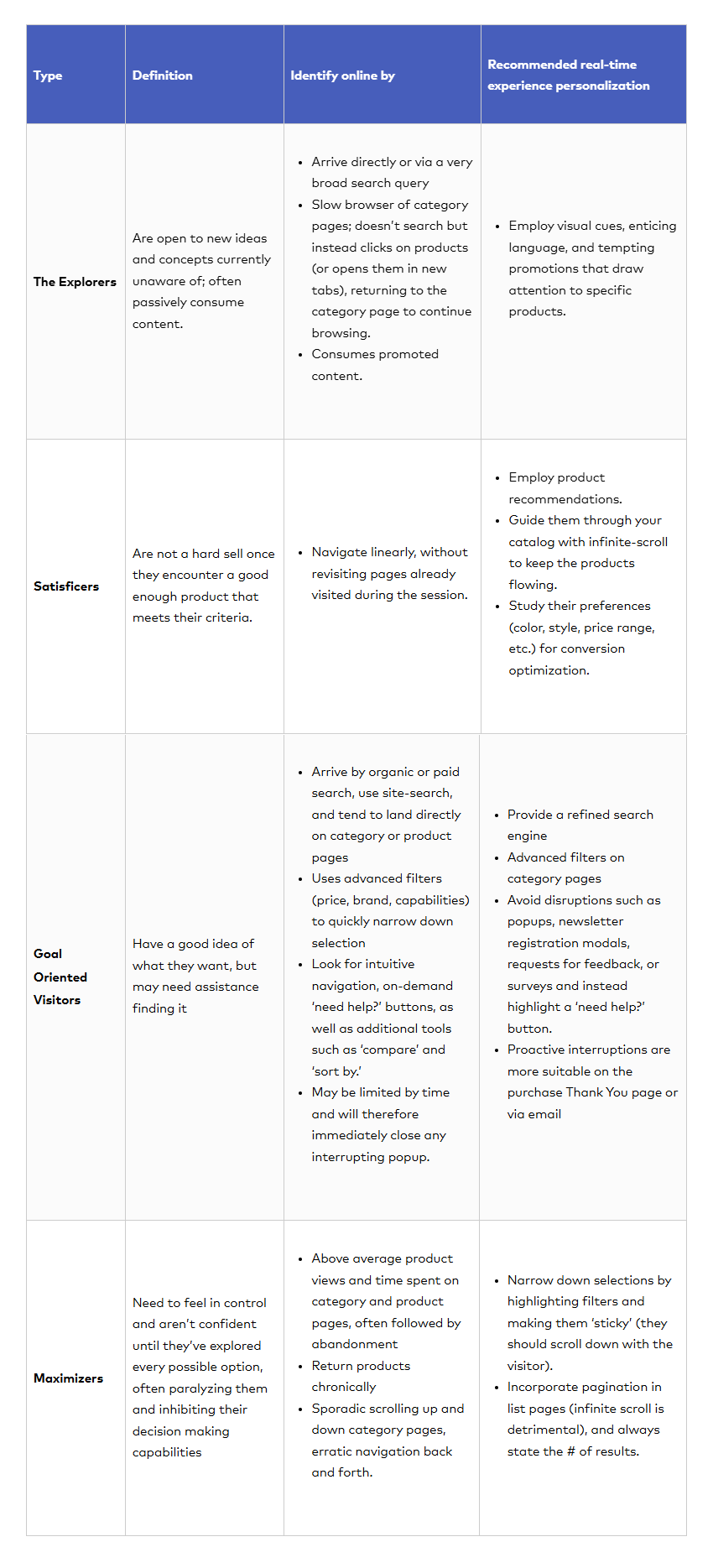
Considering a few separate scenarios, let’s pinpoint and define a few of these ad-hoc personas, extracting key differentiators and providing a few examples of how you can better serve your customers an appropriate experience in real-time.
 

Scenario 1

On Sunday morning, a shopper sets out to the streets of Manhattan to buy a pair of running shoes. Not a big shopper, she finds the task of identifying the right product and making the purchasing decision quite daunting. As such, she wants to be left alone to examine the goods until she finds a suitable pair, not wanting to be pressured by salespeople. 

Unfortunately, within the first five minutes in the shoe store, three different sales assistants approach to offer their expertise, volunteering information about new footwear collections and hovering around as the shopper sifts through price tags. Becoming irritated, she decides to leave and go online to browse quietly without interruptions. 

The Exploratory  and/or Satisficer Buyer
A persona who is open to new ideas and concepts currently unaware of.


Scenario 2

A wife sends her husband out to buy a printer with a budget of $100, noting her preference for the HP brand name and that photocopying capabilities are a must-have. This shopper wants to be efficient and waste as little time as possible exploring all of the available options and is, therefore, eager to receive assistance the moment he walks into the store.

Despite needing a sales rep who can show him the relevant models matching his criteria — as well as explain the pros and cons of each to help facilitate his decision among a variety of options — the first two reps know very little about this type of product and seem to ignore the shopper’s questions. By the time the third rep arrives, he is so disappointed with the in-store experience, he decides to visit HP’s website and buy the printer online.

The goal-oriented and/or maximizer buyer
A persona who has a good idea of what they want yet needs assistance finding it.
 

Whatever the scenario, personas must evolve to match the ever-demanding needs of retail shoppers, be it in-store or on the web. This level of omnichannel retailing will only happen when marketers adapt their strategies and tune into real-time signals, mapping experiences beyond basic demographics and pre-defined sets of rules to what really gives shoppers substance — their preferences, motivations and spending trends in the moment. That’s where the decision-making happens.


template

Contact sales

Talk to an expert to learn how Mastercard can enhance your business through our products and services.

Mastercard