Lesson

A primer on one-to-one marketing and personalization in e-commerce

One-to-one marketing implies a more personal approach to customer relationship building by narrowing broad communications to contextually relevant, highly tailored experiences. 

Shana Pilewski profile photo

Shana Pilewski

Vice President,

B2B Marketing ,

Mastercard

Often expressed as 1:1, one-to-one marketing implies a more personal approach to customer relationship building by narrowing broad communications down to contextually relevant, highly tailored experiences.

Once a lofty idea that felt out of reach, this is marketing’s ‘new normal’ as technology has ushered in the ability to tailor experiences for customers based on a variety of information now ripe for activation. Now, along with real-time context (such as geolocation and even weather conditions), a complex understanding of your customers — built on preferences, aspirations and spending patterns — can help your business isolate and customize experiences in as much detail as desired. 


Advantages and disadvantages of one-to-one marketing

This level of micro-segmentation requires a granular understanding of site visitors’ real interests along with their current position in the customer journey, as this allows you to segment them by purchase intent and how they engage with your personalized content. Based on real-time context and past spending trends, machine learning algorithms can recognize previously unknown connections and respond to them in a way that raises customer satisfaction and revenue.

For example, an airline knowing when and where (email, push notification, SMS, etc.) to alert a passenger about upcoming check-in or boarding deadlines, tips on what to pack, how to prepare, flight delays, upgrade options and so on.

Though this type of advanced personalization can be hard to attain — in the case of a marketer who does not have access to the data insights required to successfully tailor personalized content, users may receive incoherent or irrelevant messages. Fragmentation of data insights from various point solutions used to personalize experiences make omnichannel retailing near impossible when a unified approach and single view of the customer is necessary.

Should a company comply with privacy rules and regulation around customer data insights, there are no real disadvantages to delivering highly contextual communications with precision; there is only improper execution and limitations on the part of the technology you employ to power your one-to-one marketing efforts.


Taking the right approach from one-to-many to one-to-one

There’s a strong connection between data insights, segmentation and personalization. Getting one-to-one marketing right is much easier when there’s a solid understanding of the characteristics of the segments it is based on. A common practice is to first discover, analyze and prioritize the most high-value customers and only then personalize. A simple pyramid-like structure can portray the facilitated dialogue between the three elements:

Pyramid Base: Enhancing data insights – The key to both segmenting and personalizing experiences is having robust customer data insights. The richer your data insights, the better the understanding of your audience, and the better you can segment and personalize experiences based on them.

Mid-level: Segmentation – Once you have uncovered a sufficient number of valuable data insights, you can start analyzing them, looking for interesting correlations between groups.

Top Level: Personalization – Real-time, one-to-one personalization can only be achieved if you have enough data insights, know who your audience is and understand what your most valuable segments are.

And considering today’s e-commerce environment, where less than 5% of a site’s visitors are likely driving more than 90% of revenue, marketers can no longer personalize for a large segment of users. Instead, one-to-one marketing should be optimized to emphasize conversions from that crucial 5% of visitors who contribute most to their site’s KPIs.


One-to-one marketing examples

Personalized product recommendations

Displaying “popular items” is the most common product recommendation strategy — but serving user needs with personalized recommendations is the best strategy for maximizing revenue. 

The best recommendation engines are able to assess what’s known about a particular visitor and deploy the most appropriate strategy based on the availability of data insights, online context, user preferences and so on to solicit engagement. 

Personalized promotions, offers and discounts

Online retail brands can cater to customer needs on a personal level and maximize purchase likelihood by displaying highly incentivized notifications and overlays in real-time, based on users’ intent, demographics, preferred product attributes, on-site context, past buying patterns and other data insights. 

Personalized promotions example

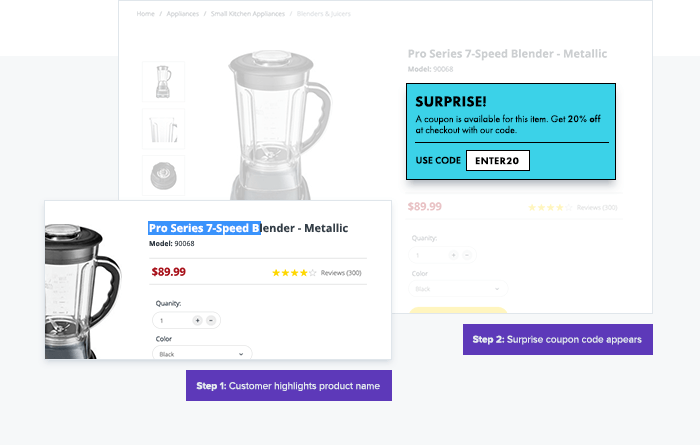
A real example from  a leading household appliance retailer in Europe  on how they have surfaced a secret surprise coupon for audience segments who were highlighting the product name.

Learn more about delivering a surprise coupon to price-conscious shoppers.

Personalized search

Customers expect to find what they are looking for as fast as possible. In fact, 69% of visitors search for a product once they hit a retailer’s site.¹

By delivering highly personalized search results based on past history and general spending trends, you can ensure they find the items most relevant to them and with accuracy. 

Personalized promotions example

But search isn’t just a list of recommendations anymore; using the latest in AI-driven algorithms and personalization, search can now dynamically adjust to the various ways that your audience looks for the products they need. Advanced semantic search and visual analysis are empowering brands to interpret the meaning behind a query or uploaded image — not just the words — leading to faster, simpler and more impactful product discovery and navigation.


The promise of true personalization

Delivering a great customer experience starts with a deep understanding of how customers engage with your brand. Ultimately, that information is the key to unlocking growth for your business. But without being able to access and action your data insights, tailoring custom experiences is simply out of reach, as are the customers with which you wish to connect. 

Personalization platforms allow marketers, product managers and conversion rate optimization (CRO) professionals to individualized, one-to-one experiences at the right moment, in the right context and across every touchpoint. 

Mastercard Dynamic Yield is not affiliated with the research cited in these sources.

[1] Nosto. “Research: 69% of online shoppers go straight to the search bar when visiting ecommerce sites, but 80% leave due to a poor experience,” Feb. 2023.

Contact sales

Talk to an expert to learn how Mastercard can enhance your business through our products and services.

Mastercard