Use this robust program to develop a conversion rate optimization strategy that will help you achieve sustainable growth.
Optimizing your website to ensure high conversion rates is one of the most important aspects of any marketing strategy. The thing is, it is also one of the toughest areas to deal with. Here’s a simple, yet effective, 4-step model for building a successful conversion rate optimization strategy.
While there’s a lot you can achieve with conversion rate optimization (CRO), companies that adopt website personalization and experimentation as a team effort typically achieve meaningful growth and better results. To launch tailored experiences at scale, you want to build a comprehensive CRO strategy.
A good CRO strategy has multiple contributors, with different functions from marketing, product, UX and development teams. All of them can contribute their skills and knowledge to the success of the program.
As you work within a team, you must build a foundational set of practices:
Once armed with a list of prioritized ideas, the next steps come into play: Creation, execution and then back to analysis. But this is an ongoing process. Make every idea a learning opportunity by thinking one step ahead. Consider what you could learn if your hypothesis was proven correct or incorrect in the case of a variation winning, losing or lacking statistical significance. Sometimes, this analysis may lead you to new ideas.
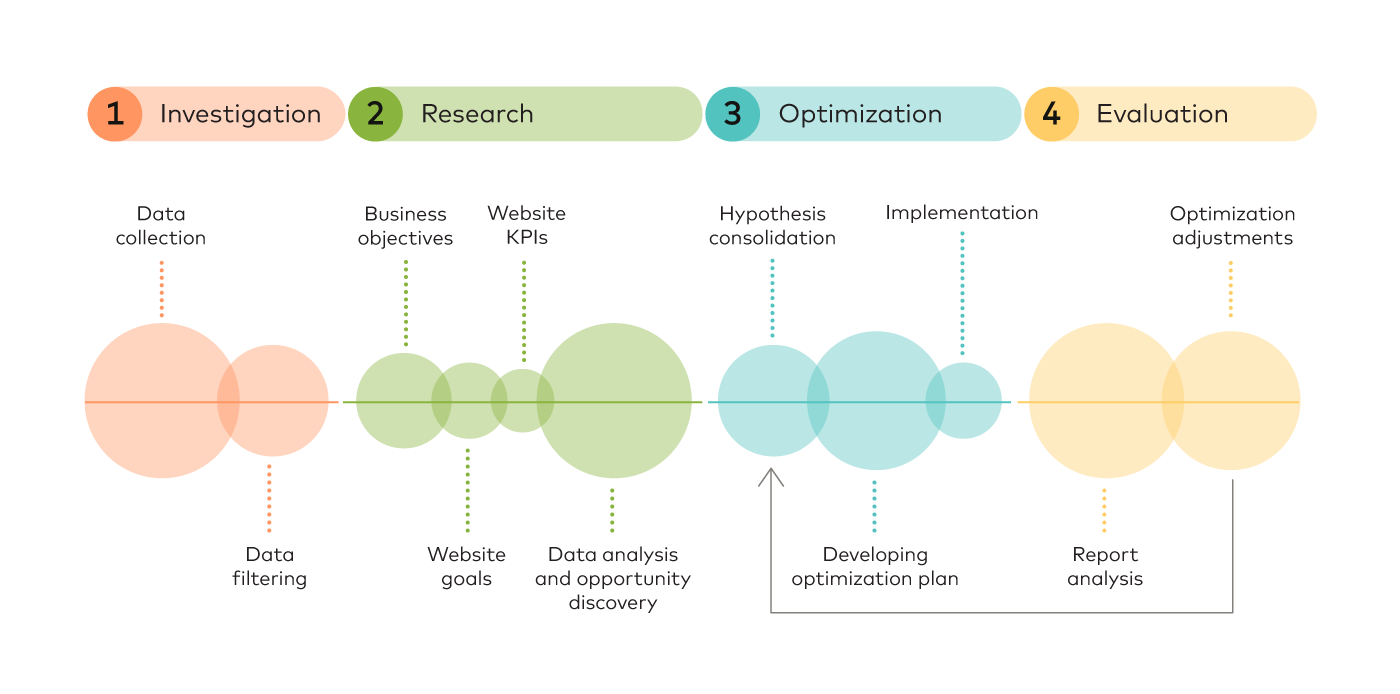
The following chart provides a bird’s eye view of the experience optimization process and methodology. Each step in the process is represented by a unique color. The X-axis represents the elapsed time between the steps of the process; while each circle represents the estimated capacity of the specific process in terms of work involved. Of course, in reality, the amount of work may vary from one case to another. The bigger the circle is, the more time consuming the task involved is for marketers.
This step has a clear and straightforward objective: To gain a high trust level with your web analytics data insights. Generally speaking, it is a two-part process:
Now, when you trust your findings and feel comfortable with its level of accuracy and organization, it is time to move forward and learn as much as possible about the business and its online activities:
One way to approach this is by looking at the main categories your content is cataloged by. For example, if your business is a food delivery service, you can segment by user preference (e.g. vegans, fast-food lovers, health enthusiasts, etc.).
You should also think about your main acquisition channels: Do you spend a lot of money on display ads? Do you have a lot of direct traffic? These channels behave differently with different intent levels.
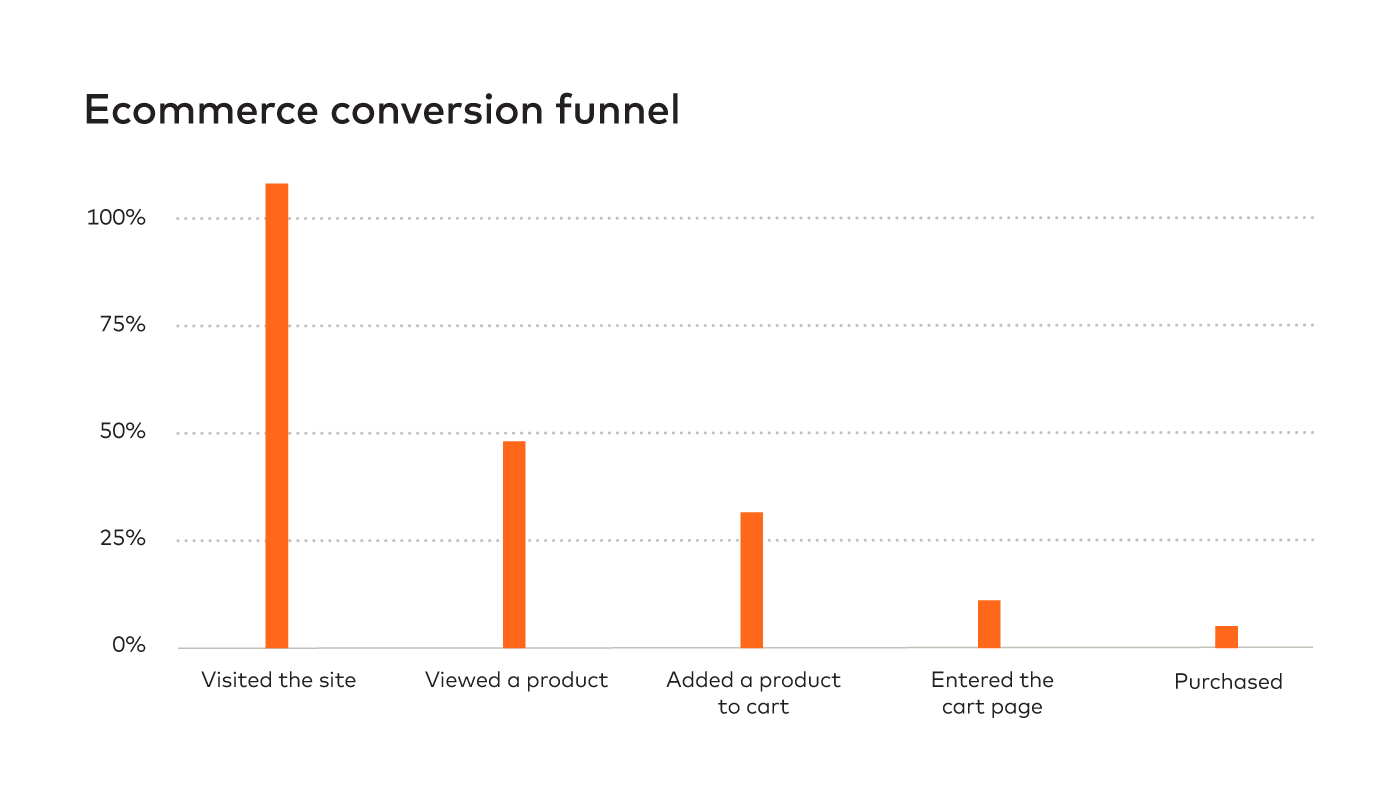
Every business has a primary conversion funnel where you define what success looks like. The funnel maps the different steps a user needs to take until a conversion (i.e. your primary metric) is completed. If we take an e-commerce site as an example, the funnel steps could be:
Typical e-commerce conversion funnel
After building this funnel into your analytics platform, you can start analyzing it:
After that, think about your secondary KPIs (e.g., newsletter subscription, register to loyalty program). Define those KPIs and analyze these conversion funnels as well.
Now would be a good time to take the opportunities you have discovered and put them into practice.
Once you have analyzed the data insights and have identified your opportunities, it’s time to get creative. How do you plan to solve your pain points? No one knows your business more than your team. We recommend involving everyone on your team: Customer support, marketing and even development.
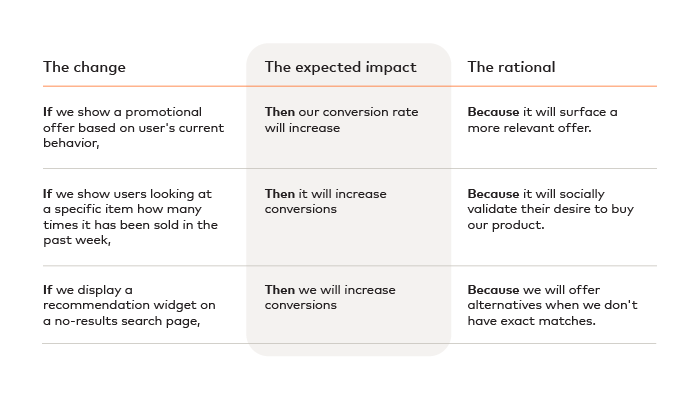
A good idea is based on a hypothesis. A hypothesis clearly indicates what change you are considering, what you believe the outcome will be and why you think the change will drive this outcome.
Taking the time to write your hypotheses correctly will help structure your personalization ideas, get better business results and marketing insights, as well as avoid time-wasting tests.
If your hypotheses are oriented toward improving your metrics, your team can focus on digging into the data and designing strong tests.
Your hypothesis should include three elements: “If [The Change], then [The Expected Impact] because [The Rational].”
Here are a few examples:
Ideation: How to develop ideas for your CRO programs
Based on your hypothesis, start building the optimization plan. In particular, explore what the specific changes are that you would like to implement and test by preparing the new copy, designing materials and such.
It’s easy to get carried away with ideas, so now you probably have more than you can actually handle; more ideas than you can actually spec, your design studio can design, your dev team can develop or you can properly analyze. How do you decide what to do next? A good personalization program includes a prioritization system. A simple way to do it is to consider effort (the amount of work needed) and impact (how much it will “move the needle”).
For every idea, estimate the amount of work needed. Think about all the people that will work on it. There’s the marketing and product teams (e.g., writing the spec), the design team (e.g., if graphic design is needed), the dev team (e.g., developing it) and the QA team (e.g., testing it). For each team, how simple or complicated will it be to bring this idea into life? Don’t be optimistic; be realistic. This is the “price” you will need to “pay”.
For example, showing a recommendation widget upon exit intent is easy to launch. There’s an out-of-the box Mastercard Dynamic Yield template and trigger for that. However, changing the layout of the homepage requires a lot more effort. Think about getting approval from all stakeholders for this drastic change, redesigning the new layout and all homepage promotions to fit the new layout, the custom code that your dev team will need to write and the heavy QA that will be needed.
For every idea, try to estimate the impact it will have on your business. Again, don’t be optimistic. Ask yourself:
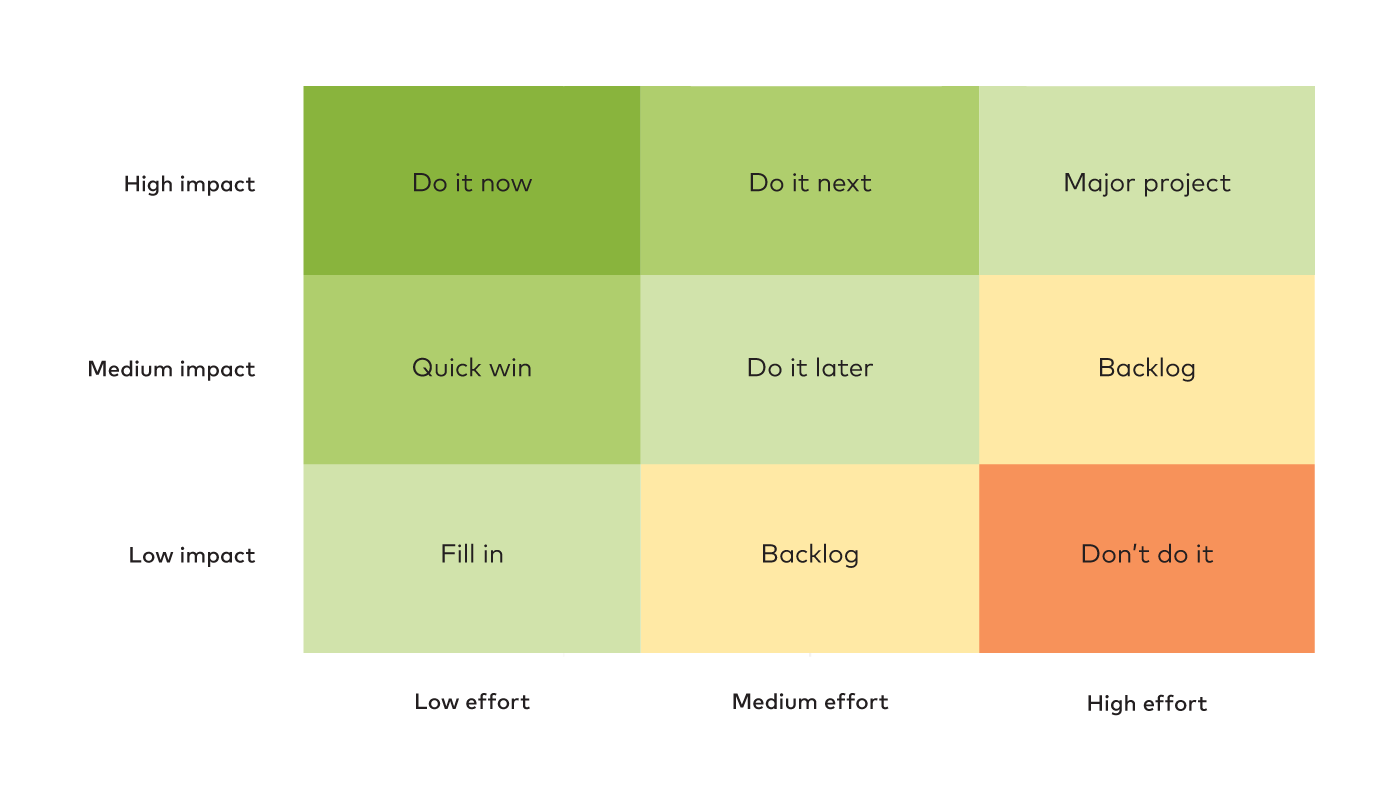
An impact-effort matrix is a decision-making tool that will help you turn your pool of personalization ideas into a prioritized list — a roadmap. By scoring the effort and impact of each idea, you can “calculate” a priority score.
After scoring your list of ideas, see where they are mapped in the impact-effort matrix:
Impact-effort prioritization matrix
If there’s an idea that you believe will have a high impact and be low effort, do it now. On the other hand, if there’s an idea that will require a lot of resources to develop and execute that will likely not result in significant impact, consider de-prioritizing it, or in some cases, not doing it at all.
By scoring all of your CRO ideas independently and placing them over the above matrix, you will get an overall priority score between 1 to 5:
Now, put all of the ideas into action and go live on the site. The time and effort that will be required from you in this step will vary depending on the accessibility and usability of your marketing optimization software. When implementing, remember to configure different content variations, narrow down segments and, if using a personalization platform, implement content personalization triggers as well.
Once enough data insights are gathered, it is time to analyze results and arrive at conclusions:
1. Report analysis: Explore the optimization reports and look for noticeable changes. Identify new audience segments, methodological pitfalls and find out where you succeeded. Do not be afraid of finding failed initiatives; they would only help you gain valuable insights about what is working better for your audience segments.
Read further on how to effectively analyze and interpret A/B testing results and learn why some failed results can actually be winning.
2. Optimization adjustments: If necessary, modify your optimization initiatives with different conditions and segments. Always double-check yourself and preview the results to avoid any errors. Adjust and be patient. Depending on traffic, it may take a while before getting high-confidence, sustainable results.
Conversion rate optimization is not a linear process but a circular one. It includes researching, A/B testing and analyzing. Once you are done with the final evaluation step, it is a good idea to go back to step three and formulate new hypotheses and optimization ideas.