Deep learning
Self-training algorithms typically leverage recurrent neural networks (RNNs) to predict the next best item a customer will most likely engage with, based on other customers with similar browsing or purchasing history. These algorithms can also be designed to engage customers from the very first page view with relevant items, solving the cold start problem.
Recent advances include reinforcement learning and hybrid models that combine collaborative, content-based and contextual signals for optimal recommendations.
Collaborative filtering
One of the most popular recommendation strategies, collaborative filtering bases recommendations on similarities between different users. The system analyzes the site engagement of users similar to a current user — the items they’ve viewed, the products they’ve purchased, the items they’ve added to their carts — and recommends these products to other users displaying similar preferences and intent on any page type.
While collaborative filtering is a popular strategy in the market, research has found that “recently viewed” and “viewed together” algorithms consistently outperform it. Deep learning algorithms are rising in popularity for these use cases, such as those that identify the relationships between different items by looking at product interactions across the user base and recommending the next best item accordingly.
Affinity-based
These strategies allow marketers to make compelling product recommendations when and to whom they matter most. As customers browse a site, interacting with various products, they are exposed to a number of product attributes, such as color, brand, style and more. Recommender systems then use these interactions to identify and infer user affinities and preferences, building rich audiencing capabilities for personalization.
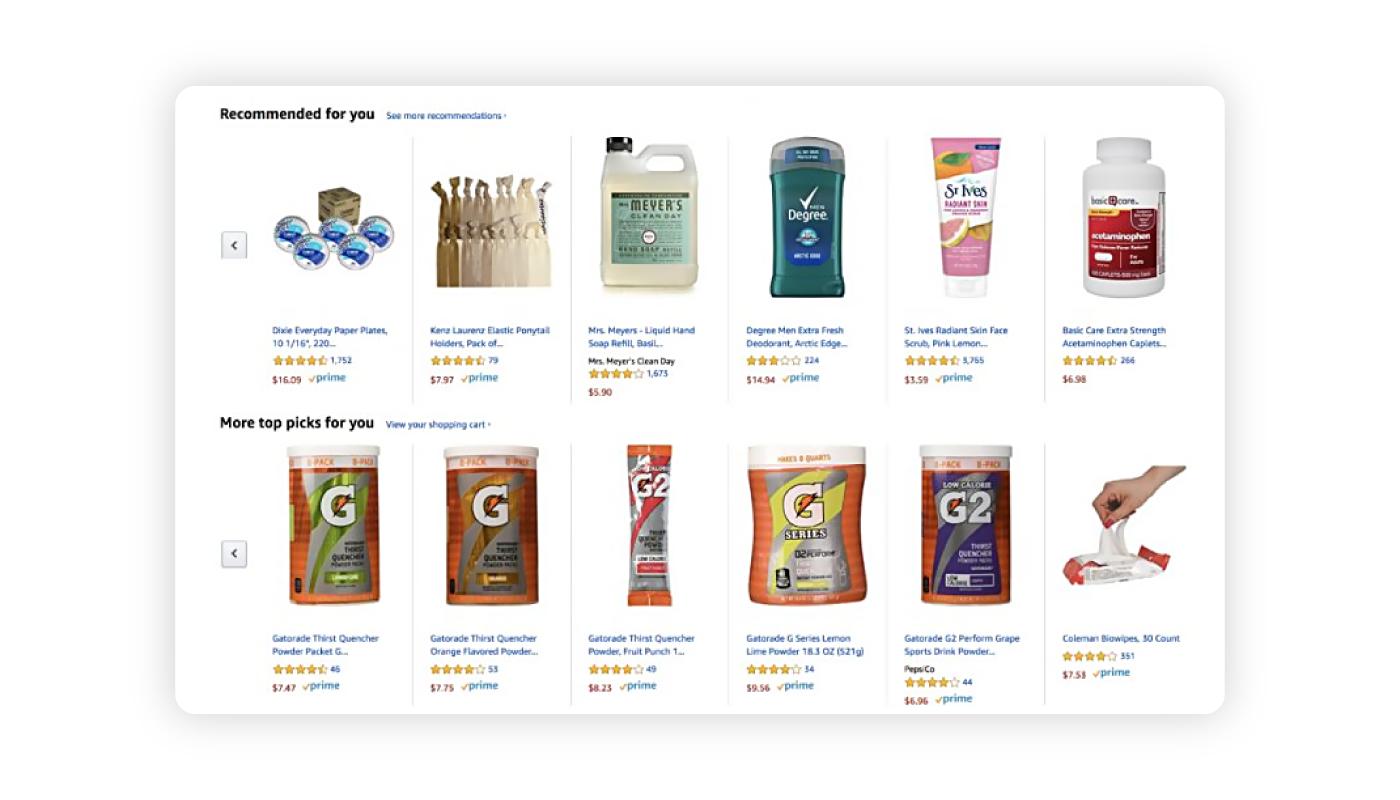
This strategy features a weighted score based on the correlation between user engagement (number of views, add-to-carts, purchases, etc.) and the attributes of products they’ve interacted with. The system then bases its recommendations on these scores and can work in real-time, detecting any preference changes. Often taking form as a “Recommended for You” widget, this strategy is suitable for all page types.
Empathy-Based
An adaptive automatic algorithm that leverages the optimal recommendation algorithm and strategy based on the customer’s state of mind, journey stage and website location.
Recently viewed
When using this strategy, the system recommends the last items viewed by the current user, with the most recently viewed items appearing first. These recommendations are typically based on insights from the last 30 days.
Additionally, a similar approach is the “viewed with recently viewed” strategy, which displays items that are typically viewed in the same session with the last items viewed by the current customer.
Last/recent purchase
This recommendation strategy specifically looks at the most recent purchase(s) a user has conducted, typically within the last year. Ideal for encouraging repeat purchases, it surfaces products a user has purchased that may need to be replenished, like pet food or makeup. A simple and straightforward strategy when deployed, it displays the most recently purchased product by a customer in a recommendation widget.
Bought with
When onboarding offline transaction insights, you can leverage them to power smarter recommendations online. With the “purchased together offline” strategy, the system recommends products that have been purchased together offline with the item currently in view on the e-commerce site. The products displayed in these widgets are scored based on the number of times they have been purchased together in the same transaction, recommending products that are strongly linked to one another and demoting products that are typically purchased with many other items.
Similar to the offline recommendation strategy, a “purchase together online/offline” strategy — using offline transaction insights — recommends products that have been purchased together either offline or online with the item currently being displayed.
When using “purchased with recently purchased,” the recommender system looks at the last items purchased by the current user, suggesting items that are usually purchased together with these recent purchases. For example, when deployed on the homepage, this strategy can show all visitors who have bought an item in the past week complementary items while they are still relevant.
Akin to the “purchased with recently purchased” strategy, the “purchased with last purchased” approach ensures all recommendations are based solely on the most recent purchase completed by the current user.