Lesson

An introduction to product recommender systems

A beginner’s guide to product recommender systems, the strategies behind them and examples of strategies used by today’s leading digital brands. 

Yaniv Navot profile photo

Yaniv Navot

Senior Vice President, Commercialization,

Consumer Acquisition & Engagement,

Mastercard

Product recommender systems surface items available for purchase across web pages, mobile apps, within emails or on any connected screens, such as kiosks and various IoT devices. One of the most popular methods used by retailers, recommendations guide visitors to products they are likely interested in, improving the discovery process and helping them find what they want more efficiently. 

Today, retailers often have thousands (and sometimes millions) of products in their inventories, making it difficult for shoppers to dig up exactly what they are looking for. And with personalized recommendations, brands can help users easily find relevant products based on their preferences, spending trends, interests and intent, with an end goal of driving sales, upsells, cross-sales, larger cart sizes and higher average order values (AOVs).


What are product recommender systems?

Powered by machine learning, a product recommender system is the technology used to suggest which products are shown to customers interacting with a brand’s digital properties. Fueled by a number of algorithmic decisions, recommendation algorithms analyze user, product and contextual data insights — both onsite and offsite — to present a personalized experience across your customer base. 

Improving the discovery process, this helps users find what they are looking for — and sometimes products they don’t even realize they are looking for. In doing so, businesses can learn more about each user’s unique preferences and interests, optimizing performance in real-time while simultaneously refining their testing roadmaps for the long-term. 

And when it comes to product recommendations, there is no archetypal strategy marketers should use for every widget. Different strategies must be applied for different users, depending on the amount of information available about the customer, their spending and engagement patterns as well as the context of products on a site. This includes how visitors interact with your site, status, geo-location, time of day, past purchases and more.


The strategies behind recommender systems

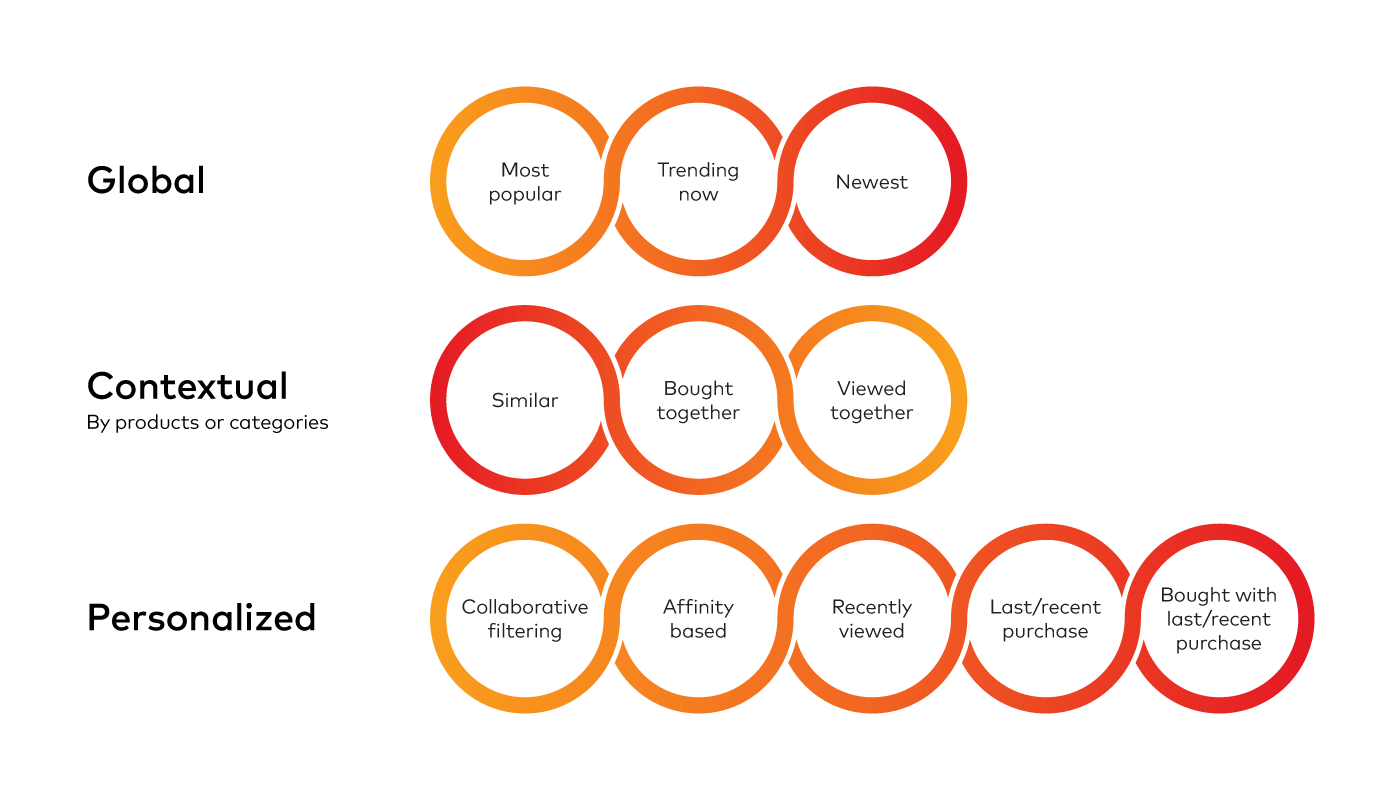
Recommendations can provide key insights and the opportunity to better understand who a customer is in order to delight them, add value and improve the overall relationship with a brand. And when it comes to the strategies behind each of them, there are three primary tiers:

  • Global recommendation strategies
  • Contextual recommendation strategies
  • Personalized recommendation strategies

Each of these strategies dictates which products are included in an experience.


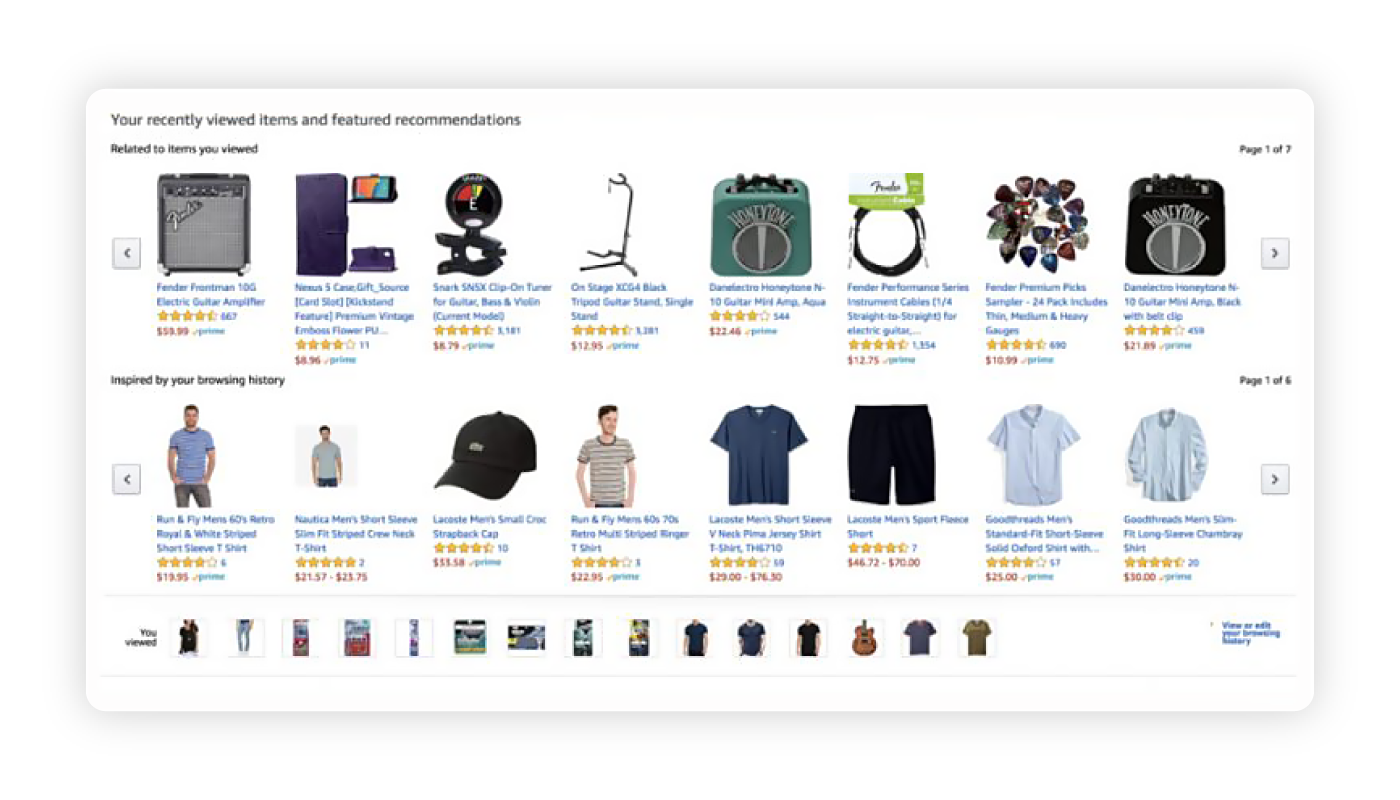
Product recommender example

Picking a recommendation strategy

When selecting a strategy, marketers must first assess the amount of user and product data insights available, as well as a user’s location in the purchase funnel, allowing this information to dictate which strategy to deploy.

Global strategies 
These strategies tend to be the easiest to implement, simply serving all users — be they long-time customers or first-time visitors — the most frequently purchased, popular or trending products in a recommendation widget.

Contextual strategies 
These strategies rely on product context, assessing product attributes — such as color, style, the category it falls under and how frequently it is purchased with other products — to recommend items to shoppers.

Personalized recommendation strategies 
Personalized strategies, the most sophisticated of the tiers, don’t just simply heed context but also the actual motivations, preferences and engagement patterns of users themselves.They take the available user data insights and product context into consideration to surface relevant recommendations on a 1:1 level. This means, in order to effectively deploy them, a brand must have access to data-driven insights about the user, such as purchase history, wants and needs, clicks, add-to-carts and more.

In certain situations, the user’s interaction history can even be coupled with the history of all other users on a site to recommend products. For example, using a “Collaborative Filtering” strategy, users are recommended items based on the preferences and interactions of site visitors that have exhibited similar engagement patterns. Meanwhile, preference-based recommendations are based on data insights a recommender system automatically aggregates to build a holistic understanding of a given shopper, suggesting items according to understood user preferences.

Product recommender example

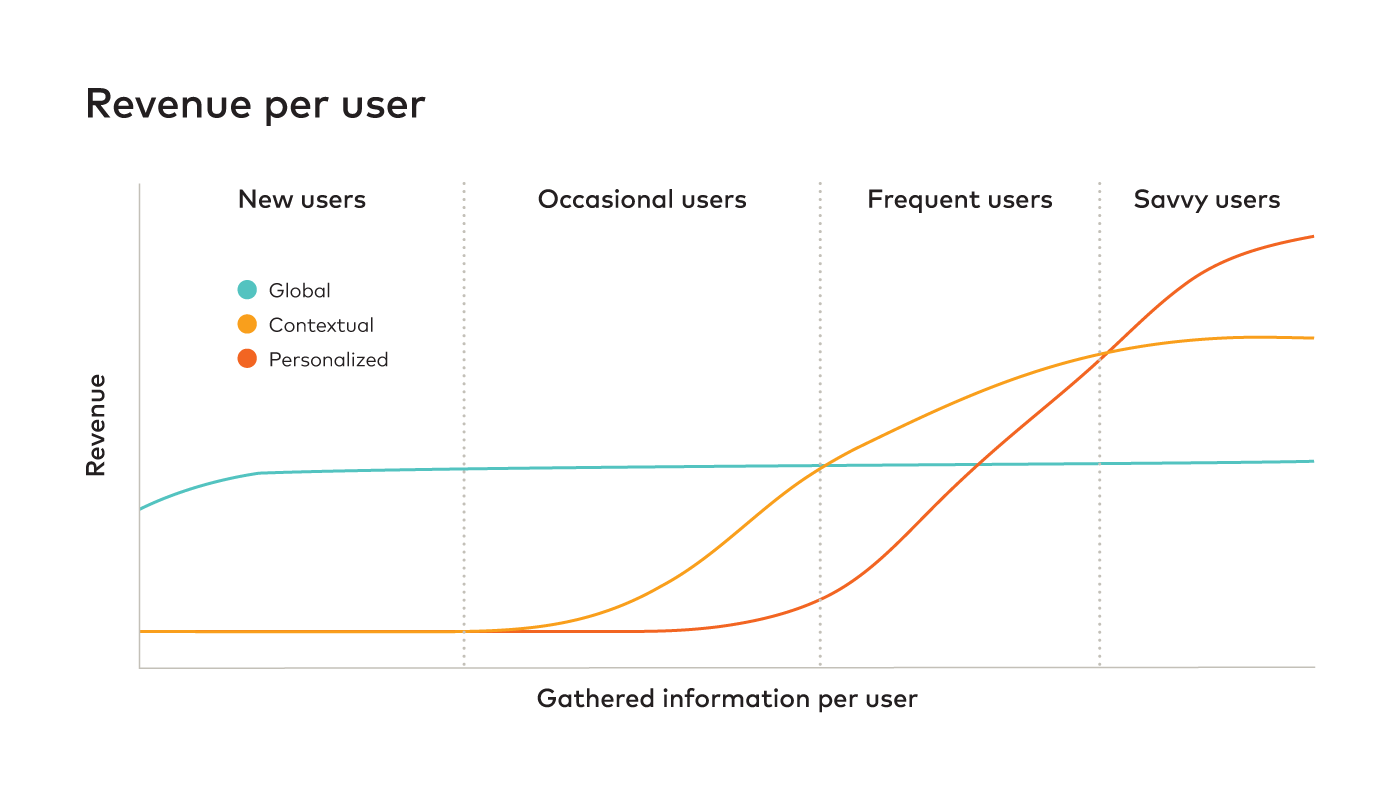
Global strategies can be used for every type of site visitor, whether new, returning or loyal. And contextual and personalized strategies can be used within the first session or pageview if contextual, first- or zero-party data insights are available for the user, such as their geo-location (contextual) or their preferences (personalized). 

The potential to drive revenue increases when recommendations are best suited to these insights. For example, marketers should use contextual or personalized strategies for frequent shoppers and VIP users, who they have ample data insights on. Additionally, these strategies are strengthened when layered atop each other, maximizing the impact of the deployed recommendations.


Crafting product recommendations

The strategies behind recommendations must be identified in advance and must explain the logic behind the recommendations themselves. Examples of this logic include: 

  • Recently viewed 
  • Most popular 
  • Show similar items to the item currently in view 
  • Show items based on the visitor’s browsing history 
  • Show items that are viewed together with an item currently in view
Product recommender example

An example of a “Most Popular” recommendation widget on a category page 

The strategies behind recommendations must be identified in advance and must explain the logic behind the recommendations themselves. Examples of this logic include: 

  • Recently viewed 
  • Most popular 
  • Show similar items to the item currently in view 
  • Show items based on the visitor’s browsing history 
  • Show items that are viewed together with an item currently in view

These strategies will enhance (or limit) the recommendations served to each user, allowing marketers to tailor the widgets to best optimize performances and the desired objective. Once a marketer has selected a strategy to use for a recommendation widget, they can set up rules, such as “exclude recently purchased items” or “only include items that cost $25 max,” to narrow down which products are featured in each widget. 

Additionally, certain strategies are better suited for specific pages. For example, “Viewed Together” is ideal for product pages, as they relate to products already in view. “Purchased Together” is a good fit for cart pages, especially right after a user adds an item to their cart. And “Most Popular” is a great homepage recommendation strategy, helping to kickstart the discovery process for both new and returning visitors.

Combining context and intent

Recommendation strategies and algorithms employed should vary according to each user’s displayed intent, and user signals help infer and identify the likelihood of a conversion. 

  • Users with low levels of intent are often new visitors, unidentifiable, arrive via search or social or are on a mobile device. 
  • Users with a medium level of intent are often returning visitors, identifiable, arrive directly to the site or via email campaign or interact with a site on a desktop device. 
  • Users with a high level of intent have either made a purchase in the past, have added items to their cart or search products directly on the site. 

These intent level classifications inform the strategies and rules each marketer chooses for a test. For example, for users with low intent levels, the “Viewed Together” strategy will encourage further product discovery and exploration. Meanwhile, for a user with a high level of intent, such as a past purchaser, a “Purchased Together” strategy is a better fit, increasing the likelihood of cross-selling the visitor.


Data insights and recommender systems

In order to effectively deploy recommendations, you need data insights. Both implicit and explicit, these data insights are automatically ingested by the system, allowing it to identify which products to serve to each user in a recommendation widget. A recommendation engine can collect contextually relevant data insights across your entire customer base. Sites collect first-party data insights, while data insights from third-party sources, such as CRM or offline purchase history, can be onboarded. The more data insights available, the stronger your personalization strategy becomes. 

Types of user data insights

Being able to access the following types of user data insights can help power smarter recommendations: 

  • Location: The country, region or city a user is located in 
  • Tech: The type of device a user is accessing a site from, the browser-type they are using, their operating system and more 
  • Demographic: A user’s gender, age, marital status, etc. 
  • Engagement: Ways that shoppers interact on-site, including clicks, add-to-carts, hovers, number of pages viewed, etc. 
  • Preference-based: The interests displayed by a user on-site 
  • Online and offline purchase history: The products a user purchased on-site or in-store 
  • Traffic source: The source of traffic a user is visiting from, including direct traffic, paid traffic, social traffic and referral traffic 
  • Third-party: Information about a user from outside sources, onboarded through a data management platform (DMP) 

Access to these data insights helps marketers identify buyer personas and understand purchase trends, which can inform segmentation strategies. Other elements, like knowing a user’s traffic source or the device they are using when engaging with a brand, can inform messaging strategies. 

The more a user visits and interacts with your site, the more data insights become available. The system can then use them to predict what users are most likely to purchase, make smarter segmentation decisions and serve more relevant recommendations.

Visitor Type          Data Available
First-time visitors      Only context (IP/geo, traffic source)
2+ visits      Some usage data insightsSome product-viewed data insights
Repeat visitors      Purchase historyDeeper usage data insightsUser preferences

Types of product data insights

Product data insights are also essential, as they give recommender systems the ability to put the right items in front of the right users. Product data feeds, which house a retailer’s entire product catalog, can be synced with recommender engines. Product feeds include basic information about the products available on a site, including, but not limited to:

  • SKU 
  • Product name 
  • Product URL 
  • Price 
  • In-stock status 
  • Images 
  • Keywords 

Marketers can customize product feeds, adding in more product data insights that can later be used for smarter personalization, such as color, size, style, etc. The more product data insights are available, the stronger your contextual and personalized recommendation strategies become.


The power of product recommendations

Product recommendations are a great way to improve the overall user experience, guiding visitors through the discovery process while simultaneously generating more revenue for your organization. And with machine learning doing much of the heavy lifting, marketers can experiment with different strategies, segmentation practices and widgets at scale, exposing more products to users than ever before to generate ROI and boost their companies’ bottom lines. 

Contact sales

Talk to an expert to learn how Mastercard can enhance your business through our products and services.

Mastercard