Lesson

An Introduction to Affinity-Based Recommendations

Learn how to leverage user affinity data to make more effective personalized recommendations at scale.

Gidi Vigo profile photo

Gidi Vigo

Vice President of Product,

Dynamic Yield,

Mastercard

There are a variety of factors to consider when choosing the right recommendation strategy, primarily the end goals users are looking to achieve. Certain approaches are constructed with a heavy emphasis on product and provide recommendations based on generic rankings (e.g. most popular products, trending articles) or specific page contexts (e.g. articles most similar to currently displayed content, products most frequently bought with currently displayed product). 

Others, however, utilize the true power of personalization and home in on individual user preferences and affinities to make recommendations. For organizations with lengthy product catalogs or content indexes, affinity-based recommendation has proven to be a powerful method of making compelling recommendations when and to whom they matter most. 


Bridging Interactions and Attributes 

Pinpointing user affinities begins with a qualitative and quantitative analysis of on-site engagement patterns. A user’s interactions with content or product items — such as viewing or rating a certain product, adding a product to cart, searching for a specific brand or commenting on an article — provides important signals about their personal interests, preferences and intent.As users interact with product or content items within a site, they simultaneously become exposed to a wide range of attributes that characterize those items: in e-commerce, these attributes can be a product’s brand, color, style, price-range and more; for publishers, these can be an article type (written or video), category, keywords etc. Combining data insights about user interactions with the attributes that characterize items yields valuable insights into understanding user preferences on an individual level. 

This fusion of interactions and attributes lies at the heart of affinity-based recommendations and can be leveraged through the use of multi-dimensional affinity models.


Affinity modeling

Affinity modeling is hardwired to make the most effective recommendations even as user preferences change over time. User preferences are subject to and influenced by a variety of external factors, such as outdated trends, content staleness and technology obsoleteness. 

To effectively capture changes in user preferences, affinities are refined with every additional pageview, action and event in real time, favoring recent interactions over older ones. Taking the recency of each interaction into account helps derive the user’s intent and allows organizations to consistently make highly effective and relevant recommendations. 


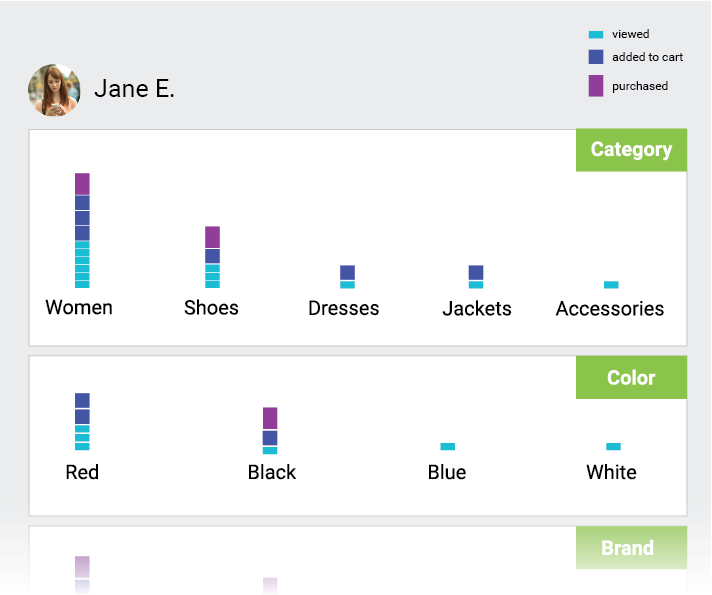
Interactions chart example

Ranking all the attribute values Jane has interacted with according to a hierarchy of her most meaningful interactions (viewed, added to cart and purchased) narrows down Jane’s purchase intent and reveals which product attributes she has the greatest affinity towards. 

With these affinity data insights in hand, the site can recommend products that Jane will be most likely to engage with.


Changes in users’ wants and needs 

Affinity modeling is hardwired to make the most effective recommendations even as user preferences change over time. User preferences are subject to and influenced by a variety of external factors, such as outdated trends, content staleness and technology obsoleteness. 

To effectively capture changes in user preferences, affinities are refined with every additional pageview, action and event in real time, favoring recent interactions over older ones. Taking the recency of each interaction into account helps derive the user’s intent and allows organizations to consistently make highly effective and relevant recommendations. 


Conclusion 

Affinity-based recommendation is one of the most important and efficient ways of untangling and leveraging the complex web of data insights surrounding user preferences. Aggregating these insights through the use of affinity modeling yields a deeper understanding of user preferences on an individual level and allows organizations to tailor compelling content and product recommendations for maximized engagement opportunities. Learn more about Mastercard Dynamic Yield's Affinity-Based Personalization. 

Contact sales

Talk to an expert to learn how Mastercard can enhance your business through our products and services.

Mastercard