Dive under the hood of AffinityML, a neural network algorithm that unlocks real-time understanding of individual customer preferences, enabling to anticipate and fulfill their needs with pinpoint accuracy.
Published: January 08, 2024
It’s never been more important for marketers to deliver experiences that resonate with each customer on an individual level.
Affinity modeling, a mainstay in the modern personalization toolkit, is a powerful way to achieve 1:1 relevance, but as customer expectations rise, so too does the need for an even more powerful solution.
The industry standard for calculating customer affinity today, in essence, relies on the assumption that what a customer has demonstrated liking in the past, they will continue to like in the future. But what if the affinity model could do more, to truly predict a customer’s future preferences and interests? What if it could adjust for one-time purchases, identify complementary products a customer might be interested in and even account for the cadences of repeat purchases? All of this and more is now possible with AffinityML, a neural network algorithm that predicts affinity with unrivaled accuracy and takes understanding your customers to a whole new level.
Affinity models represent personal connections forged between audiences and a particular topic, brand, product, service or attribute. These could be affinities to specific brands or types of content, or even more granular, from sizes and colors to dietary preferences, loan types and more.
These profiles capture an intricate understanding of user preferences and interests according to their online spending patterns. But how is affinity calculated?
Traditional affinity models add a score to a user based on the metadata connected to a product they’ve interacted with. This score is calculated by capturing every engagement a user has with a given digital property and then collecting all of the product attribute values associated with the interaction. Every interaction a customer has with a product will update the score of each attribute value according to the type of interaction as well as when it occurred. For the data insights to become meaningful, a correlation between the user interaction and the attribute value is then determined. Traditionally, this is done by assigning a weight to each engagement based on its assumed level of intent and then summing up the total number of engagements per each value. The higher the level of intent, the greater the weight given to the interaction. These scores can be used to create an affinity model, allowing marketers to rank product attributes like color, brand, category and so forth based on the customer’s activity.
A cornerstone of our personalization philosophy, affinity models play an important role in developing audiences, establishing audience segments and serving relevant product and content recommendations. Through this adoption of affinity profiling, we've witnessed remarkable results from our affinity-based personalization, opening up an entirely new world of potential for brands to capitalize on what they know about their customers and inspiring us to dive deeper into the intricacies of user engagement trends.
Dynamic Yield’s AffinityML, part of the AdaptML system, enables marketers to understand their customers better than ever before with a neural network algorithm that identifies future-purchase intent. Traditional models make assumptions about user interests based on past interactions. AffinityML, on the other hand, is a self-learning algorithm that can predict changing customer preferences, even before the customers themselves know it. This predictive capability enables marketers to anticipate and respond to evolving intent, ensuring that personalized affinity-based recommendations are served to all customers.
Here’s a breakdown of how AffinityML empowers you to harness the power of AI to understand your customers more deeply:
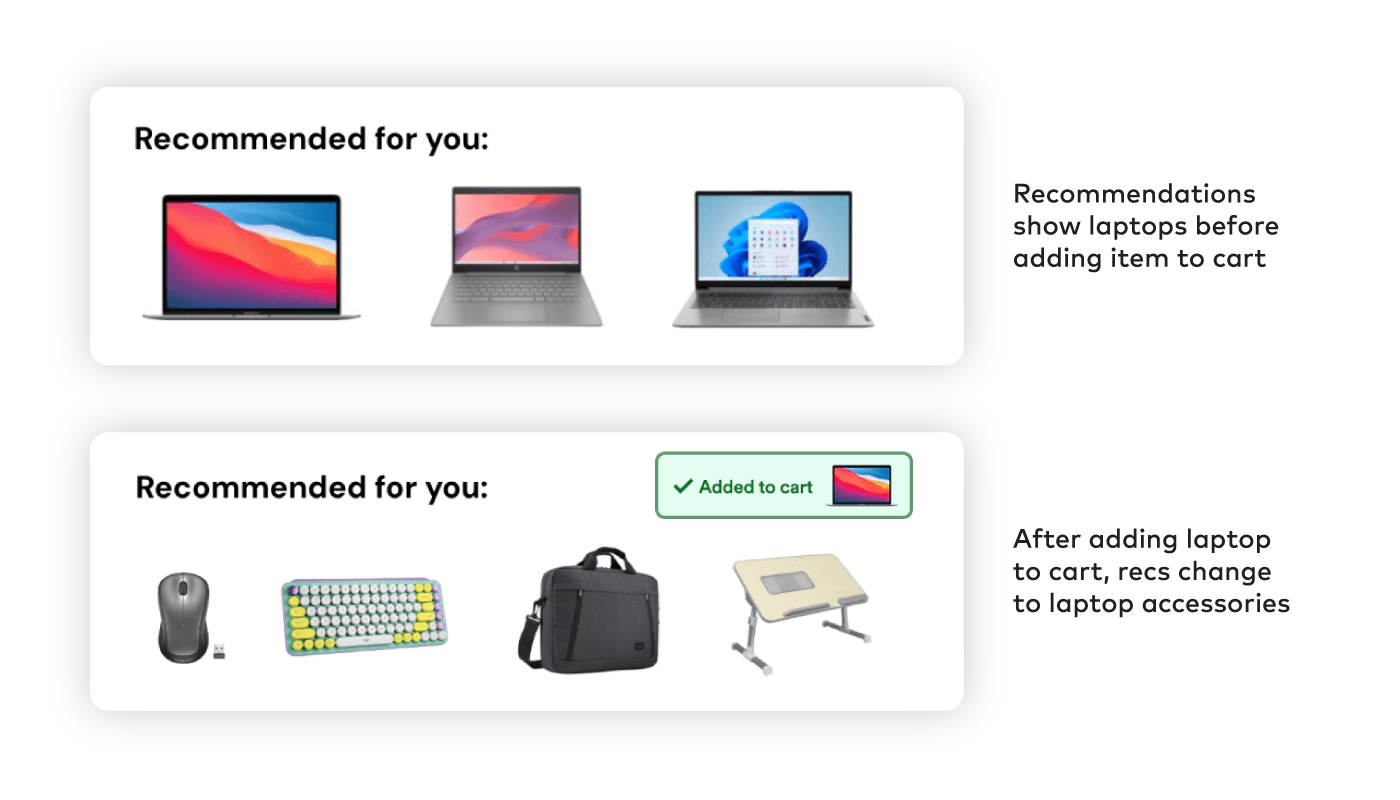
AffinityML identifies and recommends complementary items to the product a customer has added to their cart, dynamically adjusting their model and affinity recommendations in real-time.
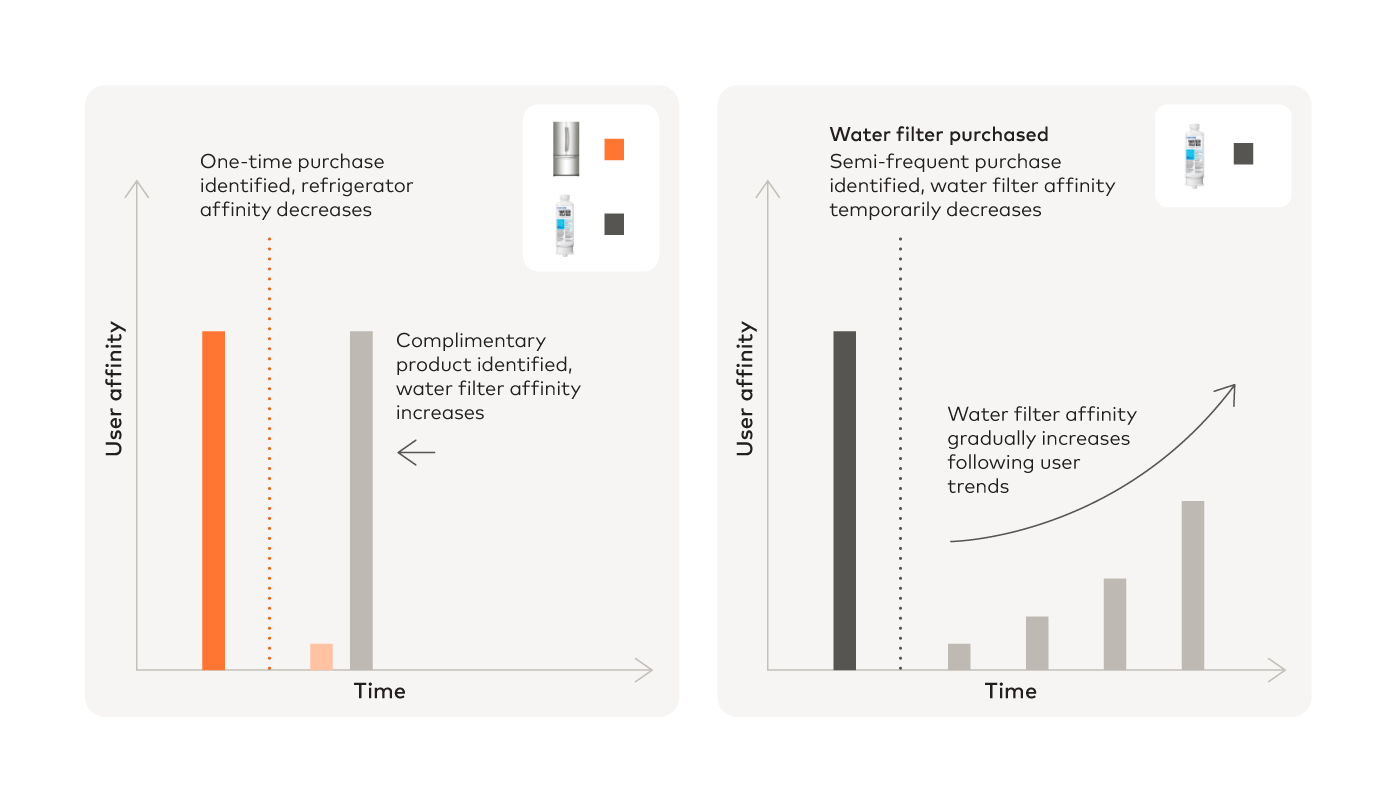
AffinityML can also be used to identify atypical behavior exhibited by customers and predict one-time category purchases, automatically increasing or decreasing user affinity for these categories according to the historical purchasing activity of all users.
After a customer makes a one-time refrigerator purchase, affinity to refrigerators decreases to near-zero while affinity for water filters, a complimentary product, increases. When the customer purchases the water filter, their affinity for new filters decreases, steadily growing over time in accordance with the buying cadence for replacements.
The evolution of affinity modeling, particularly with the advent of Mastercard Dynamic Yield’s AffinityML, is undeniably shaping the future of personalization. A testament to our unwavering commitment to delivering the most intuitive and impactful digital experiences, AffinityML not only predicts customer intent; it anticipates and responds before it even becomes apparent. By embracing AffinityML, marketers can forge deeper connections with their customers, delivering experiences that feel tailor-made for each individual across every digital interaction.