Published: August 21, 2026
When it comes to managing their finances, consumers today are increasingly taking advantage of a range of different platforms. The average consumer has five to seven financial accounts1, using services offered by traditional banks, fintechs and digital-first providers.
Yet, each option comes with another layer of complexity. In “Wallet Fatigue 2025: Why Users Rely on Multiple Finance Apps,” a study conducted in 2025 by the fintech company Decta, over 80% of respondents reported at least occasional confusion about which platform had the particular information or function they needed2.
No wonder consumers are choosing providers that make interactions easier and more relevant. A 2024 FICO survey shows that 73% of customers prefer to do business with banks that personalize their products and services3.
Open finance can help financial institutions (FIs) and fintechs level up their offerings by connecting consumer financial data — but only if consumers agree to share it. To earn that “yes,” organizations must first earn their trust.
In this blog, we’ll explore the steps organizations can take to build consumer confidence by making data sharing easy to understand, simple to control, and rewarding for both customer and provider.
Two common questions that may arise when consumers are asked to share financial data are: 'Is it safe?' and 'What do I get in return? To earn their trust, organizations must prove that both sides of the value exchange work in the customer’s favor, by applying appropriate user controls and data safeguards, and by delivering products and experiences that make financial data sharing worthwhile.
Transparency is often an important driver of trust: businesses can build consumer confidence by succinctly explaining how they collect information, who they share it with, and how their services produce the outcomes they intend. The clearer the provider is about how they use data, the easier it is for consumers to say “yes.” In fact, over three quarters of consumers would switch providers for more transparency into their data, and 43% have already done so, according to “The State of Open Finance 2026,” a report by Mastercard and Financial Times Longitude4.
It’s equally important to specify the benefits users gain in return. While 89% of consumers surveyed for “The State of Open Finance 2026” said they are willing in principle to grant access to their data, nearly half said they must first understand what it will be used for. Organizations should make the value exchange clear at the moment of consent — “share this data so we can help you do X” — and highlight specific advantages, such as reducing forms and paperwork, informing clearer spending insights, speeding up applications or receiving relevant product offerings.
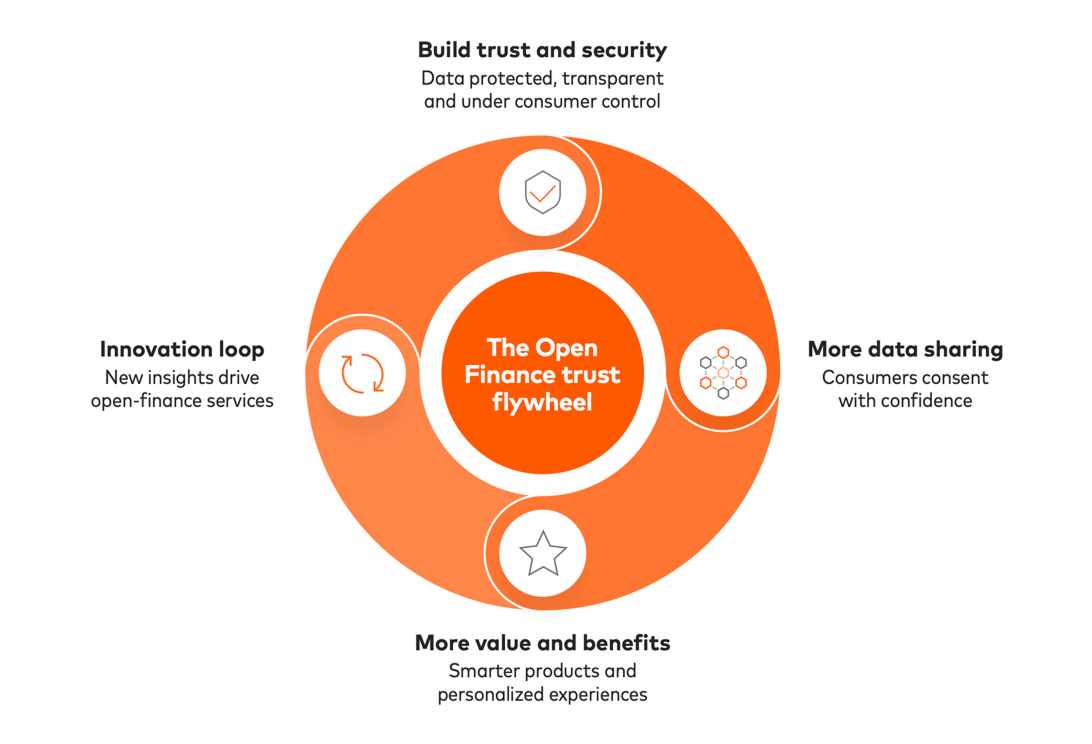
When consumers see that sharing their financial data helps them navigate onboarding and improves lending experiences and personalized financial services, they are more likely to continue engaging and sharing with their providers: According to “The State of Open Finance 2026,” open finance improved customer loyalty and retention for most respondents6. By treating data permissioning as an ongoing relationship rather than a one-time transaction, organizations can activate a data flywheel: trust encourages sharing, sharing enables value, and value reinforces data-sharing.
Earning trust is only the beginning. Maintaining it requires a backbone of governance, security and technology that protects information and promotes responsible data stewardship. Before asking consumers to share data, organizations must make sure their systems and operations are up to the task.
The first imperative is to update application programming interfaces (APIs). APIs are virtual bridges that allow different types of software to communicate, so institutions can share permissioned information and offer advanced third-party services. As the foundation for data connectivity, APIs must be able to deliver the reliability, scalability and security that modern financial experiences depend on. Businesses should pair this infrastructure with transparent, user-centric consent management and high-security authorization processes.
Once they permission their data, consumers expect it to be handled responsibly. Effective data governance must be a foundational layer with clear standards, technical protocols and audit mechanisms that ensure customers’ data is used only for its explicitly approved purpose.
A single fraud incident can prompt customers to opt out for good, even if the breach occurs through a third-party provider or data aggregator. Organizations must ensure their partners uphold rigorous security standards, including:
Once organizations have built a secure foundation for data sharing, the next step is to put that information to work. A smart move is to prioritize top open finance use cases that offer obvious benefits for their consumers, such as faster onboarding and account verification, fairer lending and more relevant personalized services.
Why does this matters? By reducing friction in key customer journeys, organizations can create smoother experiences while gaining a more holistic view of their customers’ financial needs and behaviors rather than a partial, fragmented view.
“Banks want to engage their customers better,” Rajat Padhi, vice president and global lead for Mastercard Open Finance Advisors and Transformation, said in an interview with Mastercard on June 1, 2026. “Open finance data can help them figure out what matters most to their clients, so they can build more personalized relationships and increase retention.”
Given the many moving parts involved in trust-centric data sharing, creating a scalable open finance strategy can be challenging. That’s why it’s important for organizations to choose a partner with a global scale and proven expertise in financial data and technology management to help them prepare for long-term success.
For 60 years, trust has been the backbone of the Mastercard brand. As a longstanding global financial services provider, we protect more than 175.5 billion transactions every year8, and we embed the same standards of security across all our platforms. That commitment extends to our role as data stewards. In 2019, we made a pledge to uphold high standards in our data practices to ensure that consumers control and benefit from their information. We have also constructed multiple layers of security to protect that data.
Mastercard’s comprehensive open finance ecosystem empowers financial institutions and fintechs to offer personalized financial management, lending, account-to-account payments and small business solutions. Mastercard also helps its partners design clearer consent flows so consumers understand why they are being asked to share data and recognize tangible advantages from saying “yes.”
At a time when earning and sustaining consumer trust is becoming a competitive differentiator, financial institutions and fintechs can stand out by creating clearer data-sharing experiences that deliver meaningful value to consumers. By building trust into every interaction, providers can create lasting relationships and lead the next generation of personalized financial services. Book a demo today and discover how Mastercard Open Finance can help you deliver value for consumers and your business.
Consumer-permissioned data is financial information that a consumer chooses to share with an authorized provider for a clear purpose, such as simplifying account opening, receiving personalized insights or applying for a loan. The consumer remains in control of what they share and how it is used.
Secure financial data sharing in open finance allows consumers to authorize trusted providers to access selected financial information for a specific purpose. To share financial data securely, banks and third-party providers connect via digital bridges called APIs that enable the protected, real-time exchange of information. With APIs, fintechs, banks and other providers can integrate seamlessly to offer smarter products and services.
Open finance helps financial services providers turn consumer-permissioned data into actionable insights that can support faster onboarding, more informed lending and risk decisions, stronger fraud prevention and more relevant customer experiences. It can also help providers improve retention, expand access to credit, develop new products and increase revenue⁷.
Customer expectations are shifting toward faster, more connected and personalized financial experiences. As competition increases, financial institutions need trusted access to permissioned data to remain relevant, respond to changing customer needs, enable tailored financial management tools, foster long-term customer relationships, strengthen risk prevention and provide a seamless digital service journey.
Open finance already drives impact across a wide spectrum — from everyday transactions to complex lending decisions. Some of the most powerful use cases include:
[1] American Banker and Mastercard. (2026). “From Data to Outcomes: How Open Finance Empowers Financial Institutions to Personalize at Scale,” p. 2.
[2] Decta. (2025). “Wallet Fatigue 2025: Why Users Rely on Multiple Finance Apps.”
[3] FICO. (2024). “2024 Bank Customer Experience Survey.”
[4] Mastercard and Financial Times Longitude. (2026). “The State of Open Finance 2026,” p. 4.
[5] Ibid., p. 17.
[6] Ibid., p. 9.
[7] Ibid.
[8] Mastercard. (2025). Form 10-K.