Travel
May 28, 2026
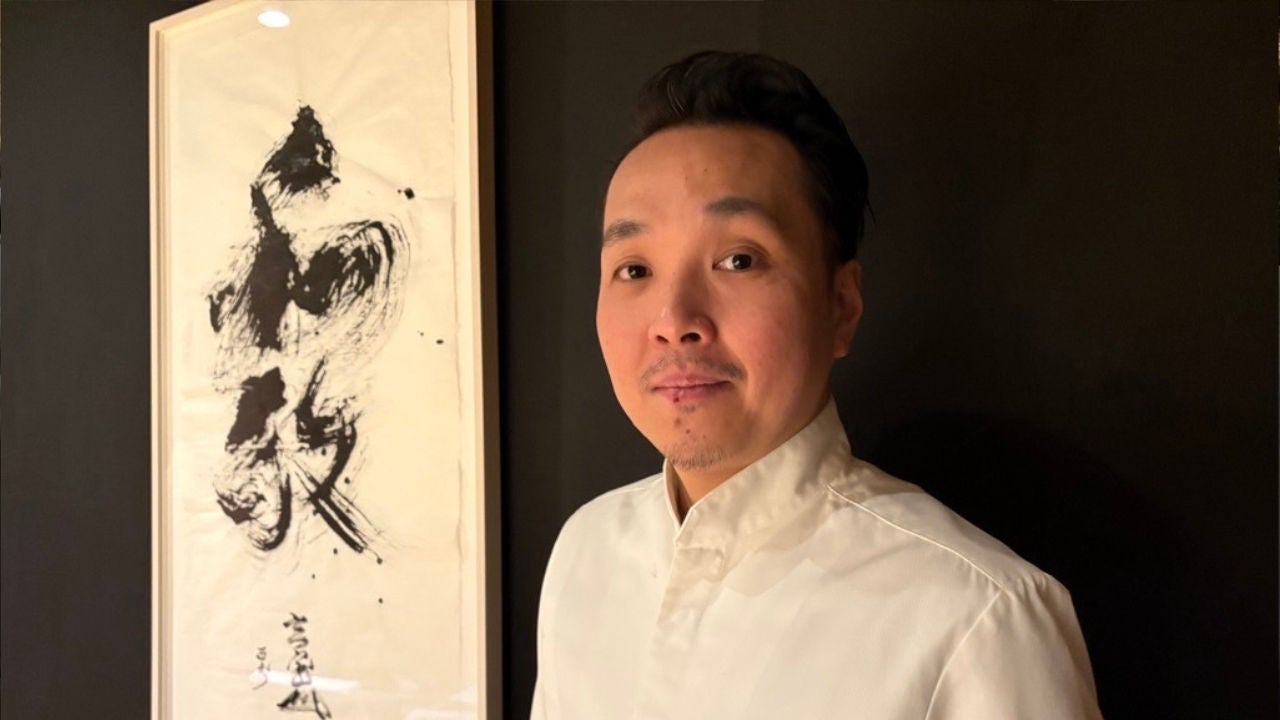
Hiroki Odo, standing next to a calligraphy scroll bearing the Japanese characters for harmony and balance, is the chef who brought kaiseki dining to New York City with his namesake restaurant in the Flatiron District. Kaiseki is the Japanese dining tradition rooted in seasonality, harmony, artistry and exacting technique. (Photo credit: Ben Fox Rubin)
At Odo, food is never just food. Each course arrives as part of a carefully constructed sequence — a story about season, texture and restraint, told in gestures so precise they can feel almost ceremonial.
Stepping through the front door at this unassuming brick midrise on a Flatiron District side street, guests first enter Hall, the narrow, cloister-like cocktail bar that serves as a kind of antechamber to the meal ahead. With its carved wood walls and leather-wrapped brass rail, the space invites quiet conversation over Japanese whisky, washed with A5 wagyu fat if you desire.
A few steps beyond, a gleaming brass door opens and the atmosphere changes. Inside Odo, only 14 guests at a time are seated at the chef’s counter, where chef Hiroki Odo and his team move with studied calm through a seasonal five- or nine-course kaiseki menu.
Standing at a massive black stone counter, he turns each movement into part of the experience: lifting an etched metal bowl with industrial-looking pliers, meticulously portioning seaweed with chopsticks into deep bowls glazed with gold, using a short brush to sweep yuzu zest onto a plate delicately enough to keep its tiny oil glands intact so the citrus blooms in front of the diner, not before.
“Kaiseki cuisine has a lot of simplicity and a lot of texture,” Odo says earlier through a translator as we sip a smoky green tea over a live-edge table in a private dining room in the rear of the building. “The flavors are lighter than at a typical fine-dining restaurant. It’s less about the wow factor and more about understanding seasonality and the subtlety of different ingredients.”
In New York, where sushi counters seem almost as ubiquitous as slice joints and many diners are familiar with omakase, Odo has pioneered kaiseki, the Japanese fine-dining style built around a progression of seasonal courses and shifting techniques, where rhythm and restraint shape the entire experience, transporting guests not just to a place but to a moment in time.
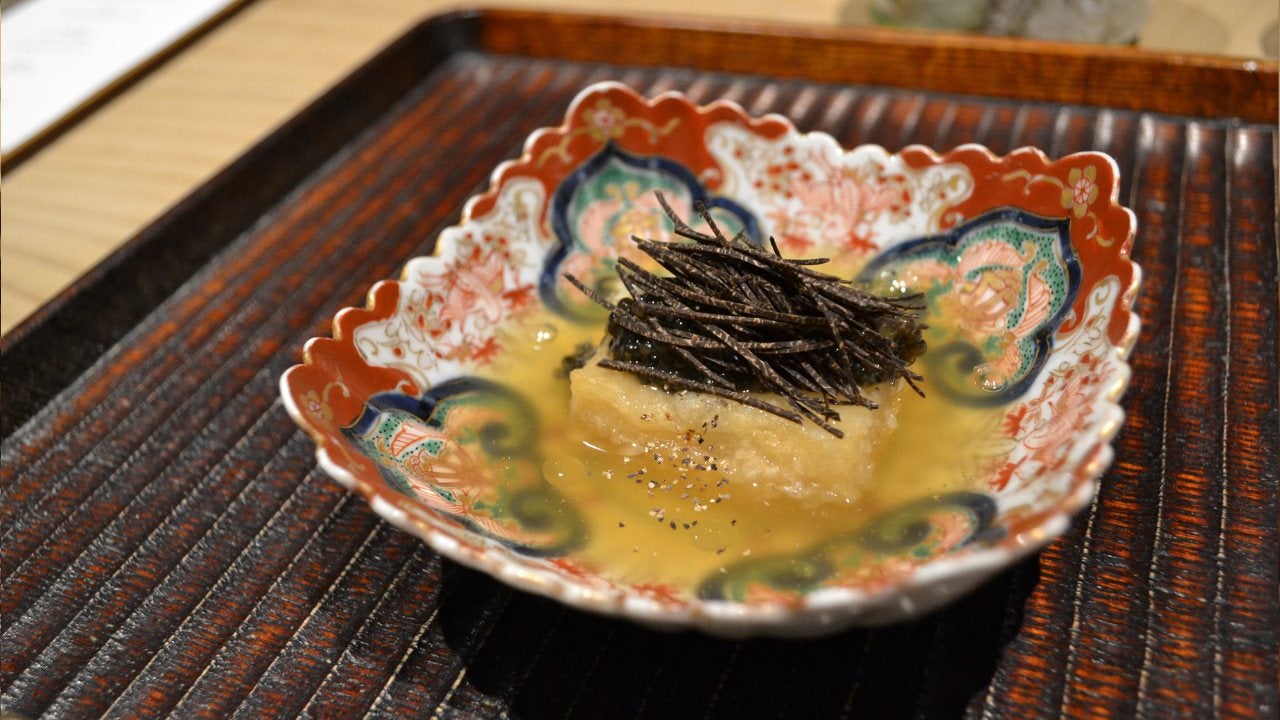
A kaiseki meal opens with a small plate that sets the tone of what's to come. Today it's sesame tofu in dashi topped with uni, osetra caviar and black truffle. (Photo credit: Ben Fox Rubin)
The meal is deliberately paced, with each course arriving like an offering. Today’s lunch, on a cold March day when spring still feels like a hypothetical, begins with sakizuke. Literally meaning “placed first,” it’s the Japanese equivalent of an amuse bouche, a small bite meant to set the tone of the meal. Here it’s sesame tofu in a deeply savory but still light dashi, topped with creamy Hokkaido uni, osetra caviar and matchsticks of black truffle placed just so.
Later comes the hassun course, named for the size of the square tray on which it is traditionally served: Hassun means eight sun, a traditional Japanese unit of length. It’s a study of textures: the delicate crisp of the snap pea tempura, the crunch of lotus root chip, the chewiness of a wheat gluten cake painted with a glossy sweet miso, the silkiness of soy-marinated kampachi, and, most memorably, the cherry tomatoes blanched, peeled and then soaked in dashi, a cool explosion of umami on the tongue.
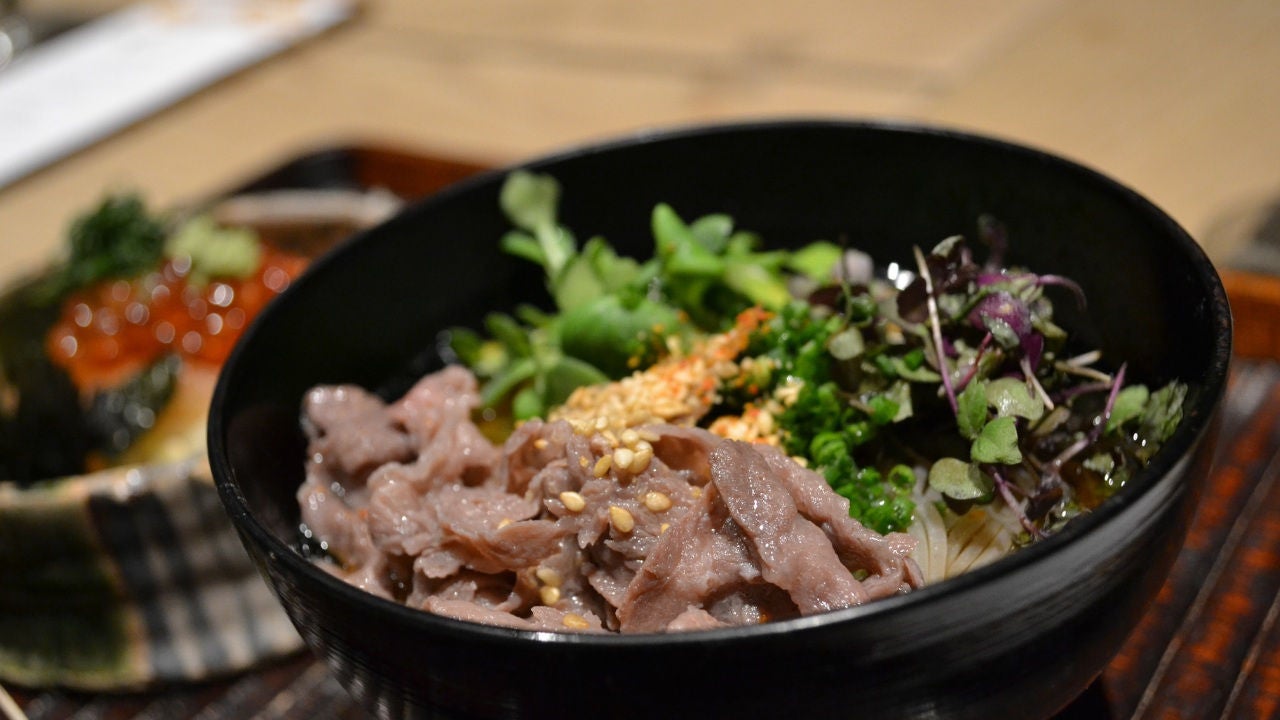
The final savory course features housemade soba topped with A5 wagyu and fresh greens. (Photo credit: Ben Fox Rubin)
For Odo, seasonality is not simply an ingredient list. It shapes the feeling of the meal. In summer, the menu leans cool and refreshing. In spring, it might turn toward shellfish or mountain vegetables. The goal is for guests to leave with a vivid sense of when they were there. “It’s not hermetically sealed,” Odo says. “It’s opens you up to the world. You will really get a sense that, ‘Oh, I just had a meal in February,’ or, ‘I had a meal in August.’”
That immersive spirit of hospitality is central to Odo’s partnership with Mastercard. As a Priceless restaurant, Odo gives Mastercard cardholders special access to curated experiences that go beyond the meal itself, such as a mindfulness meditation session with an 18th-generation Rinzai Zen priest followed by a calming vegetarian breakfast prepared by Odo at The Gallery or their monthly Izakaya Night featuring sake breweries from across Japan.
Born and raised on Japan’s Nagashima Island, near the country’s southern tip, Odo initially dreamed of a career in architecture, drawn to its tradition and discipline. And those qualities made his eventual shift to dining less of a leap than it sounds. “To understand Japanese architecture, you need to dive deep into Japanese history, then when you dive deep into Japanese history, food is a huge part of the Japanese culture, and I saw something I could be really passionate about.”
He trained at Kyoto Wakuden, one of the country’s most esteemed kaiseki restaurants, before helping launch Tokyo’s Yakumo Saryo, an acclaimed dining and tea house. He moved to New York in 2012 and quickly earned a Michelin star as head chef at Kajitsu, the restaurant that introduced authentic shōjin ryori — a plant-based style of cooking rooted in Zen Buddhism — to the United States. Shōjin ryori is in many ways a precursor to kaiseki, sharing its reverence for seasonality, precision and ingredients at their peak.
In 2018, Odo struck out on his own, opening his namesake dining counter. The restaurant received a Michelin star in its first year of eligibility and later earned two stars, a distinction it has now held for three consecutive years.
Though Odo is not vegan, there is always one course in the shōjin ryori style. “The goal is to show how just vegetables can be packed with flavor, even if it is lighter, even if it is more subtle,” Odo says, “and then when you have your meat or your rich seafood later on, you can enjoy them even a little bit more, because of that contrast.”
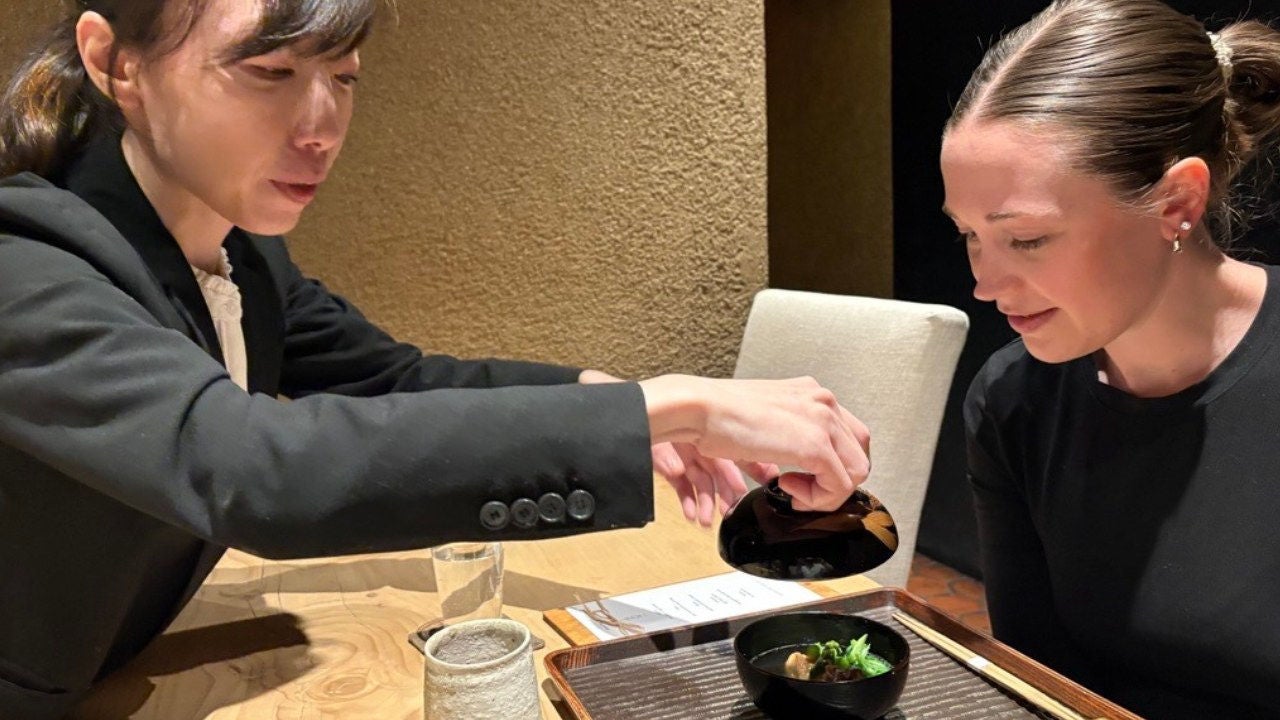
A guest is presented with soup brimming with sea bream, scallions, asparagus and maitake mushrooms and topped with aromatic yuzu. (Photo credit: Ben Fox Rubin)
Since then, Odo has expanded his culinary footprint (if not his physical one) with Hall, Odo Lounge, a speakeasy-style bar, the Gallery by Odo, which combines small plates and rotating art exhibits, and Sushi Muse, all tucked into the same Flatiron building. But earlier this year, he debuted Odo East Village, a gluten-free izakaya with a livelier a la carte take on the kaiseki format. “I’m always trying to walk the line between staying traditional but also creating a menu that’s approachable to people that are not too experienced with Japanese food,” he says.
Design and material choices matter to Odo almost as much as the food. He worked with longtime collaborator Shinichiro Ogata, a designer whom he calls his “master of aesthetics,” to create a series of rooms that reflects the same philosophy as the menu, with beauty achieved by stripping away the unnecessary, leaving deep complexities in the details, like the concrete floors textured with straw to introduce a hint of roughness, or the ceramic tea cups whose contours still carry the trace of a maker’s hand.
For Odo, dining is immersive. It’s about pace and place: from the curve of the cup to the pop of the yuzu, from the hush of the room to the rhythm of the meal. Together, they help guests understand where they are — and when they are.