Technology is often seen as a young person’s game, whether it’s teenagers immersing themselves in online gaming and social media, or college dropouts developing billion-dollar apps.
But just as older people are an increasingly large part of the population — between 2015 and 2050, the world’s proportion of people over 60 will go from 12% to 22% according to the World Health Organization — they’re an increasingly large number of tech users, and tech is adapting to meet their diverse needs in a number of ways.
One company is targeting older adults who live in senior care residences using the power of virtual reality. Mynd Immersive, which was originally founded with the goal of helping people with Alzheimer’s and dementia, now uses VR headsets and specially created experiences to give people in supported living a fresh perspective outside their typical day to day. From exploring a foreign city to scuba diving, the virtual experiences are being used for recreation as well as memory care, and are being used across the U.S. in 800 clinics, hospital systems, retirement communities, and U.S. Department of Veterans Affairs medical centers.
Dr. Jeffrey Farber, president and CEO of the New Jewish Home, a care center in New York that uses Mynd headsets for its residents, told Business Insider of the benefits of using the technology: “They go back to places that they recall from their younger years, favorite places, places where they were born, parks that they used to know every corner of when they grew up. You could feel like you're there and then share that experience."
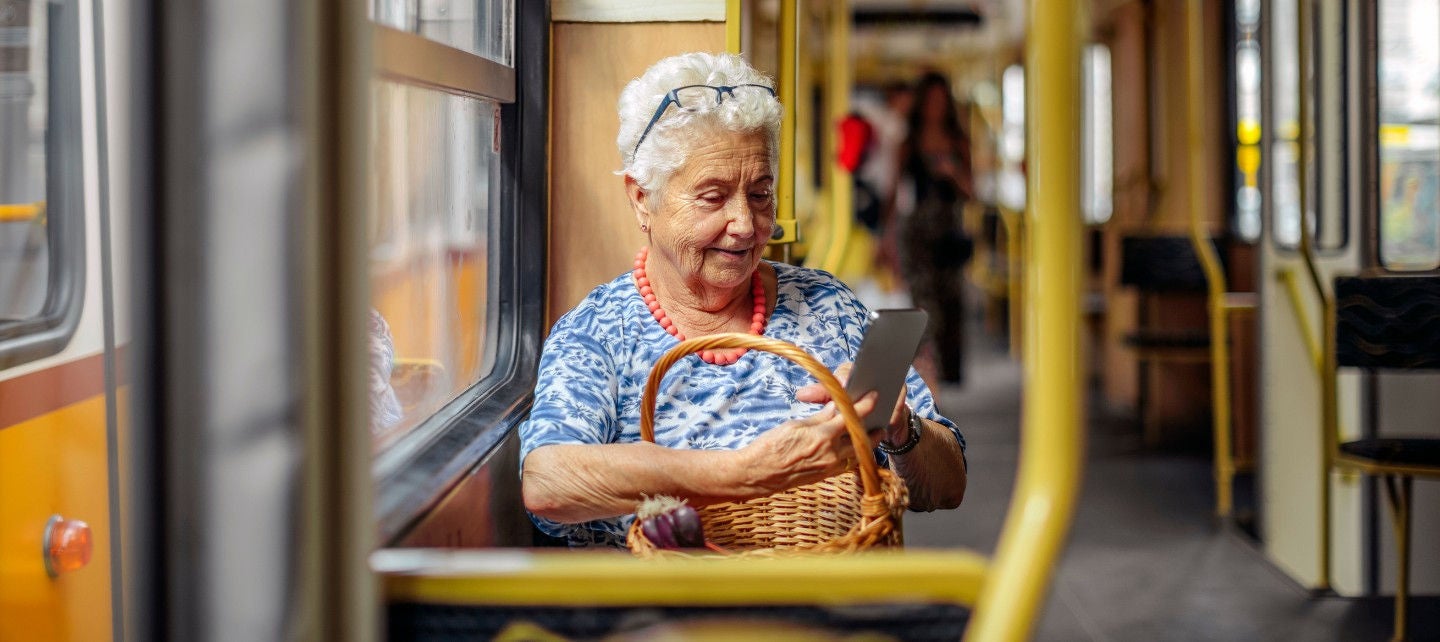
But it’s not just high-end VR headsets that are gaining a new wave of users. In Japan, the world’s most aged society with nearly 30% of the population 65 years or older, the surge of older customers is finally getting acquainted with the world of smartphones. The shift comes in response to telecoms firms shutting down 3G services in the nation, leaving around 500,000 mostly older users needing to make a leap from their beloved “garakei” flip phones.
As covered in The Guardian, many of the people forced to make the switch have enrolled in classes provided by carriers to learn how to navigate their new devices, getting up to speed on everything from how to stay safe from scams to how to properly end a call.
“When I bought my smartphone I turned it on and the number of icons was so confusing I had no idea what to do,” Hiroko Kanda, a class participant, told the newspaper. “It’s taking me a while to get used to it.”
Of course, many older people have been keen to get to grips with what the latest phones, tablets and laptops have to offer them, especially when it comes to social media. According to the AARP, in the U.S., 90% of over-50s engage with social media, with nearly half spending at least an hour a day on sites such as Facebook and YouTube.
And they’re not satisfied with simply consuming content. Many older social media users are enthusiastic creators, becoming popular influencers in the process.
Former dentist Ian Smith, from Norfolk in the U.K., started posting videos on TikTok to promote his self-published novel, encouraged by his wife who challenged him to draw in 100 followers. The octogenarian, who posts two videos a day on the site, has now amassed millions of views for his uplifting content, where he shares life experience and advice.
Speaking to the BBC, Smith said, “It's very humbling. You think, here's this 81-year-old sitting talking to a tiny little telephone and response has come from all over the world. I do a live thing on a Thursday at eight o'clock and you have people popping up from Brazil — all over the world, and it's staggering really.”
Proof, if needed, that you're never too old to learn something new.