What are you looking for?
Cybersecurity
October 27, 2026
It was a typical weekday at a private bank in Europe, and a customer had set up a transfer of €60,000. The customer wasn’t a hacker or a bot but an actual human who had willingly clicked “approve” to send money from their bank account. But the payment never went through.
And that’s a good thing.
Behind the scenes and in real time, the bank checked the receiving account against a list of accounts confirmed to belong to scammers. When a match popped up, the bank was able to intervene.
That intelligence came from Cybera, a startup that tackles a pervasive weakness in scam prevention: By the time a victim reports they’ve been scammed, the money is already gone and almost impossible to trace. By proactively identifying where the money is going, co-founder and Chief Revenue Officer Claudio Staub says, he can stop scams in their tracks.
That’s because, Staub says, “Every scam involving the transfer of funds ultimately ends in a payment.”
Instead of trying to determine whether a customer is being manipulated, New York-based Cybera identifies the accounts that criminals use to collect and then quickly launder money. To find them, it uses AI-generated personas that engage scammers and gather payment details, “using AI for good to combat scams at scale,” Staub says.
Cybera’s Money Mule Intelligence is now available through Recorded Future, the threat intelligence company owned by Mastercard, helping fraud teams identify in real time the bank accounts that criminals use to move illicit funds so that financial institutions can use the intelligence to prevent the transfers.
It’s another weapon in Mastercard’s arsenal of fraud intelligence, including Consumer Fraud Risk, which gives both sending and receiving banks real-time risk insights into account-to-account payments, and Decision Intelligence Pro, which applies advanced AI and graphing algorithms to cardholders’ behavior to help issuers assess transaction risk, detect fraud and approve more genuine transactions in real time.
There’s a technical term for the kind of scams Cybera disrupts: authorized push payment fraud. With APP fraud, scammers don’t hack into your account. It’s more insidious: They talk you into sending the money yourself. It could be in the guise of a romance that feels dreamy, a “now-or-never” investment, or a fake job opportunity that seems written with you in mind. (Because, with AI, it might have been.)
APP fraud losses are expected to reach nearly $15 billion year in the U.S. by 2028, up from $8.3 billion in 2024, according to a 2025 Deloitte report. And the damage isn’'t restricted to just financial losses, according to a 2025 survey by the Global Anti-Scam Alliance and Feedzai. Nearly seven in 10 victims reported stress from the experience, and 14% said that it created tension in their families.
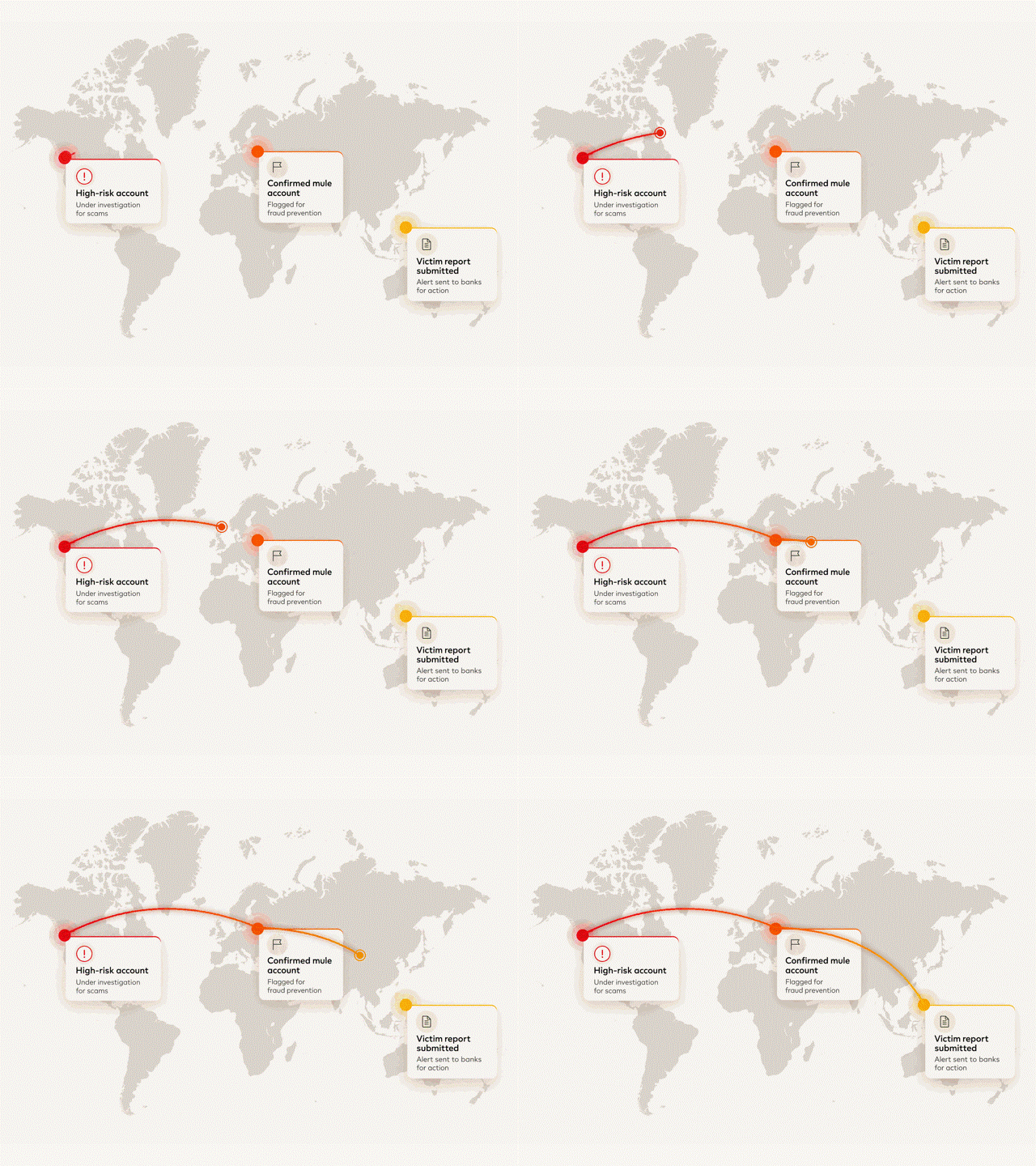
While scam tactics change and evolve, they all have one thing in common: The money has to be sent somewhere. Often, it’s a bank account, and those receiving accounts are called “money mules.” They’re an intermediary stop where the money can be withdrawn as untraceable cash or converted into crypto, with a trail that goes cold in seconds. Sometimes, the money is then relayed to another mule account, creating more distance between the victim and the scammer and making it that much more difficult to trace.
Money mule networks are not limited to scams and authorized push payment fraud. They may also be used to move funds stolen through account takeovers, facilitate traditional money laundering and support other forms of financial crime. Their reach can extend beyond banks to organizations across the financial ecosystem that facilitate the movement of funds through traditional and digital payment rails, including insurers, investment firms, cryptocurrency exchanges and title companies.
So-called mule herders can run hundreds of accounts at once and use AI to fake ordinary activity like buying groceries and paying for streaming subscriptions, so the accounts blend in with legitimate ones and don’t raise suspicion within banks.
So how do you get hold of a criminal’s account? You serve up the bait and wait for them to come to you.
Cybera builds AI personas that pose as believable potential victims. They chat with scammers and play along until there’s a payment request and the scammer shares the account details. Cybera runs hundreds of these personas across thousands of conversations every day. That means accounts can be flagged while they’re still being used, whereas traditional reporting usually catches an account only after a victim has already lost their money.
But it doesn’t end there. Breaking the news to a customer about why their money didn’t go through is not as simple as one might assume. Most banks rely on risk scores to determine whether to approve or decline a transaction, but Cybera goes beyond estimating the likelihood of fraud by verifying each account and attaching evidence and context that helps banks make a strong case to the customer. “The aim is fewer alerts with high confidence, rather than a flood of false alarms,” Staub says.
In addition to helping financial institutions block transactions to suspected money mule accounts, Cybera helps banks identify these accounts within their own customer bases so that they can act before the accounts are used to receive or move illicit funds. That intelligence has applications beyond scams, including account takeover, money laundering and other forms of financial fraud.
This is increasingly important to banks as regulations have taken effect in the U.K. requiring sending and receiving banks to split liability for losses and reimburse all APP fraud victims, with limited exceptions. Other markets have introduced or are developing more limited liability and compensation rules.
Cybera’s partnership with Recorded Future has also brought Cybera into Mastercard Start Path, the company’s startup engagement program, joining its Security Solutions cohort in February. It offered Cybera access to a broader network of financial institutions and connections within Mastercard with investors, other startups and potential partners.
Cybera’s evolution also reflects the role startups can play in bringing a new perspective to an entrenched problem. Scams and financial crime are old problems with an increasingly sophisticated playbook. As criminals adopt AI and exploit a wider range of organizations that move money, startups can bring focused, unconventional approaches to identifying the infrastructure that enables those crimes.
“They have to take a hard problem and focus on it,” Staub says, “and we focused on it for many years, but the breakthrough came only a couple years ago. So you also need to have the persistence and perseverance to keep going.”