March 12, 2026
Over the past two decades, Latin America and the Caribbean have rapidly expanded their middle class. Today, about 400 million people — 61% of the region’s population — are considered middle class, with over $5 trillion in annual spending power. By 2035, that number is projected to reach nearly $7 trillion.
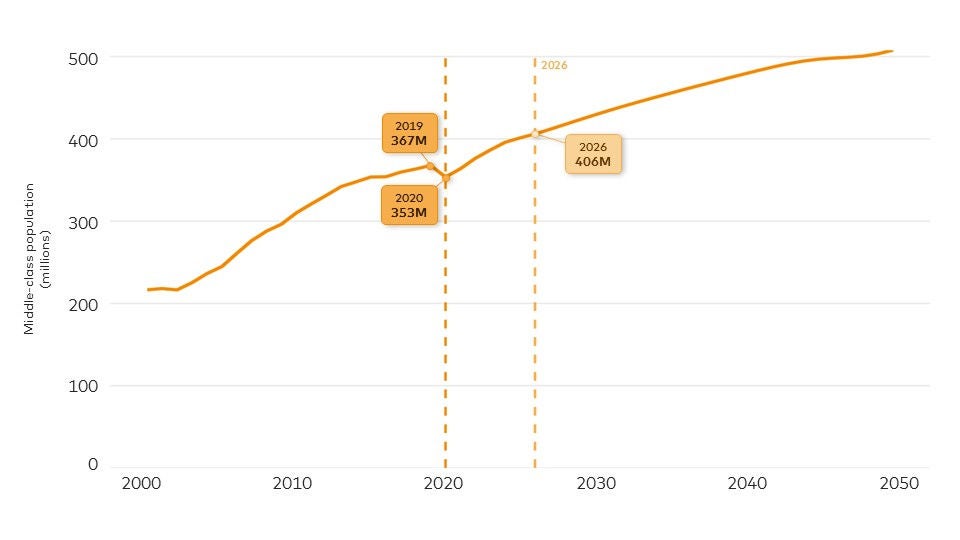
This shift reflects major development gains, with millions moving out of poverty and into greater financial access and increased spending patterns. But scale does not guarantee stability — and many households that have entered the middle class remain financially fragile. A lost contract in an informal job, an illness that generates unexpected expenses or a climate-related disruption can erode savings or emergency funds. The pandemic made this fragility even more visible: 14 million people slipped back into vulnerability in a single year (see figure 1).
Figure 1: The region's middle class lost over 14 million people during the pandemic in 2020.
Source: World Data Lab, 2026
According to World Data Lab, households are considered middle class when spending at least $13 per person per day (2021 PPP). Still, more than 100 million people in LAC — about one-quarter of its middle class — live just above the threshold at $13–$20 per day, underscoring how many remain susceptible to downward mobility when shocks occur. Limited savings and partial insurance coverage leave households and small businesses vulnerable to a single disruption. In smaller economies, reliance on tourism and remittances and exposure to extreme weather compounds this fragility.
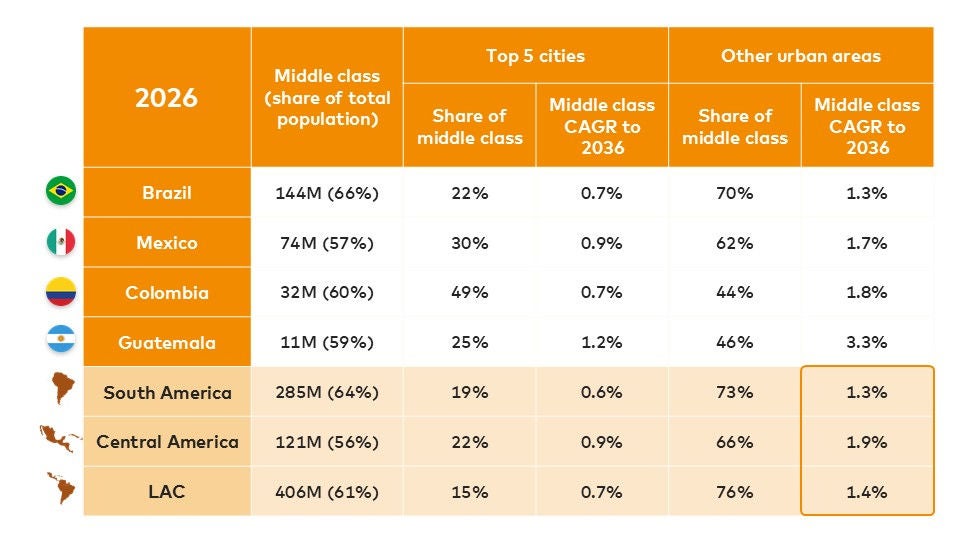
Even Brazil and Mexico — the region’s largest middle-class growth engines — are seeing growth shift to secondary cities with thinner labor markets and greater exposure to shocks. In many of these cities, access to finance lags behind major metros, making it harder for households to withstand disruptions and remain middle class. Across South and Central America, smaller urban areas are projected to drive most future middle-class growth (see figure 2).
Figure 2: Megacities remain anchors, but middle-class growth is shifting beyond top metros toward other urban areas.
Source: World Data Lab
Latin America’s inclusion agenda is evolving from helping households reach the middle class to ensuring they stay there. The priority is no longer crossing a spending threshold, but building buffers, managing risk and withstanding economic shocks — a shift from basic inclusion toward financial health.
This shift from access to resilience — the ability to weather unexpected shocks — requires stronger small business ecosystems, more inclusive financial tools and public systems capable of responding quickly when shocks occur. It also requires recognizing the central role of micro, small and medium-sized enterprises in driving employment, income and mobility across the region.
At Mastercard, we see the emerging middle class not only as consumers but as entrepreneurs, workers and community anchors. Supporting their resilience means supporting the businesses, financial service providers, and ecosystems that sustain them.
Small businesses are often the first affected by inflation, supply-chain disruptions or local insecurity — and the last to recover without support. Strengthening their digital and operational capabilities and their access to finance helps stabilize household incomes and local economies.
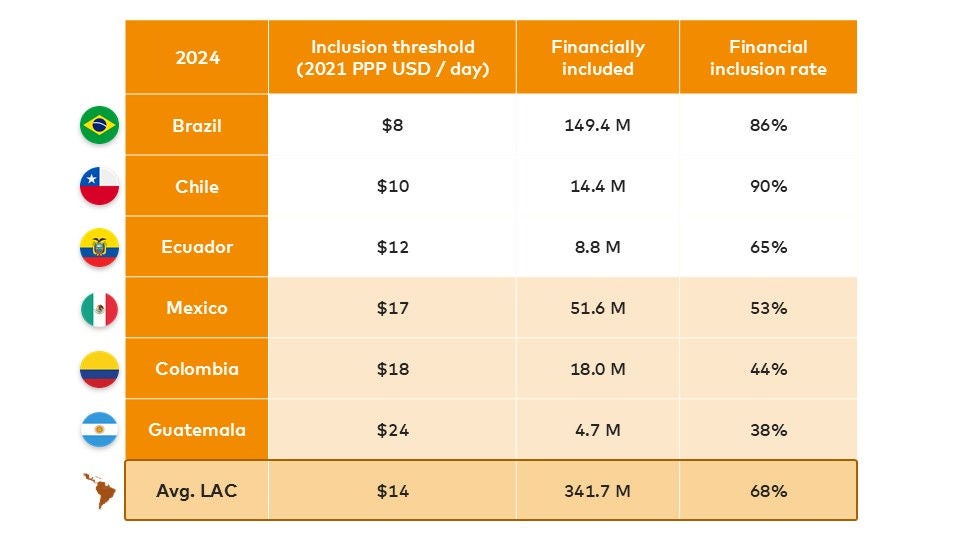
Through Mastercard Strive, we partner with local organizations in Mexico and Colombia to strengthen small businesses by digitizing operations and increasing access to capital — helping protect the incomes that sustain middle-class households. This is especially important where financial inclusion thresholds — the minimum daily spending needed to access formal finance — remain higher than regional averages. Mexico’s and Colombia’s inclusion thresholds sit above LAC’s average, and their inclusion rates trail Brazil and Chile by a wide margin (see figure 3).
In Central America, our initiatives with RISE in Guatemala are digitizing wage payments for rural workers, improving income security and expanding access to formal financial services. Digitized wages not only reduce risk and leakage but also create pathways to savings and credit histories, broadening financial health. Guatemala has one of the region’s lowest inclusion rates, making it a key country for reducing barriers to formal finance (see figure 3).
To scale and sustain impact, public-private partnerships are essential. Digital payment infrastructure, adaptive social protection systems and targeted credit facilities can help governments respond more effectively during crises, ensuring that households and businesses have the liquidity and support needed to weather disruptions.
Figure 3: Mexico, Colombia and Guatemala have higher minimum daily spending thresholds for financial inclusion than regional peers.
Source: World Bank Findex and World Data Lab, 2024
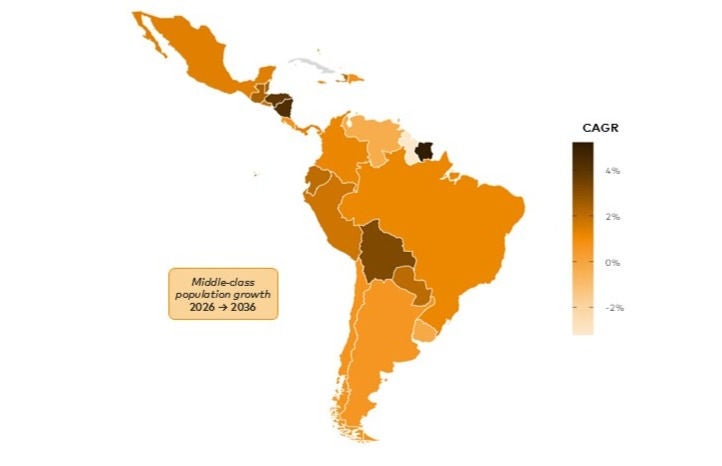
Latin America represents one of the world’s largest and most economically consequential middle-class markets. Beyond Brazil and Mexico, the fastest projected percentage growth is concentrated in smaller economies such as Suriname, Nicaragua and Honduras (see figure 4).
Figure 4: Over the next decade, smaller countries show the highest projected middle-class CAGRs.
Source: World Data Lab, 2026
Mastercard’s renewed commitment to connect and protect 500 million individuals and small businesses on the pathway to financial health reflects this reality. In Latin America, that commitment translates into strengthening small businesses, expanding digital access and partnering with governments and civil society to build shock-ready systems.
If the past 20 years were defined by mobility, the next decade must be defined by durability. A large middle class signals economic growth and advancement, but a resilient middle class is a foundation for sustained inclusive economic growth.