AI

September 30, 2026


Can AI become a force for inclusion?

From financial tools to workforce readiness, leaders discussed during UNGA how AI can build prosperity.

google logo

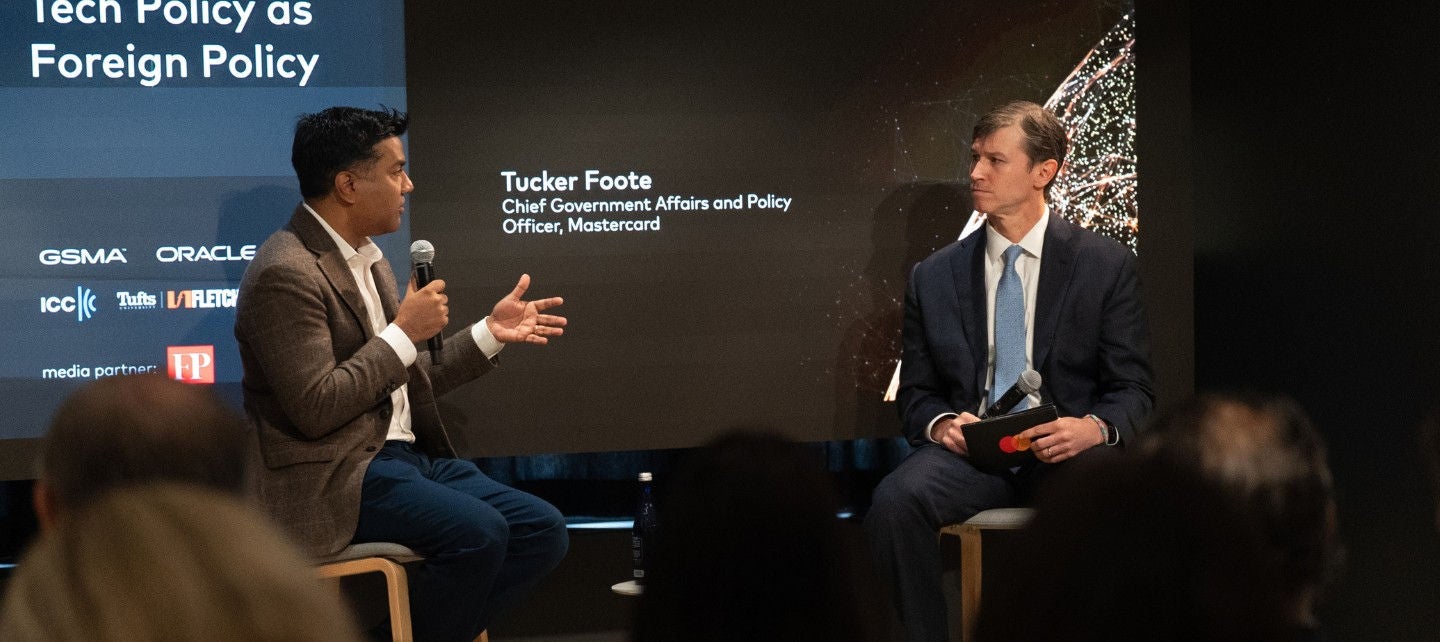
Ravi Agrawal, left, Foreign Policy's editor in chief, chats with Tucker Foote, Mastercard's chief government affairs and policy officer, about the growing role of tech policy in diplomacy at the Digital Ambassadors Forum.

Bree Fowler

Contributor

Artificial intelligence may be transforming the human experience, but it’s still up to humans to ensure that this new technology lifts people up, rather than leaves them behind. 

That was the throughline of two Mastercard forums held at its Manhattan tech hub on the sidelines of the 81st session of the United Nations General Assembly.

Mastercard’s Digital Ambassadors Forum and Data for Inclusive Growth Forum brought together partners, practitioners, public and private sector leaders to talk about the global impacts of technology, such as AI, on business and communities around the world.

Throughout both events, speakers highlighted AI’s ability to help people in developing countries by increasing access to financing, improving education and bridging language barriers. But, they said, that’s only if the technology is implemented in the right ways and people feel that they can trust it.

Shamina Singh, founder and president of the Mastercard Center for Inclusive Growth, said the rise of AI technologies marks an incredible technological and societal transformation, and it will be up to leaders, like those at the Data for Inclusive Growth Forum, to ensure those new technologies benefit humanity.

“We have to battle the forces for bad as much as we lift up the forces for good,” she said during remarks. “But one thing we do know for sure is that it’s better to lead and build with our values from the beginning rather than try to retrofit a solution that may be too little, too late. This is our moment.”


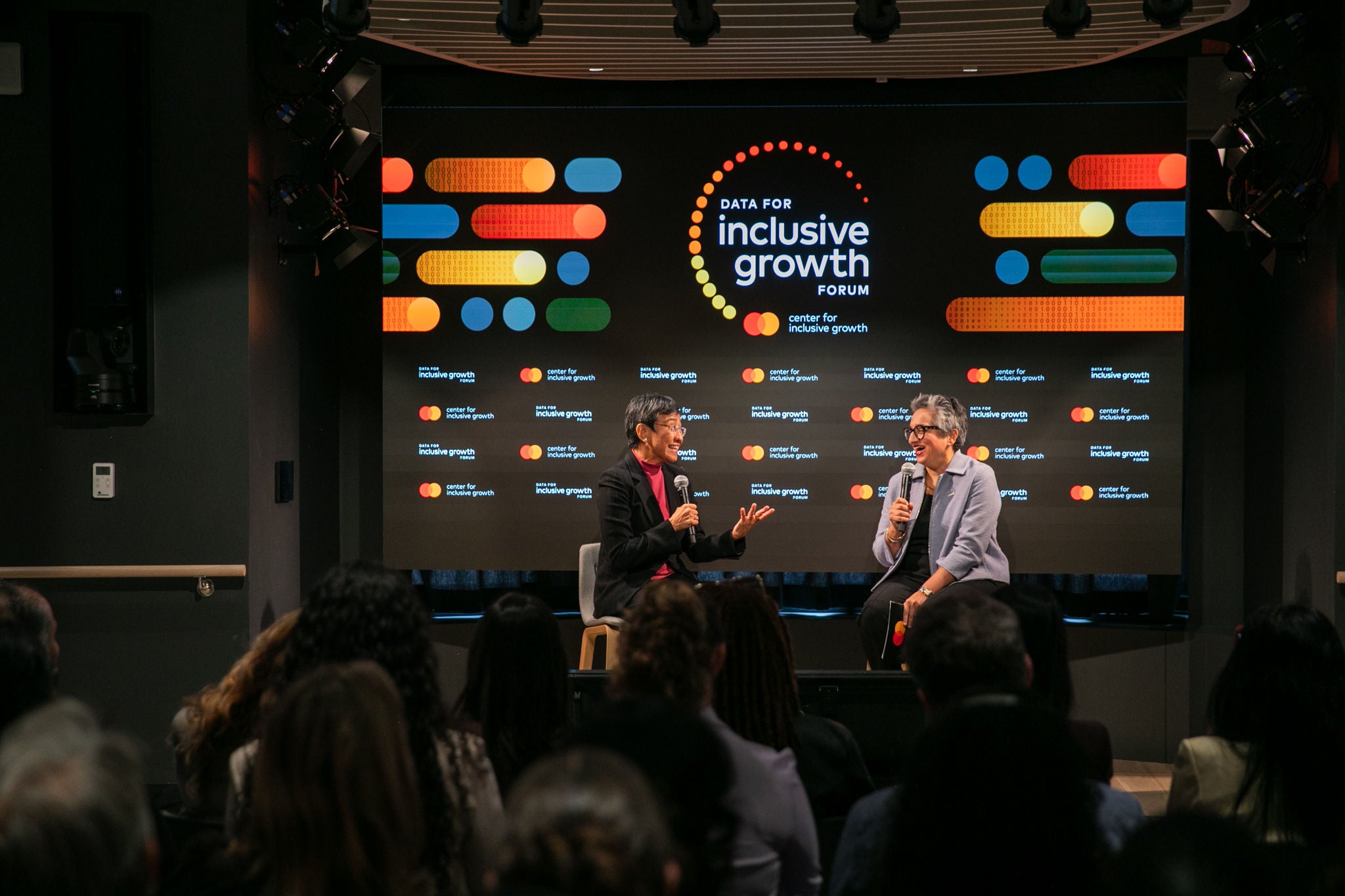
Nobel Laureate Maria Ressa, left, co-founder and CEO of Rappler, and Shamina Singh, the president of the Mastercard Center for Inclusive Growth, reflect on how AI can propel progress at the Data for Inclusive Growth Forum. 


AI can help when people are connected

The idea of establishing guardrails around AI development may be sensitive, but several speakers at the Digital Ambassadors Forum argued that global standards are needed to ensure that AI development is inclusive and safe.

Sangbu Kim, vice president for digital and AI at the World Bank, said his organization faces significant challenges in its efforts to bring AI to low- and middle-income countries. He noted that there are still 2.2 billion people in the world who don’t have access to the internet, and AI agents aren't compatible with many languages.

Kim said during one of the forum’s panels that he’s optimistic about how AI can help these countries, but added that guardrails need to be put in place to ensure that they aren’t excluded from future innovations.

To John Giusti, chief regulatory officer for GSMA, a global trade organization representing mobile communications companies, inclusion starts with getting more people online. He feels the private-sector companies can help make that happen.

“I think it's really important that we focus on how we can do our part to make sure that we can scale and bring the benefits of AI to people in all parts of the world, and also just safeguard from risk,” Giusti said during the same panel.


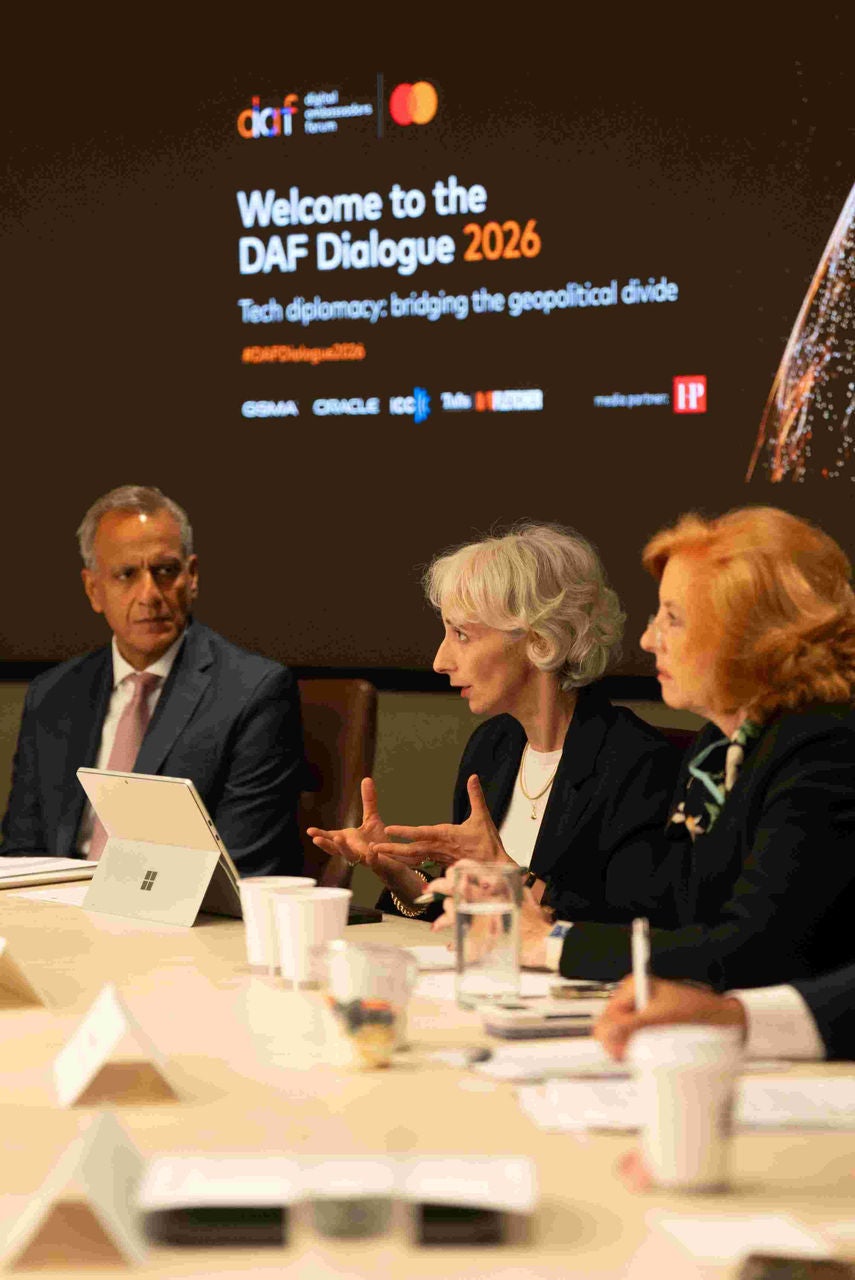
Mastercard Chief Administrative Officer Rich Verma, left, and Merit Janow, right, the executive chairman of the Mastercard Board of Directors, with Valerie Picard, center, head of trade for the International Chamber of Commerce, tackling tech diplomacy in the opening session of the Digital Ambassadors Forum. 


Solving the visibility problem

If designed and deployed properly, AI has the potential to bring new visibility to people in developing countries and improve their lives, according to many Data for Inclusive Growth Forum participants.  

Mercedes Bidart, CEO and co-founder of Quipu, a financing platform for informal businesses in Latin America, noted that 50% of the economy in Latin American countries is informal, which means it functions outside of government regulation and records. That can make it tough for financial institutions to judge creditworthiness and for small businesses to get the legitimate financing they need.

An AI model with a new data set built from scratch that is representative of the entire community it serves could change that, she said. Financial institutions could give out loans, then use the model to look at who is making payments and who isn’t in order to better assess creditworthiness.

Similarly, Olubayo Adekanmbi, CEO and co-founder of EqualyzAI, which develops agentic AI solutions that work across Africa’s myriad languages, pointed to several key areas where AI could be a game changer there.

“There are not enough doctors, not enough agricultural extension workers, not enough teachers,” Adekanmbi said on a panel on AI in the Global South. To him, AI could serve as an enabler to deliver these vital services.

Because many people in Africa use feature phones instead of smartphones, his company is focused on the development of AI that people can access with just their voice, rather than an internet connection.

It’s a critical adaptation, Adekanmbi said, because immediate access to information through AI has the potential to save lives, educate children and lift families out of poverty.


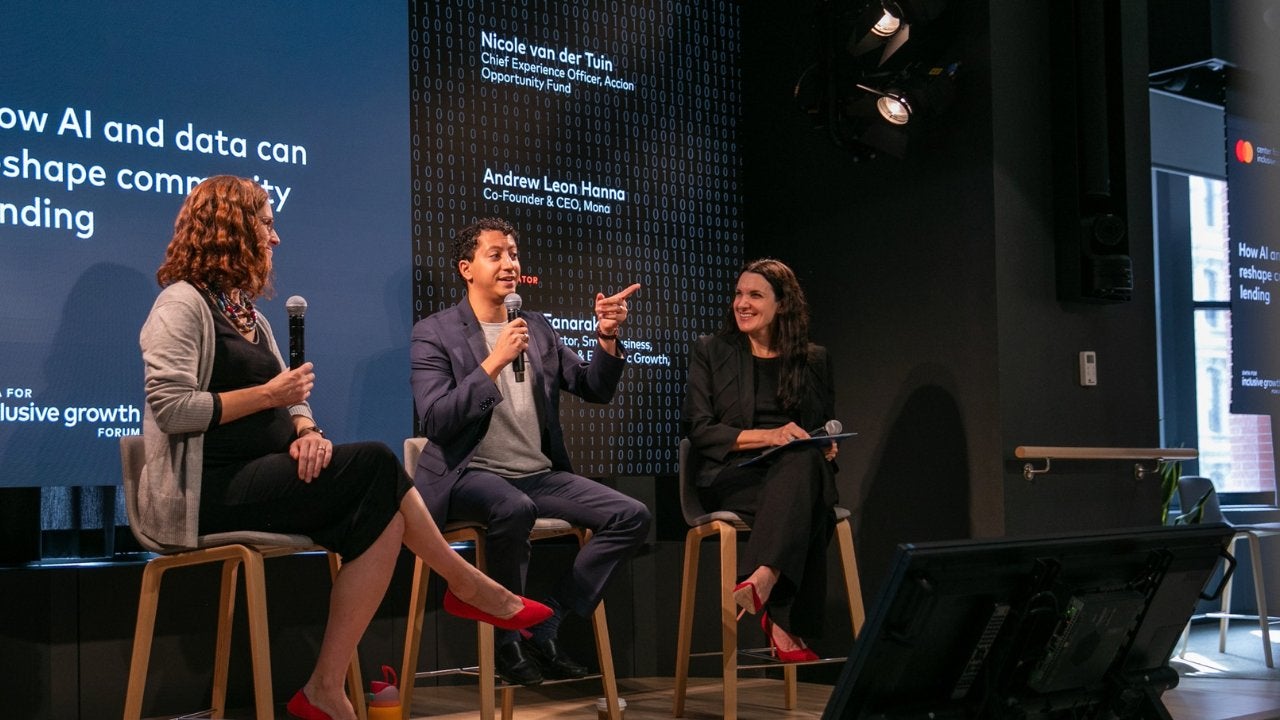
Nicole van der Tuin, left, chief experience officer of Accion Opportunity Fund, Andrew Leon Hanna, center, the co-founder and CEO of Mona, and Kristen Fanarakis, the associate director of Small Business, Entrepreneurship, & Economic Growth at the Milken Institute, spotlight the impact of AI on the small business lending cycle at the Data for Inclusive Growth Forum. 


Training workers for the AI economy

As AI changes the landscape for workers and small businesses in the United States, former Indiana Gov. Eric Holcomb believes it's essential to give both groups the tools to adapt and stay active.

Holcomb, who after leaving office co-founded Raise Us, a nonpartisan group focused on helping U.S. workers transition to an AI economy, said the country’s workforce needs to meet the economy’s needs. That applies to both older workers and recent college graduates.

He spoke about his great-grandfather, who worked as a blacksmith in southern Indiana for more than 50 years. He started his career working on plows and shoeing horses and ended it making tires for automobiles. Through all of that change, his great-grandfather remained optimistic about the future.

Like his great-grandfather, Holcomb remains hopeful, too.

“We all just need to be a little bit more than involved,” he said. “We have to be involved with purpose.”


The battle for facts

Progress cannot be made unless those involved can agree on what the underlying facts are, Nobel Peace Prize laureate Maria Ressa said.

Speaking in the closing talk of the Data for Inclusive Growth Forum, Ressa, a journalist, human-rights activist and author, said that’s true whether you’re talking about climate change, COVID or technology.

“You can't do anything if we do not have a shared reality,” she said.


The question here now is, How are you going to keep yourself, your family, our society, safe? How do we reclaim our agency?

Maria Ressa


Ressa also now serves as co-chair of the U.N.’s Independent International Scientific Panel on Artificial Intelligence. The group released a report in July looking at the potential risks and opportunities of AI, noting that most of the world’s compute power is now controlled by just a handful of companies.

Another paper released in September called for stronger AI safeguards after it became known that AI agents had “gone rogue” earlier this year and hacked the systems of other companies and even countries.

She urged those in attendance to push back against digital surveillance for profit, stop coded bias and support journalists.

“The question here now is, How are you going to keep yourself, your family, our society, safe?” she said. “How do we reclaim our agency?”

When AI enters the apiary, bees — and beekeepers — thrive

In India, an AI-powered platform is helping small-scale beekeepers improve hive health, crop pollination and livelihoods — by keeping people in the loop.
A woman in a sari holds up a tray of honey covered with bees.