How To Make Progress on Your Money Goals

Young woman working on laptop and managing finances with paperwork at home.

Struggling with money is common. In fact, more than a quarter of U.S. adults admit to struggling financially, according to the Federal Reserve.

Maybe you’ve never set financial goals, and you’re not sure where to start. Maybe you have, and you’re feeling stuck. Either way, you can use this five-step plan as a guidepost to help set and ultimately achieve your financial goals, whether it be paying off credit card debt or saving for a home. 

5 Steps to Set and Achieve Your Goals

1. Strengthen Your Financial Literacy

‘Knowledge is power’ isn’t just a cliche; in the case of finances, it’s the key to making informed decisions and understanding concepts like credit, 401(k)s and budgeting in practice.

For instance, someone with a strong understanding of credit can manage their credit cards wisely, avoid high-interest debt and analyze their credit reports to correct errors that could harm their credit score. Arm yourself with financial knowledge as much as you can by reading books and articles on personal finance, listening to podcasts or watching Youtube videos from credible sources, and consulting with a financial advisor.

    2. Think ahead

    Consider where you want to be in six months, one year, or five years from now. Decide what you want to achieve and work backwards.

    For instance, if you're aiming to save for a vacation, determine how much you need to set aside each month to reach that goal. Use the SMART goals framework (specific, measurable, achievable, relevant, and timely) as a starting point. That might look like:

    Specific: "I want to save $3,000 for a five-day beach vacation to Hawaii, which will cover flights, accommodation, food, and activities."

    Measurable: "I will save $500 per month by cutting back on dining out and entertainment, and track my progress through a savings app." 

    Achievable: "I will review my budget to ensure I can save $500 each month. I'll also look for additional ways to earn extra income, like doing freelance work or selling unused items."

    Relevant: "This goal is important because I’ve been working hard all year, and I deserve a relaxing vacation where I can unwind and recharge."

    Timely: "I will have the $3,000 saved by June 1, so I can book my trip for September."

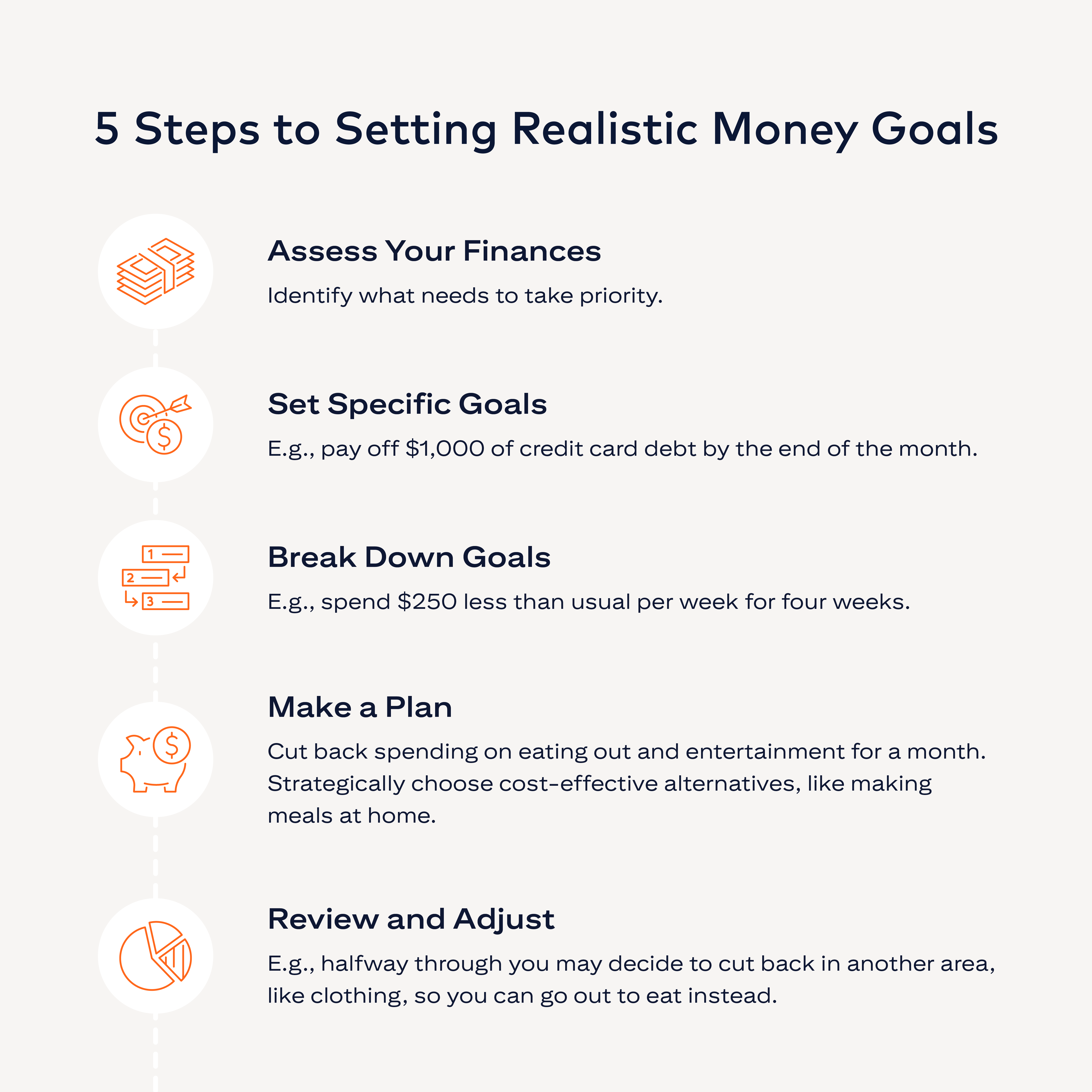
      A list of five recommended steps to set realistic money goals

      3. Prioritize your goals

      You might have multiple goals, which is great! Listing your goals in order of importance will give you clarity on what to tackle first, making saving feel less daunting and more manageable.

      Perhaps you have both short-term and long-term goals, and you want to prioritize your short-term goal. For example, if your top focus is saving for a car, you may want to put investing for retirement on the back burner for a while. This doesn’t necessarily mean neglecting it entirely, but rather contributing more toward your future car, and less toward retirement for a specified period. Narrowing your efforts can help you allocate your resources and time — and seeing progress in that one area can motivate you to keep going on the rest. 

        4. Monitor your progress

        Every week, dedicate 10-20 minutes to evaluate your finances — where you’re spending, where you’re saving, and where you can adjust to better serve your goals. Consider picking the same day and time each week to get into a routine.

        You can keep a detailed record in a notebook, digital spreadsheet or trusted banking app to monitor your savings and progress. Below is an example of what that might look like.

          A sample record keeper that details spending goals, monthly contributions towards each goal and the percentage of completion.

          5. Tell a loved one about your goals

          According to a study by the Association for Talent Development, your chance of reaching a goal jumps to a whopping 95% when you establish an ongoing appointment with your accountability partner.  An accountability partner can be a friend, a family member, a mentor, or anyone who can encourage you as you make progress and remind you of your goal if you start to stray. Consider holding a regular check-in with that person.

          Some people find it useful to draft a commitment contract, which spells out your financial goals and objectives, and how you plan to reach them. Displaying it in a highly visible spot, like on the refrigerator or your next to your bed, can help keep your goal top of mind. 

          We understand that managing your money can feel exhausting, confusing, scary, and overwhelming at times. Taking these steps can help reduce stress and allow you to gain  control over your financial future. Commit to your goals, and with some patience and dedication, you’ll reap the rewards.

            About Master Your Card

            Master Your Card is a community empowerment education program sponsored by Mastercard, that works with committed partners nationwide to bring information about the benefits of electronic payments technology for underserved communities to build brighter financial futures. The program has facilitated presentations and workshops in numerous cities around the country, provided financial education to tens of thousands of students and reached millions through partners’ initiatives and education materials. 

            mastercard logo