Trust

January 23, 2026


Confronting a new era of digital risk and responsibility at Davos

As AI adoption accelerates and cyber threats intensify, global leaders call for intelligence-led defenses and cross-border cooperation.

google logo

Vicki Hyman

Director,

Global Communications,

Mastercard

If geopolitical fragmentation was the headline out of the World Economic Forum’s annual meeting in Davos this year, the rapid acceleration of AI — holding both promise and risk — and rising cyber vulnerabilities emerged as the through lines.

The conversations among CEOs, economists, technologists and policymakers revealed that systemic cyber risk and still-developing AI governance are increasingly intertwined with a more competitive world order.

Cybersecurity attacks in particular are inflicting huge financial damage on both the businesses that are victimized and national economies, according to a new WEF cybersecurity survey that came out in advance of Davos. Scaling the average cyberattack loss to individual businesses in the U.K., cybercrime cost the economy nearly $20 billion, the report notes. Reducing major cyber incidents could boost GDP per capita by 1.5% within a decade, according to the World Bank. 

Cybercriminals don’t recognize borders, so greater coordination and shared intelligence among countries and between governments and the privacy sector is needed to strengthen cyber resilience, said experts at the Davos panel “Hard realities of cyber threats.”

“The traditional law enforcement activities are not acceptable anymore,” said Catherine De Bolle, Europol executive director. “It’s not enough for the future … We need to respect the boundaries of the different agencies, but if we do not put the information and the intelligence together to tackle that, we will never win the battle.”

Speed is also a critical problem as AI supercharges attacks. “The problem is, if a participant is attacked and then shares, it’s already happening,” said Mastercard CEO Michael Miebach in the same discussion. “We’ve got to get in the business of predicting … Even if it’s the best reaction, it’s too late. So what can I do to pick up signals earlier?” 

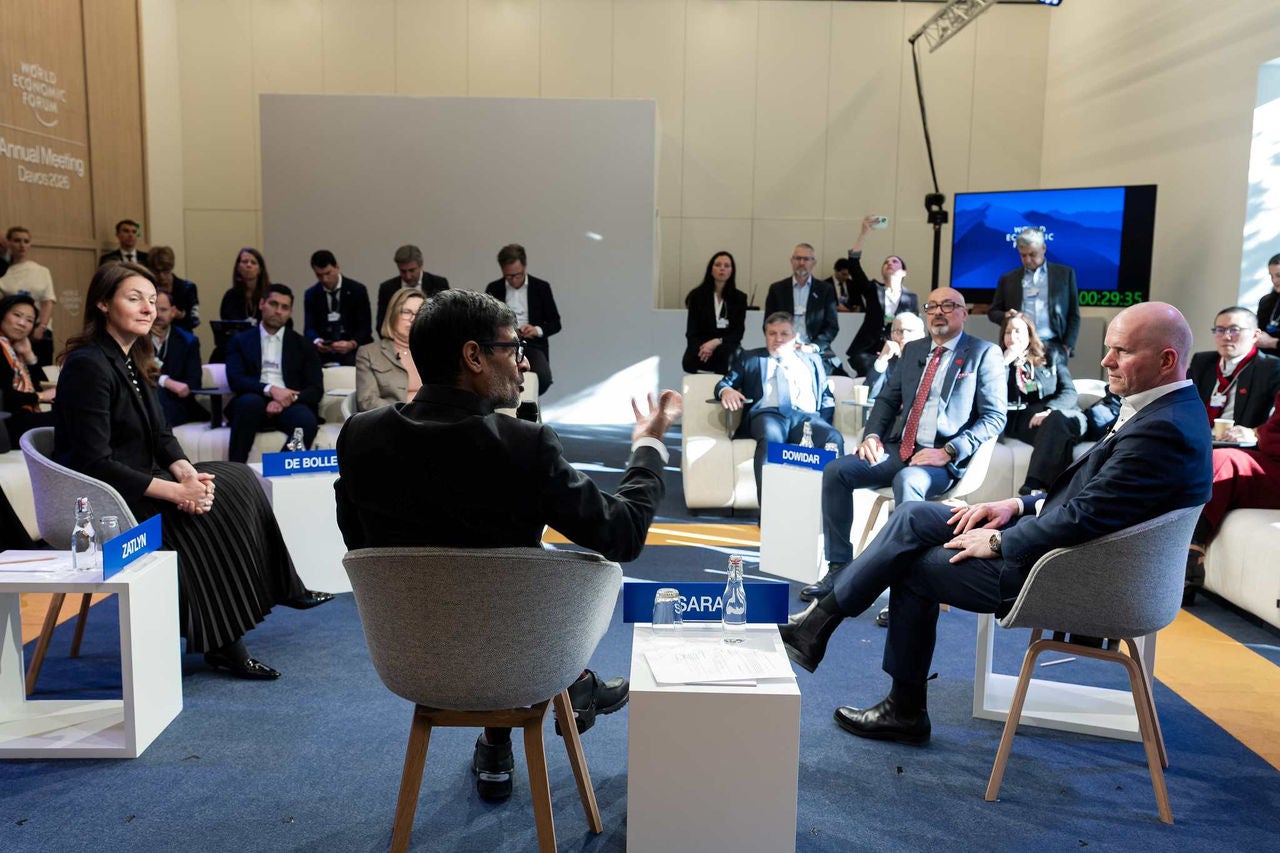
Hard Realities of Cyber Threats session with Catherine De Bolle, Executive Director, Europol (European Union Agency for Law Enforcement Cooperation), The Hague; Hatem Dowidar, Group Chief Executive Officer, e&, United Arab Emirates; Michael Miebach, Chief Executive Officer, Mastercard, USA; Michelle Zatlyn, Co-Founder and President, Cloudflare, USA; Samir Saran, President, Observer Research Foundation (ORF), India; at the World Economic Forum Annual Meeting 2026 in Davos-Klosters,

Mastercard CEO Michael Miebach, right, discusses new approaches to the growing challenge of cybersecurity in Davos with  (Photo credit: Jakob Polacsek/World Economic Forum) with, from left, Cloudflare's Michelle Zatlyn, Europol's Catherine De Bolle, ORF's Samir Saran,and e&'s Hatem Dowidar. (Photo credit: Jakob Polacsek/World Economic Forum)


In 2024, Mastercard acquired the world’s largest threat intelligence company, Recorded Future, to help its customers become proactive, not reactive. “Nobody can outspend this problem. You cannot defend against everything. If it’s not intelligence-led, you’re going to lose.”

In the WEF survey, 87% of CEOs identified AI-related vulnerabilities as the fastest-growing cyber risk of the past year, but also called AI indispensable as a shield, providing keener threat detection and anomaly-monitoring capabilities.

Buy-in for the AI future ranged widely, from Tesla CEO Elon Musk’s prediction that AI (and robots) would create a "path to abundance for all" to historian Yuval Noah Harari’s warning that we should be humbler about AI autonomy. “We think we know how to build it,” he said. “How do we build a self-correcting mechanism so if we take the wrong bet, this is not the end?"

The rise of AI agents, which can make decisions and execute tasks, with or without controls, also raised concerns for cyber resilience in the coming years.

“We know how to secure humans and infrastructure, and I think we’re building the tools to secure non-humans. The problem is interoperability,” said Nadav Zafrir, CEO of Check Point Software Technologies, in the panel “Cyber defenders in the age of AI.” “The next few years is going to be chaotic because of the interoperability … We are introducing new capabilities much faster than we understand what they can do and where they’re going.”

As AI systems more fully occupy and interact with the real world, new models of zero trust, real-time monitoring and more proactive defense across both humans and machines are needed so AI’s benefits don’t outpace its guardrails, many panelists agreed.

“As an ecosystem, all players need to come together,” said Ling Hai, president of Mastercard for Asia Pacific, Europe, Middle East & Africa, in an interview with MoneyControl, India’s financial news platform. “We need to stay ahead of this, and we need to use AI to really counter these cases that will do tremendous harm to consumers. If you think about payments, trust is so important. It takes decades to build that trust. Once you lose trust, people are not going to use your services anymore.”


Why F1 podium glory starts by putting people first

At Davos, Zak Brown reveals how he transformed McLaren Racing, how people are the key to winning, and why F1’s popularity is skyrocketing.

Horizontal pill and featured card - 1