Article

How AI and open finance are powering the next generation of personalized financial experiences

Published: August 12, 2026

Group of people at a cafe looking at their phones

AI can help organizations better understand and respond to customer needs in near real time. Open finance lets customers securely share their financial data across providers, with consent — helping give companies the context to create more relevant, personalized experiences.

But context alone isn’t enough — many customers are no longer willing to settle for generic experiences when they spend and manage their money. Some will even cut ties with a financial services company if necessary. New research from Mastercard, The state of open finance 2026, finds that organizations are using open finance initiatives and AI to keep up and get ahead.


Why consumers expect more customized financial experiences

AI’s leaps forward in the past few years are increasing customers’ personalization expectations.

The Mastercard research, The state of open finance 2026, which surveyed consumers as well as senior executives in financial services and retail, found that many customers have limited tolerance for generic financial experiences. It found that 70% of the 8,000 consumers surveyed said they are prepared to switch financial providers to access more personalized guidance on smarter financial decisions, while a separate 42% reported having already initiated a switch for this reason.


Why AI alone is not enough to deliver effective personalization

Industry executives know they need to innovate to meet customers’ personalization needs: 62% of the 300 senior executives surveyed say their brand will lose customers to competitors in the next 12 months if they don’t invest in systems that make financial interactions more convenient and personalized. Adding more AI systems to processes is one of the main innovation strategies these financial services and retail organizations plan to use in the next 12 months.

Deploying AI without a clear strategy can limit its ability to deliver meaningful results. Business leaders must first connect the dots to make sure AI has enough contextual information to generate reliable and relevant insights. Fortunately, the research shows that 70% of the consumers in the survey are willing to securely share their financial data.

Open finance initiatives connect various sources of consumer-permissioned data, and they’re helping enable more intuitive personalization. Examples include retailers adjusting payment plans based on customers’ real-time affordability and fintech firms giving small businesses targeted advice based on real-time cash flow. Executives expect these kinds of data integration initiatives to support improved organizational performance moving forward.


Open finance initiatives allow AI to personalize with precision

Over the past 24 months, open finance has helped organizations generate AI-driven insights into customer behaviors. In this period, expanded access to consumer-permissioned data has helped 6 in 10 organizations in the survey generate near real-time AI insights into customer engagement as well as broader risk factors. AI insights into customer spending patterns are helping inform how organizations can fine-tune their products and services:

  • 67% say these insights have enabled them to issue new product offers
  • 56% say these insights have enabled them to provide personalized financial advice

Using open finance initiatives to build awareness of what customers need goes beyond meeting expectations today. It also builds the foundation for competing in the next era of personalization expectations. “Knowing your customers is important,” says Roshni Joshi, assistant vice president and technical general manager for field engineering at Databricks. “Especially as we’ll increasingly see a shift toward expressed permission being issued so that financial providers can take automated actions on behalf of customers.”

“That [hyper-personalization] is only possible by using AI and collecting vast amounts of consented behavioral data and industry data,” adds Joshi. “And of course, organizations need to be doing this in a privacy-safe manner that increases trust.”


Customers want to trust AI, and the right experiences can help them get there

Hyper-personalization has compelling advantages, such as saving customers time. But in practice, its success depends on whether companies have achieved trust, transparency and strong data practices.

This raises a question: Do customers trust AI enough for it to be used to personalize their financial management?

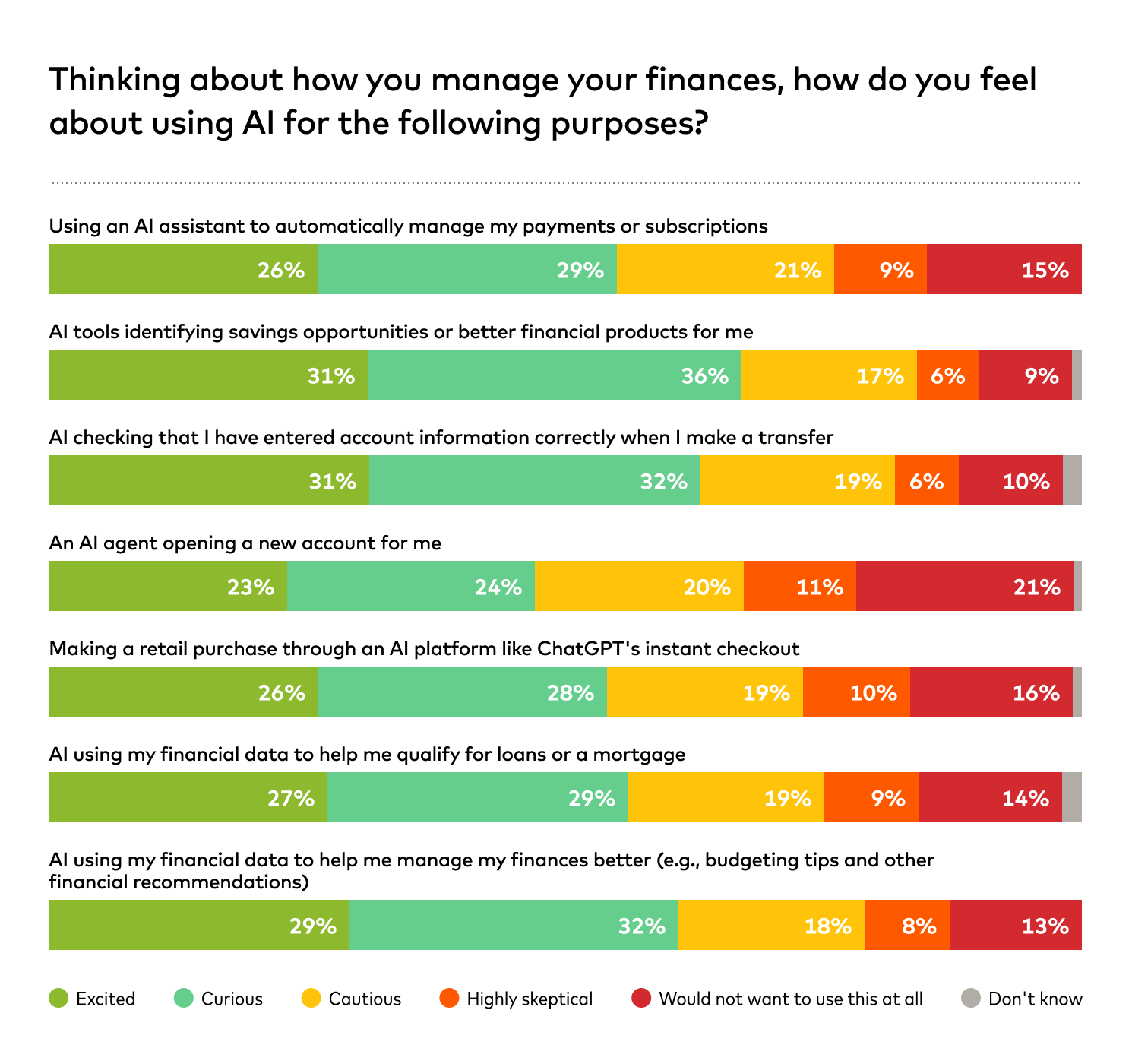
Overall, the research indicates that customers feel positive about trusting AI assistance in their financial lives. Many (57%) are open to trusting AI recommendations about their finances rather than only trusting human experts.

But organizations need to proceed with caution. Asked for their reactions to AI being used for certain financial tasks, consumers are most positive about AI tools that identify savings opportunities or better financial products for them. They’re most skeptical about using AI agents to open new accounts. Financial services and retail companies should consider these nuances as they launch new AI features and communicate any changes to customers at the point of consent.

template

Some consumer characteristics can indicate how comfortable people are likely to be with trusting AI with their finances. Gen Z consumers in the research are more likely to be positive about it, while baby boomers are most likely to be negative. Cultural factors might also influence attitudes. Consumers in the study from France, Poland and Sweden are more likely than average to not want to use AI at all for their finances, and consumers in Australia and the U.S. are most likely to feel excited about it.

As they try to meet customers’ expectations of hyper-personalization, organizations will have to consider these nuances to ensure their use of AI doesn’t sabotage customer trust.


What is the future of hyper-personalization in financial experiences?

Hyper-personalization is fast becoming a customer entitlement. To provide it in a responsible way, financial organizations can combine open finance measures with AI-powered systems. “Customers have personal objectives in their financial lives,” says Mastercard’s Jess Turner. “For instance, booking a trip or saving for a house. Open finance allows organizations to step in and give them the more relevant answers they need [to achieve these goals] by examining their financial data, such as income and spending behaviors.”

“Hyper-personalization like this is only just beginning to be explored in open finance programs,” adds Turner. “And I think its impact will be profound. Because nobody is truly empowered unless they’re financially independent, and open finance provides insights that can improve the financial wellness of the wealthiest and least wealthy alike.”

Financial and retail organizations that do not act on this opportunity may risk losing relevance with today’s customers. As a result, they could also risk affecting their brand’s market share.

For more insights, read The state of open finance 2026: Realizing the Promise of Connected, Permissioned Financial Data.

Book a demo

Consult our team to learn how Mastercard can enhance your business through our products and services.

Mastercard