Article

Unlocking Personalization in Financial Services: The Power of Audience Strategy

Facing strict regulations, organizational silos and long processes that can inhibit personalization efforts — financial services can break the mold and stimulate progress by focusing on 3-4 primary audiences.

Published: April 10, 2023 | Updated: April 02, 2024

Erika Whitestone profile photo

Erika Whitestone

Director,

Customer Success,

Mastercard

Financial industry coworkers working together

With the value of personalization at 92% in the financial services industry and at an all-time high for industries like e-commerce, where 96% of companies believe in personalization (or have made it core to the customer journey), why have financial services been slower to adopt the practice?

Especially given that, unlike in e-commerce, where a customer may leave and never come back, the process of opening up an account with a financial brand is much more involved. Every click, form filled or transaction made translates into an abundance of data insights that makes the financial industry uniquely well-positioned to activate personalization.

Typically met with more guardrails that can inhibit personalization efforts, the key lies in focusing on process — and at the heart of this lies the development of a strong audience strategy.


Addressing the elephants in the room (or organization)

It’s no secret that the financial services industry is among the most highly regulated, but here are some of the challenges that often present themselves when it comes to building a personalization program.

Structural silos

Separate teams manage different pieces of the digital customer experience and, therefore, more silos are created. Ownership can even vary from entire websites down to specific pages, and this disparity leads to valuable information about loyal customers either being disconnected or lost. Exacerbated by the sheer amount of processes enforced around internal resource access, teams quickly become impeded when it comes to making changes that would improve the customer experience.

Methodology misalignment

While financial institutions (FIs) may have the advantage of abundant customer data-driven insights, results are dampened by a lack of proper methodology to put it into practice. Too focused on the ideal future state of website personalization, teams end up creating dozens and even hundreds of micro-segments to try and support the delivery of 1:1 experiences. Useful in certain scenarios, these granular segments are incredibly difficult to scale up and fraught with inefficiency, resulting in time wasted on tedious audience creation for campaigns that are either negligible in terms of audience size and impact or clash with other customer experiences.


An effective FI personalization strategy to enhance audience relevance

Already faced with organizational silos and long processes, teams operating within financial services simply cannot afford to employ ineffective segmentation and engagement strategies for their personalization programs.

Instead, they need to start with the basics, identifying and coming to understand what their 3-4 primary audiences represent and then using that information to personalize experiences accordingly. By consistently narrowing in on, analyzing and optimizing toward these few but important audiences, financial brands can circumvent their resource constraints and become more efficient, effective and agile.

The guidelines for selecting your primary audiences

In choosing a set of primary audiences and developing experiences that speak to them, financial institutions should follow a few core guidelines:

  • Audiences must be based on a single segmentation principle
  • Only 3-4 audiences should be prioritized at the maximum
  • Audiences should cover 100% of the site’s traffic 
  • All ideas, execution and analysis are meant to stem from these primary audiences

If they take this focus, FIs can win in terms of new customer acquisition and growing their current customers’ activity, spending and engagement. The key is to dedicate and align resources within the organization to ensure that the primary audience strategy is effective and scalable for personalization across the customer lifecycle.


Applying a primary audience-based personalization strategy for financial services

Recognizing that static segments from past activities may no longer be relevant, it is recommended to understand your audiences and develop strategies to influence their behavior. Some examples of segmentation principles for financial services include:

  • Engagement level: Are they logging in to pay their bills, signed up for automatic payments or engaged in other telling activities?

  • Lifecycle phase: From prospect to early month on book, mature or declining — where are they in the customer lifecycle?

  • Product attainment: How many products or services do they use and are they in different categories (cross-sell opportunities)? 

You can layer customer preferences and aspirations on top of the primary audience to match shoppers in each audience to their interests. For example, one prospect may have an inclination toward travel perks, while an early month on book customer may prefer cashback. Or a user with low engagement may be interested in home loans, whereas a high-engagement visitor might prefer information on auto loans.

Within each segment, you can also start to investigate what KPIs are most important to focus on and build out use cases to test a personalization strategy that aims to improve that metric. So long as you always have a control group to learn what works and doesn’t for each audience.

Some examples of personalization KPIs for financial services include:

  • Open accounts click / apply click / get started click 
  • Application start or complete
  • Form submission
  • Mobile app downloads

Now, let’s put it all together with some examples that use “lifecycle phase” as the audience segmentation principle to optimize for different KPIs. 


Recreate the consultative experience to guide customers to the right products and services

Primary audience: Prospect

Hypothesis: By providing prospects with a guided questionnaire, we can better understand their wants and needs while helping them learn about the bank before ultimately surfacing the right product or service, which we believe will increase “apply” clicks.

Strategy: Trigger an overlay experience upon landing on the website for unknown visitors with five questions that ask about the user’s interests and personal goals, showcasing relevant articles and products upon completion.

See this use case in our Inspiration Library.


Tailor on-site welcome messages according to audience

Primary audience: Early month on book

Hypothesis: By targeting early month on book users when they sign in with a hero slider on their account homepage that includes different messages about ways to get started, we believe we will increase click-through rate (CTR).

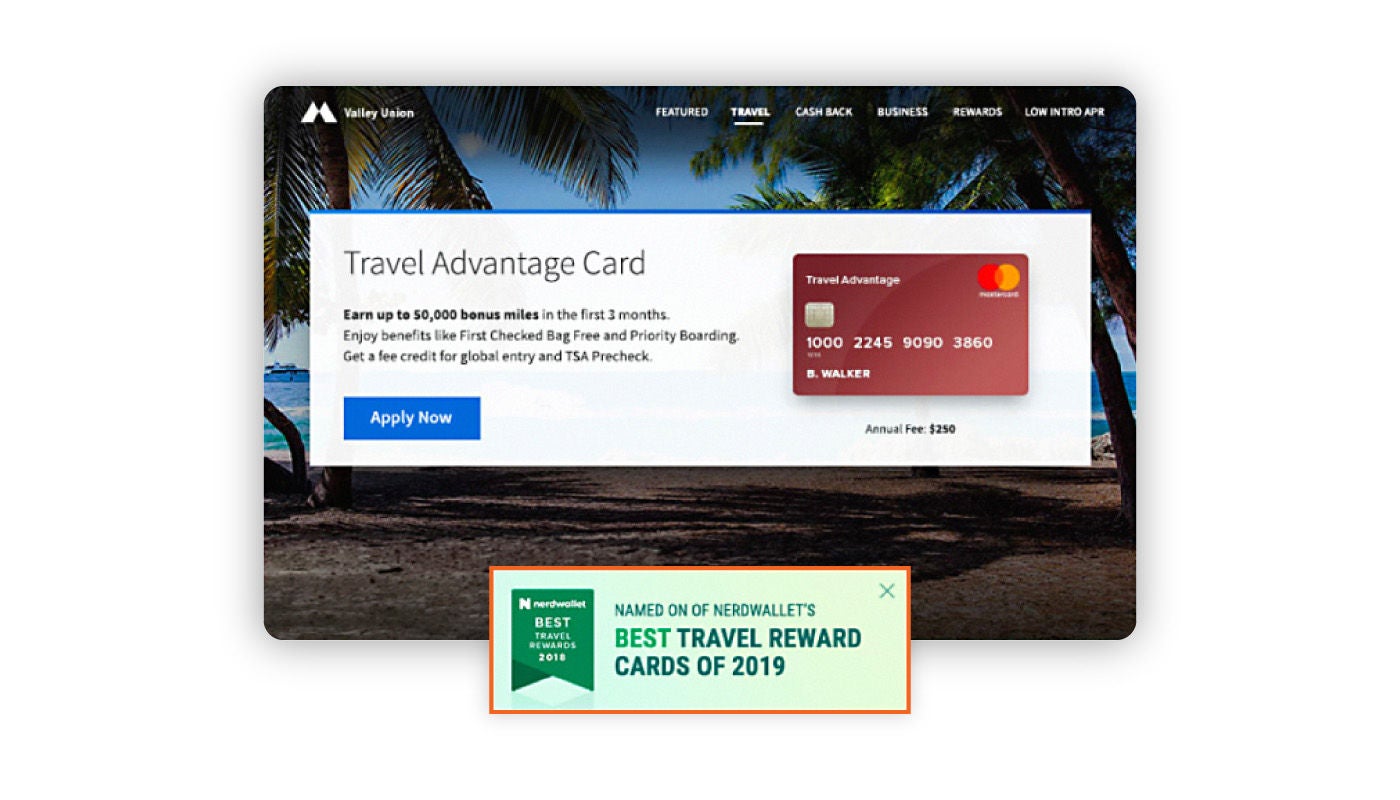
Strategy: When the early month on book users land on your website, change the hero banner to showcase messages about activation, registration and ways to spend.

Example of a personalized hero banner

See this use case in our Inspiration Library.

Recommend based on customers’ spending power and financial preferences

Primary audience: Mature customer

Hypothesis: By serving mature customers messaging about the benefits of additional products and services they aren’t currently signed up for, we believe we will increase “apply” clicks on those products.

Strategy: When a mature customer arrives on-site, showcase a product recommendations widget on their account homepage and across product category pages with additional relevant offers and services.

See this use case in our Inspiration Library.


Communicate time-sensitive offers to increase conversions from low-engagement customers

Primary audience: Declining customer

Hypothesis: By delivering special timely offers to declining customers, we believe we will create a sense of urgency and encourage them to act, increase offer CTR (and decrease decline rates).

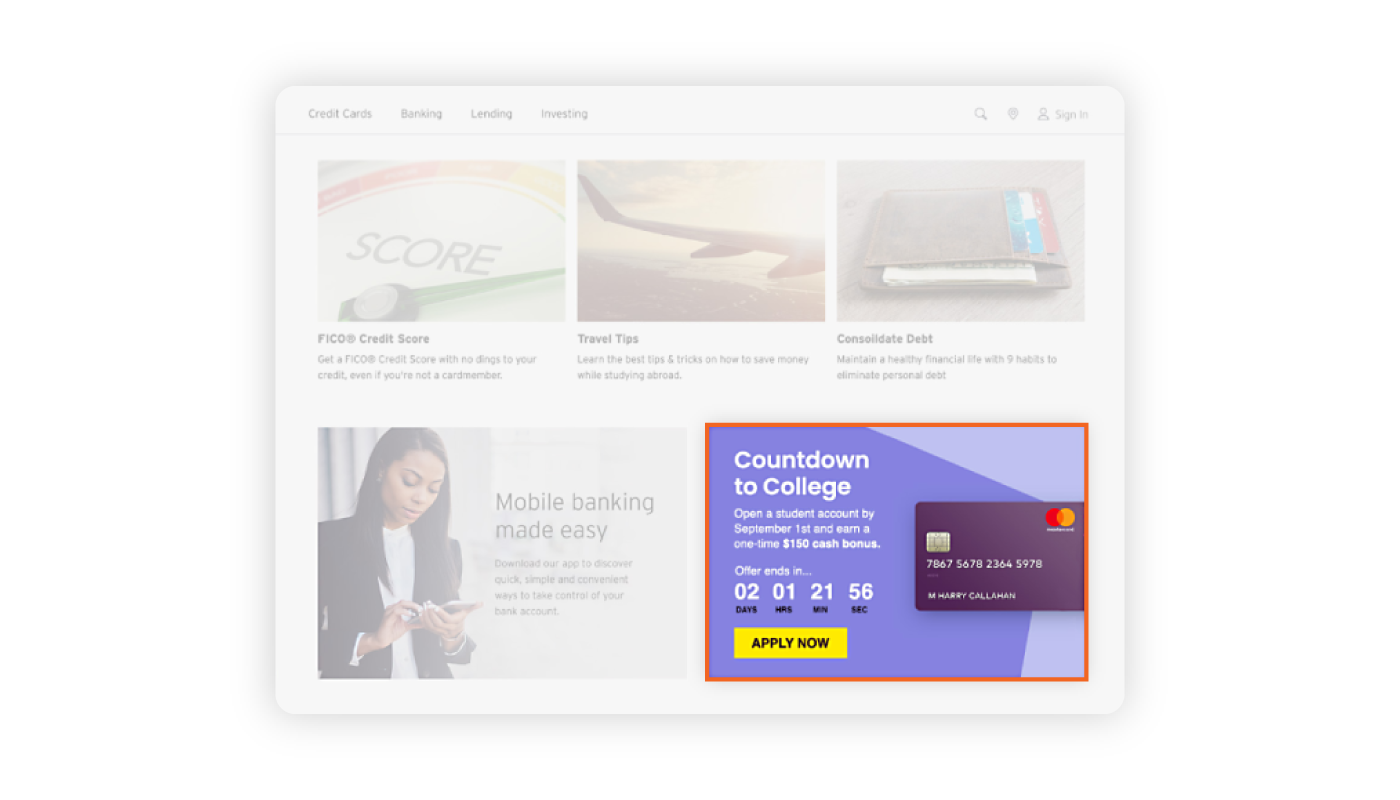
Strategy: When a declining customer lands on-site, showcase time-sensitive offers either in the form of a homepage hero banner, notification or overlay message that can include a countdown timer.

Example of a countdown banner

See this use case in our Inspiration Library.

Primary audience methodology alleviates institutional constraints to bring sustainable personalization to financial brands

To stay ahead in the competitive financial service market and unlock personalization’s power in an industry ripe with data insights, teams should focus on a process that allows them to analyze them iteratively, test new ideas and continually improve the customer experience.

By homing in on the primary audiences methodology outlined today, those within financial services will be on their way to better understanding their customers and delivering digital experiences that will provide value to both them and the business.

Contact sales

Talk to an expert to learn how Mastercard can enhance your business through our products and services.

Mastercard