See how the world’s second-largest home appliance retailer used personalisation to scale localised experiences across 63 domains and 21 markets for its 3 core brands: Electrolux, AEG and Zanussi.

Electrolux, one of the world’s largest and most recognisable home appliances manufacturers, sells appliances, spare parts and accessories on separate sites for 6 globally recognised brands including AEG, Zanussi, Frigidaire, Westinghouse and Anova. The company’s personalisation journey began in 2020 with a limited roll-out to three sites in Italy, Sweden and Germany. However, the team soon realised the enormous potential for scalability with Dynamic Yield’s Experience OS, possible even with its small central team.
This central team rolled out a global programme to personalise 63 domains, displaying products based on regional popularity and availability and seamlessly managing local discounts, currencies and images for 3 of Electrolux’s brands in 21 markets and 6 languages. The ingenuity of Electrolux’s team structure also allows the brand to manage unique regional campaigns that address more nuanced, market-specific customer needs, driving incremental revenue.
Maintaining authentic customer connections
With the size of Electrolux’s business, staying relevant to customers without losing efficiency and communication across worldwide teams and brands is challenging. Until the adoption of its personalisation programme, Electrolux’s ability to deploy meaningful personalised and localised experiences online was limited to the basics, manually managing product recommendations and their differences in language, currency and local inventory.
But to truly speak to the customer, a business needs more than the basics. Price sensitivity, tendencies with behaviour that relate back to cultural factors and even the level of service a user expects on a page can all be traced back to regional differences — differences that are critical yet difficult to address at scale.
Electrolux leveraged Experience OS to deliver different experiences to 63 domains, 21 markets and 3 brands with a single campaign, creating a scalable system that can be maintained by a central personalisation team of only two people. This frees up regional teams to get more granular and address local customer pain points, all with the same tool. Below are some examples of how Electrolux has realised successful localisation via its personalisation programme.
Electrolux’s central personalisation team uses global KPIs to identify which web experiences are valuable to deploy across all their brands. These include homepage recommendations, limited-time offer pop-ups, loyalty programme nudges and more. To deploy these key web experiences across all regions and brands, the team starts with a single campaign in Experience OS, then builds multi-language variations to hit the different locales, adjusting each variation for regionally-specific currency and targeting conditions.
The result is dozens of unique experiences, on multiple domains and brands, that run from a single, overarching campaign. This is both easy to maintain and allows the team to optimise for centrally-defined KPIs, without sacrificing awareness of the nuances of each brand and region.
These campaigns are possible because Electrolux ingested an enormous multi-language, multi-property product feed into Experience OS, a feed that contains thousands of items with over a hundred data attributes for each product. Dynamic Yield’s capability to ingest product feeds of this scale and complexity allows Electrolux to drive consistent and orchestrated experiences throughout all locales, taking into account product availability, prices, promotional offers and more for 21 different markets.
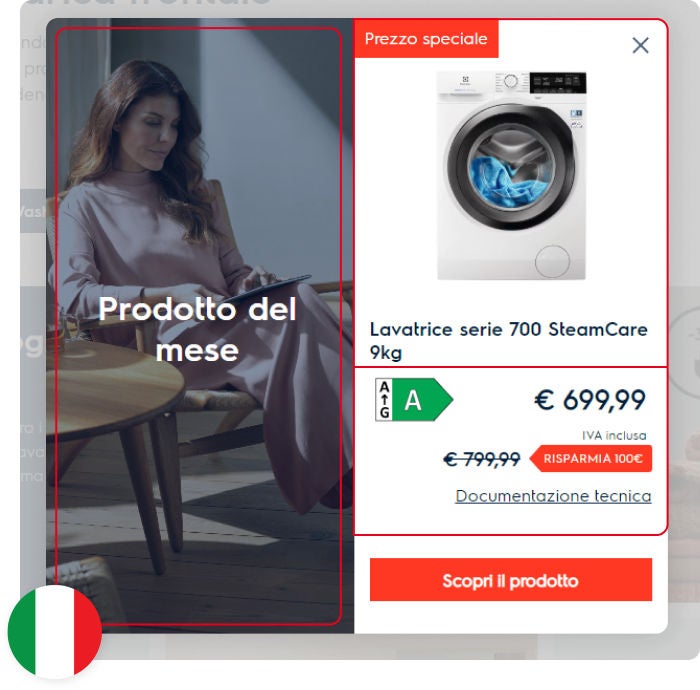
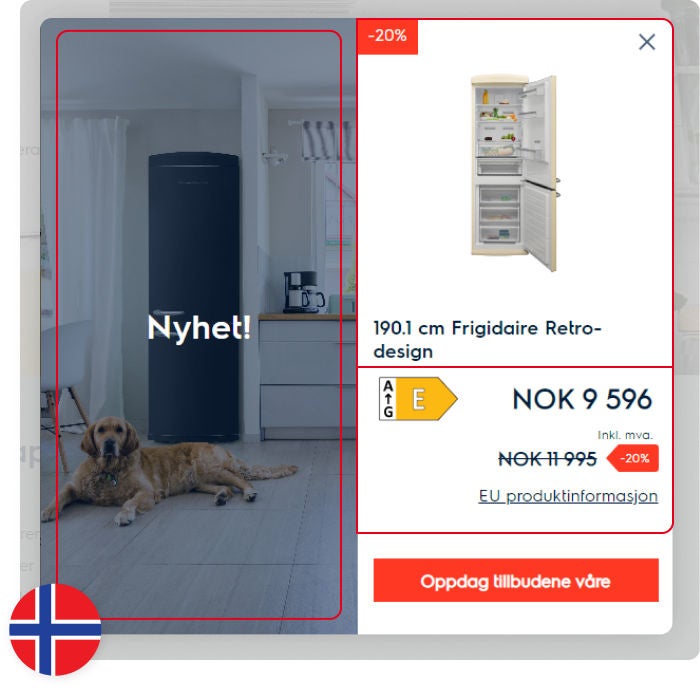
Electrolux has a “Product of the Month” promotion unique in every region. While this was a challenge to promote before personalisation, now the team swaps the promotions every month with a single, easily managed campaign. Here is an example of what the “Product of the Month” promotion looked like in Italy versus Norway:
Although these pop-ups were built from the same campaign, the result is two entirely different experiences based on the region, featuring variations in the product, copy, language, currency and size of the discount.
Almost every element in the pop-up is adjusted for the region, including the product featured, the copy, language, currency and size of the discount. This single campaign represents a sustainable way for the central personalisation team to address different market needs, pushing key products at the right time, in the right region, for less work.
Another KPI for the central team was to encourage loyalty programme sign-ups across all brands and regions. Historically, this was challenging because the website prompts involved different terms and language localisation and took frequent, manual updates to manage.
Now, the personalisation team optimises loyalty programme sign-ups from a single call-to-action campaign. Here is what the end result looked like for non-members on the Electrolux site in Italy versus non-members on the AEG site in Poland:
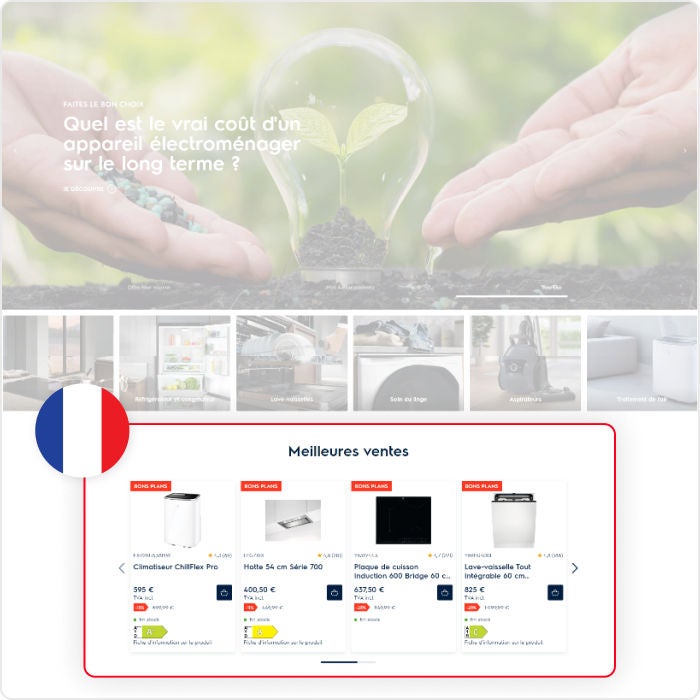
These homepage recommendations for first-time visitors were built from the same campaign, deployed with the same algorithm (Most Popular) and deployed on the same date and time. Yet, the end result reflects different local promotional policies, language, pricing, currency and products.
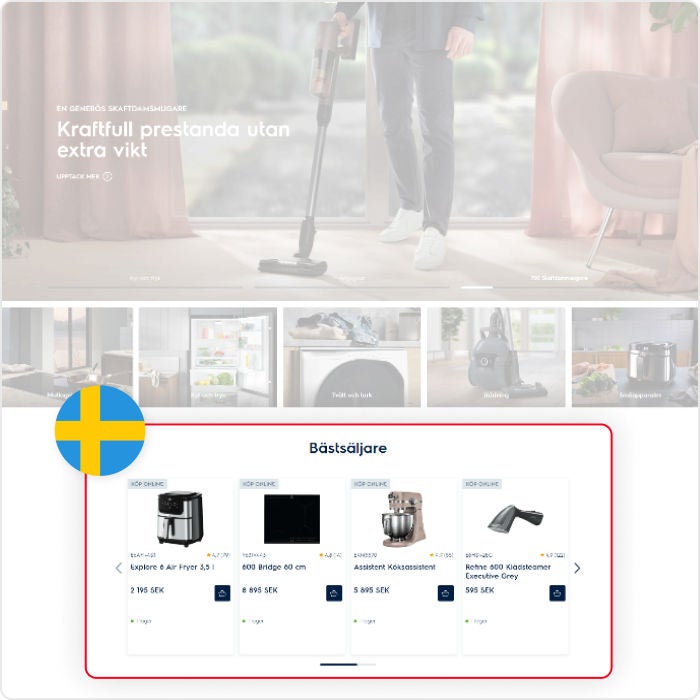
The experiences account for regional differences, showing an AC in France (where it was more relevant for the time of year) versus an air fryer in Sweden. Additionally, different currencies, languages and price points apply. Overall, this recommendation campaign delivered personalised suggestions, tailored to 63 different regions accounting for local preferences, on 63 site domains — automatically.
While the above example demonstrates Electrolux’s ability to scale a single recommendation campaign across 21 markets, it’s worth noting that the personalisation team runs dozens of recommendation campaigns across all 63 of its domains. Recommendations are deployed on basket pages, product pages and category pages and can be scaled across markets or contained locally as the team desires. The team also uses different OOTB strategies, including deep learning recommendations and some customised logic unique to their business. For instance, Electrolux uses Dynamic Yield’s Bring Your Own Logic capability to recommend accessories for items in a user’s basket, scaled across most markets.
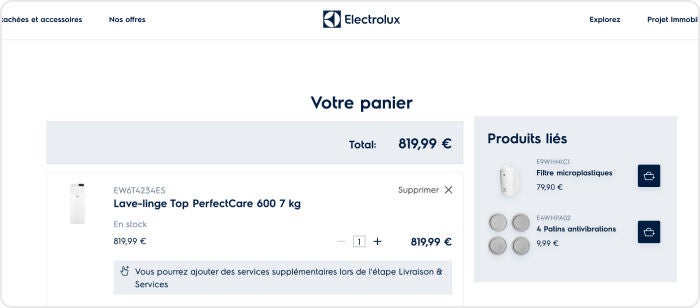
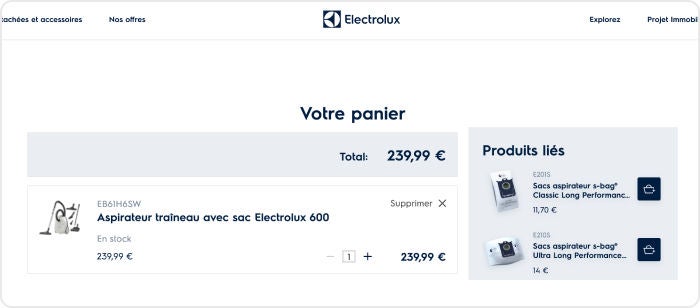
Electrolux applied customised logic to Dynamic Yield’s algorithms to recommend accessories based on items in a user’s basket. In the first image, a washing machine in the basket yields recommendations for washer pads and a microplastics filter. When a vacuum is added to the basket (2nd image), recommendations for vacuum bags appear.
Electrolux added their logic to Dynamic Yield’s existing algorithms to display only accessories related to the items in the user’s basket. This was possible because of Electrolux’s intricate product feed, which contains over a hundred data points per item and enables the team to match accessories to products. By leveraging this feed in Experience OS with unique logic applied to Dynamic Yield’s cutting-edge algorithms, Electrolux can deliver accurate accessory recommendations at scale.
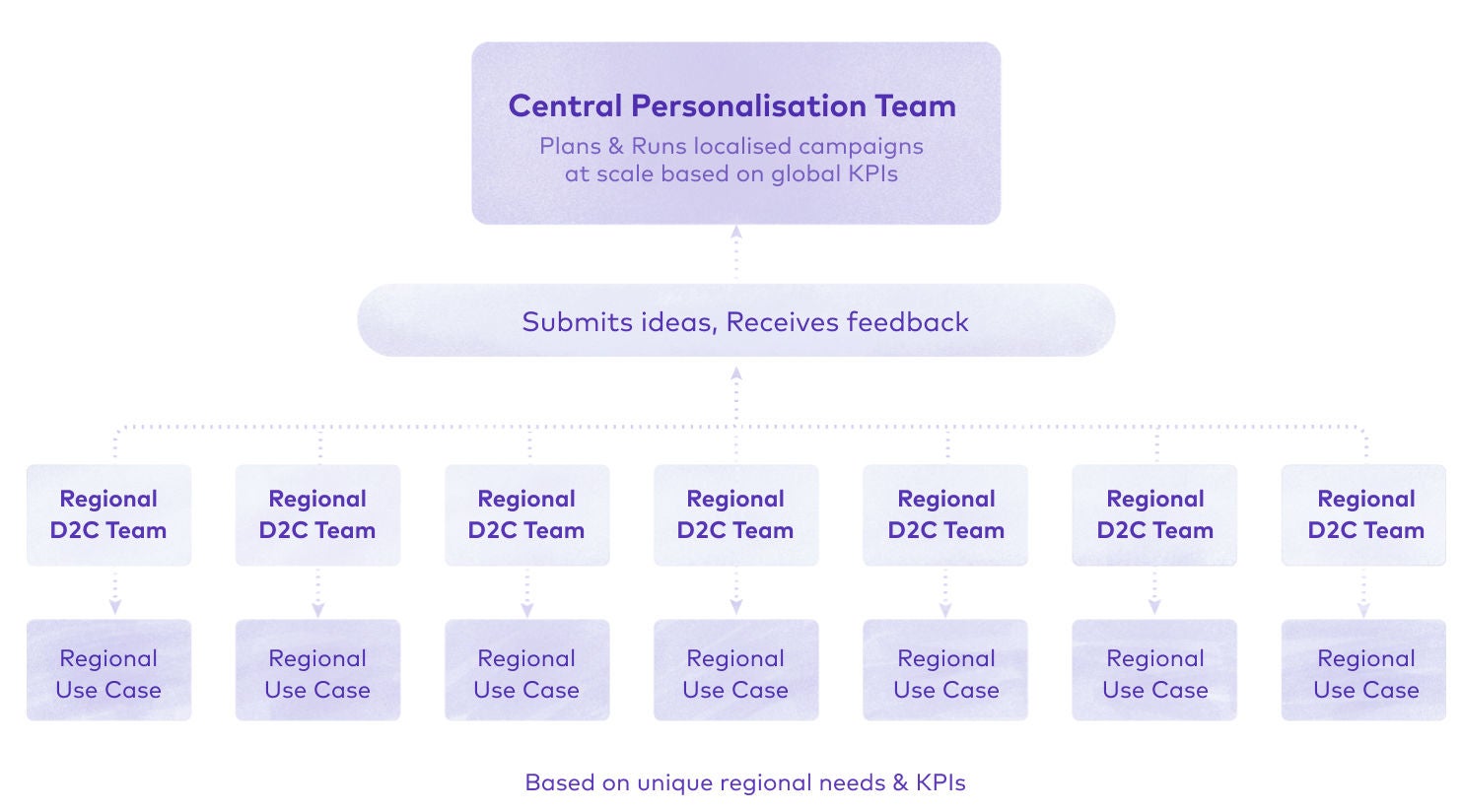
While the adoption of Dynamic Yield has empowered Electrolux with the right tool to execute localisation at scale, it wouldn’t be successful without the ingenuity of the brand’s team structure. Electrolux splits the work between a two-person central personalisation team, which oversees global KPIs and campaigns and small regional teams, which brainstorm, pitch and optimise for granular regional nuances.
Electrolux has a small central personalisation team, which runs campaigns to optimise for global KPIs across the brands and regional teams, which monitor unique customer pain points by region and deploy personalisation campaigns on certain domains to address them.
This structure has allowed Electrolux to optimise quickly despite its size, not just for universal campaigns such as homepage recommendations, but all the way down to regionally-nuanced experiences that demonstrate the brand understanding of pain points and expectations that vary for customers across the globe.
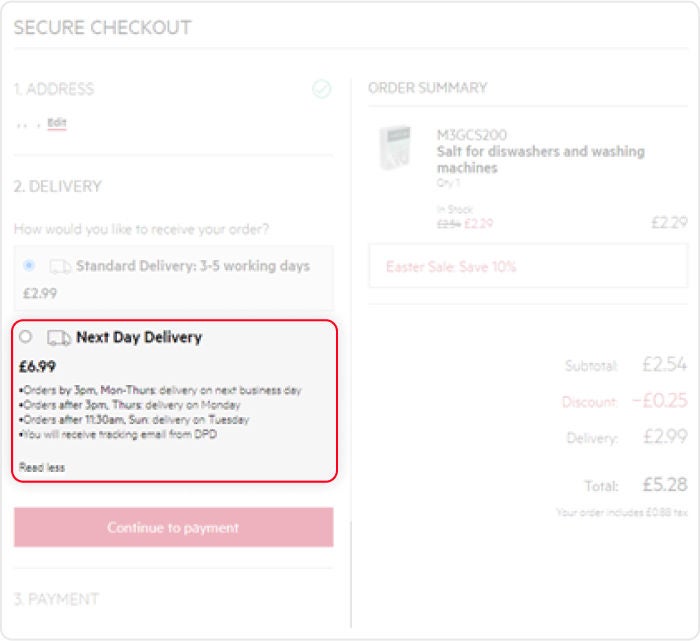
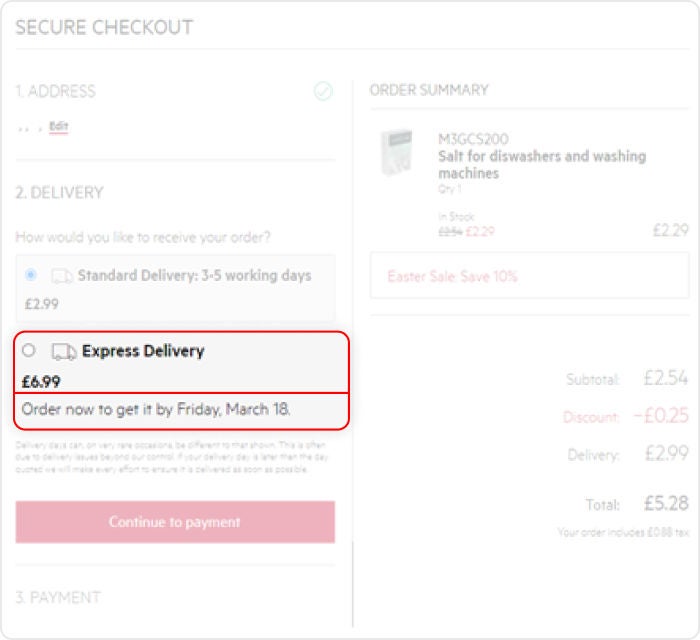
For example, the regional UK team observed that customers in this region were particularly frustrated by unclear express delivery times. So, the team deployed a campaign on the UK domains to deliver a personalised delivery date estimation based on the customer’s location, date and time of purchase.
The original experience (left) was a pain point in the UK because it lacked clarity on delivery times. The personalised campaign (right) displayed a delivery estimate based on the individual’s location, date and time of purchase, yielding an +8% revenue uplift against the original.
The personalised delivery estimate solved for this pain point and created an improved customer experience, something that was highly valued in the UK market. This campaign yielded an +8% revenue uplift when compared to the original experience.
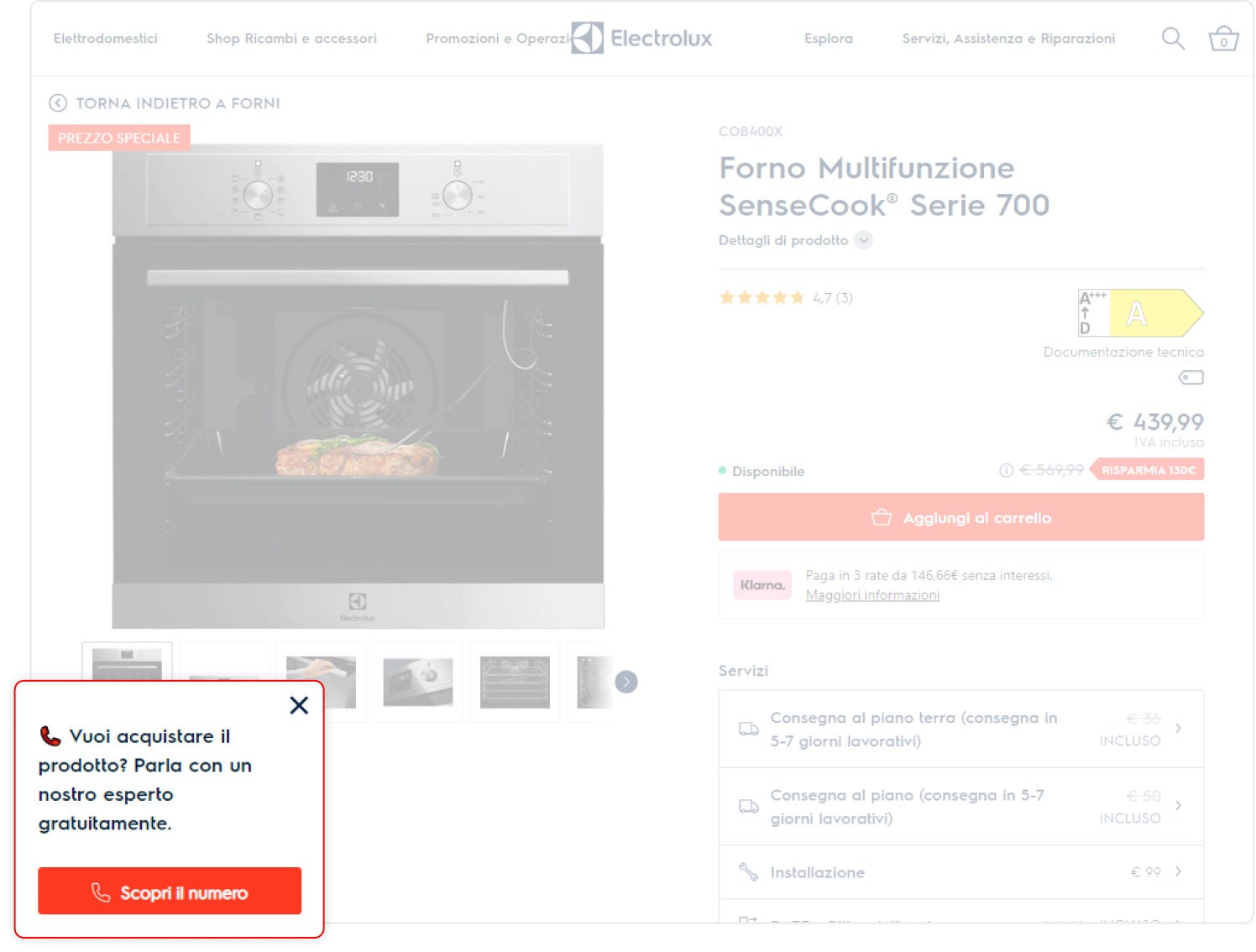
In another example, the regional team in Italy observed that live customer support was important in the Italian market, especially for appliances with a high price point. So, they built a campaign promoting Electrolux’s order-by-phone service to appear on the PDPs of high-ticket items.
This campaign promoted Electrolux’s order-by-phone service on the PDPs of high-ticket items, specifically for the Italian market, where the team observed live support was critical to close an expensive purchase. The result was a +70% increase in sales via phone compared to no promotion of the service.
This campaign was particularly effective for paid traffic and supplemented advertising campaigns with increased support coverage for products with a high price point. As a result, the Italian region saw a +70% increase in sales via phone compared to prior months when the campaign was not live on PDPs.
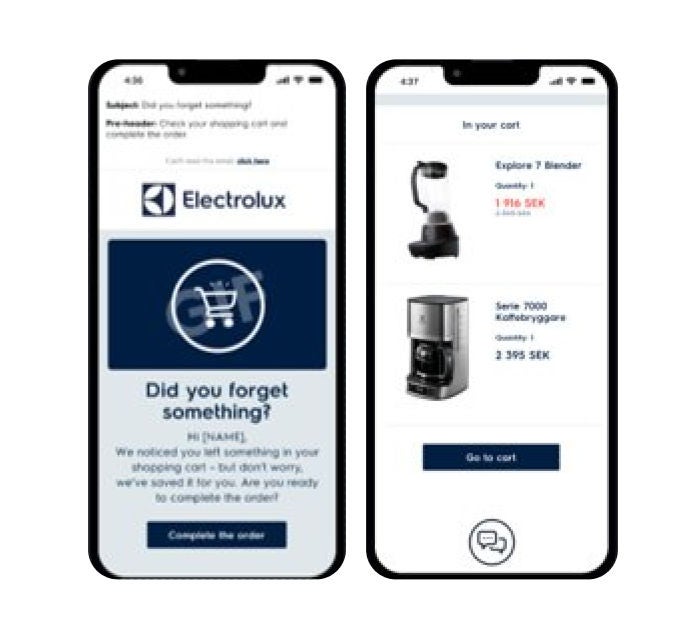
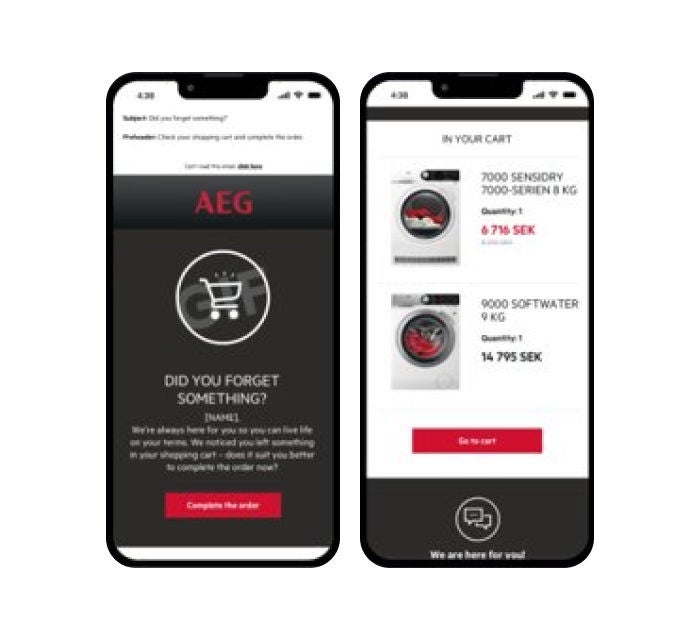
Aside from Electrolux’s sophisticated localisation programme, the team continues to push the boundaries of personalisation by introducing new channels. Electrolux recently leveraged triggered emails to re-engage visitors who had abandoned their basket, easily scaling this across brands, regions and languages.
Electrolux uses triggered emails to re-engage with visitors who have abandoned their baskets, scaled across brands, regions and languages with one tool.
With Experience OS, Electrolux is able to seamlessly deliver personalised emails at key times, improving re-engagement and reducing churn.
Following the launch of these exciting experiences and its new channel on mobile app, On plans to continue pushing the boundaries of personalisation by focusing on localisation across priority markets and developing more nuanced audience groups.
Personalisation aims to demonstrate a clear understanding of the customer and remove friction in the shopping process. For a global brand the size of Electrolux, a critical component of personalisation is localisation. Getting regional nuances right, including details in language, pricing, offers, featured products and content, all reflect the brand’s understanding of the customer and what they need.
Until the adoption of Dynamic Yield, localisation at scale was manual and limited in its scope. Now, it is possible for Electrolux to maintain localised experiences and optimise and accelerate for critical KPIs, all with the same number of resources in place.