Small business

June 11, 2026


The business of starting over

Closures, floods and other challenges tested Gloria Jeng’s business — and revealed her resilience.

google logo

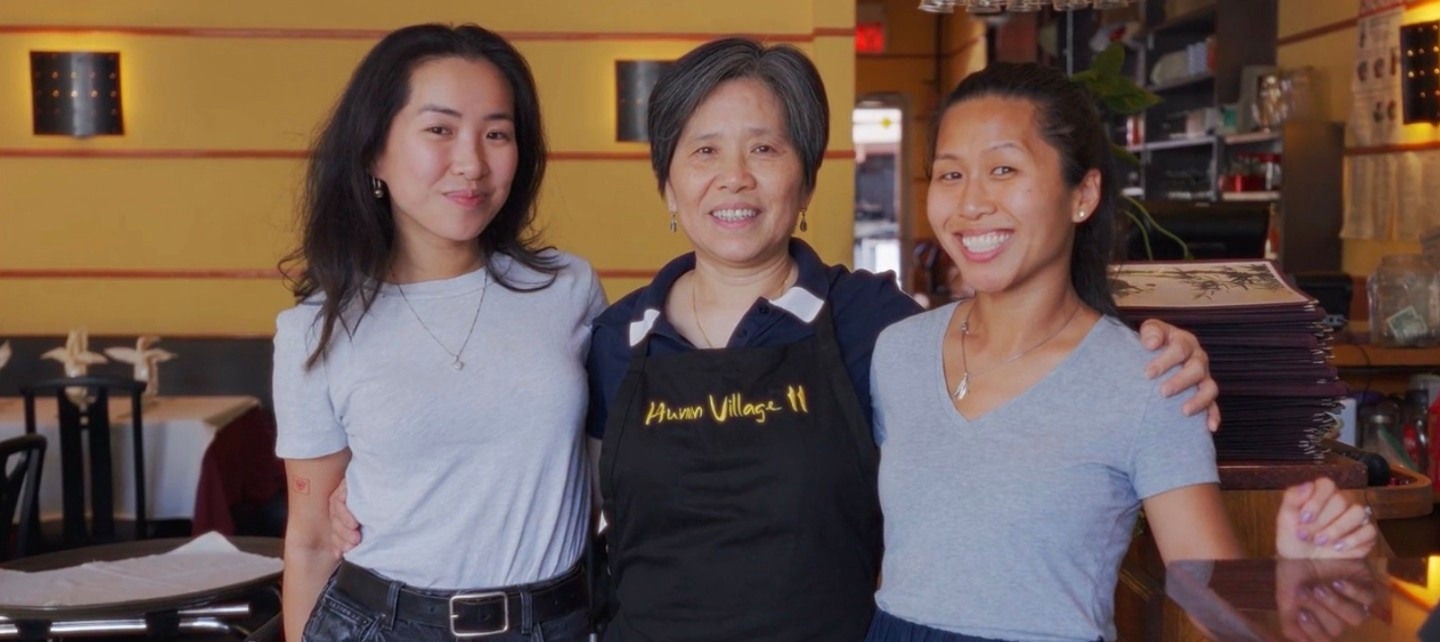
Gloria Jeng, with her daughters Jennifer, left, and Jessica, right, at Hunan Village II, a regional favorite in Westchester Country for nearly two decades. (Photo credit: Arsalan Danish)

Arsalan Danish

Director,

Global Communications, Mastercard


Rebecca Abraham

Manager, Global Communications, Mastercard

It was an opportunity born out of disaster, but an opportunity nonetheless.

When Gloria Jeng arrived in the U.S. from China’s Jiangxi Province in 1982, along with her parents and two brothers, she dreamed of becoming a nurse. But after learning English, she found a job in a restaurant and never looked back. In the 1990s she opened a restaurant in Syracuse, New York, and then another on Long Island, but they didn’t last. “I thought if I worked hard, I can make my dream come true,” she says. “But I was wrong.”

Then, in 2007, her husband heard that a long-standing Chinese restaurant in Hartsdale, New York, had been hit by a flood, and the owners of Hunan Village II didn’t want to take on the challenge of rebuilding and decided to retire. “When I first came to Hartsdale, I loved this place,” she says. “I loved the neighborhood. I loved everything here. So I took this place. That’s the opportunity we made.”


Video: Inside the mind of an entrepreneur

Like many immigrants, Gloria Jeng pursued the American dream in the kitchen, creating a path to stability for her family. Watch her share her story. 


Please accept functional cookies to watch this video.

poster


The hospitality industry has long been a pathway into the American dream. One in five restaurant industry workers are foreign-born, and nearly 38% of dining and accommodation owners were born elsewhere, according to U.S. Census figures. That’s one of the highest percentages in any industry. Yet immigrants face additional roadblocks, from language barriers to a lack of credit history in the U.S. that makes it difficult to get loans.

Traditional finance certainly felt out of reach for Jeng, so her family stepped in, including one of her brothers, a successful businessman who supported her without hesitation. By then parents of two daughters and a son, she and her husband tirelessly renovated the restaurant over nearly nine months, and then she leaned on contacts from her previous restaurant jobs, including suppliers and former employees, to open the doors.

Challenges remained, including the rising cost of ingredients and difficulty finding staff with the right customer service mindset. Then COVID-19 hit, forcing the restaurant to shut for three months. The following year, the remnants of Hurricane Ida tore through the Northeast, flooding the restaurant again. Insurance didn’t cover the damage.

Jeng rebuilt, piece by piece and person by person, getting help from her landlord, who gave her a six-month rent break; her daughters, who started a GoFundMe; and customers and neighbors who donated what they could, determined to see the restaurant open again. “They’re like my family,” she says. “When I see them, I’m happy.” 


A young girl cradles a landline phone in a restaurant.

Jessica Jeng-Mitchell, now a Mastercard communications director, learned how to work the phones in her mother's Syracuse restaurant. (Photo courtesy Gloria Jeng)


Technology has also helped her adapt, including a point-of-sale system that translates orders from English to Chinese, and online ordering, which she started during the pandemic and which now accounts for 20% of her business.

For Jeng, the restaurant has always been about something more than business. The setbacks, closures, challenges and change deepened her resilience and allowed her to build a life in the U.S., to find stability for her family, to create generational mobility.

“I want to make sure my children all finish college,” she says. “Their future has to be more successful than me. They don’t have to work as hard as me — but they have to be better than me.”

What small businesses need now: Simplicity, AI and resilience

At Mastercard’s Small Business Summit in New York City, experts and entrepreneurs shared tactics to cut through complexity, stay vigilant and keep moving.