Travel
May 11, 2026
To trace Bristol’s past and present, start by weaving through the stream of joggers pounding along the sides of the Floating Harbour at the heart of the old port city in southwest England.
Home to crowded bars and shipping-container restaurants, the docks were once the center of the lucrative maritime trade that generated wealth for the city from the Middle Ages. During one of its darkest chapters, its warehouses brimmed with tobacco and sugar that slave traders brought from the Americas.
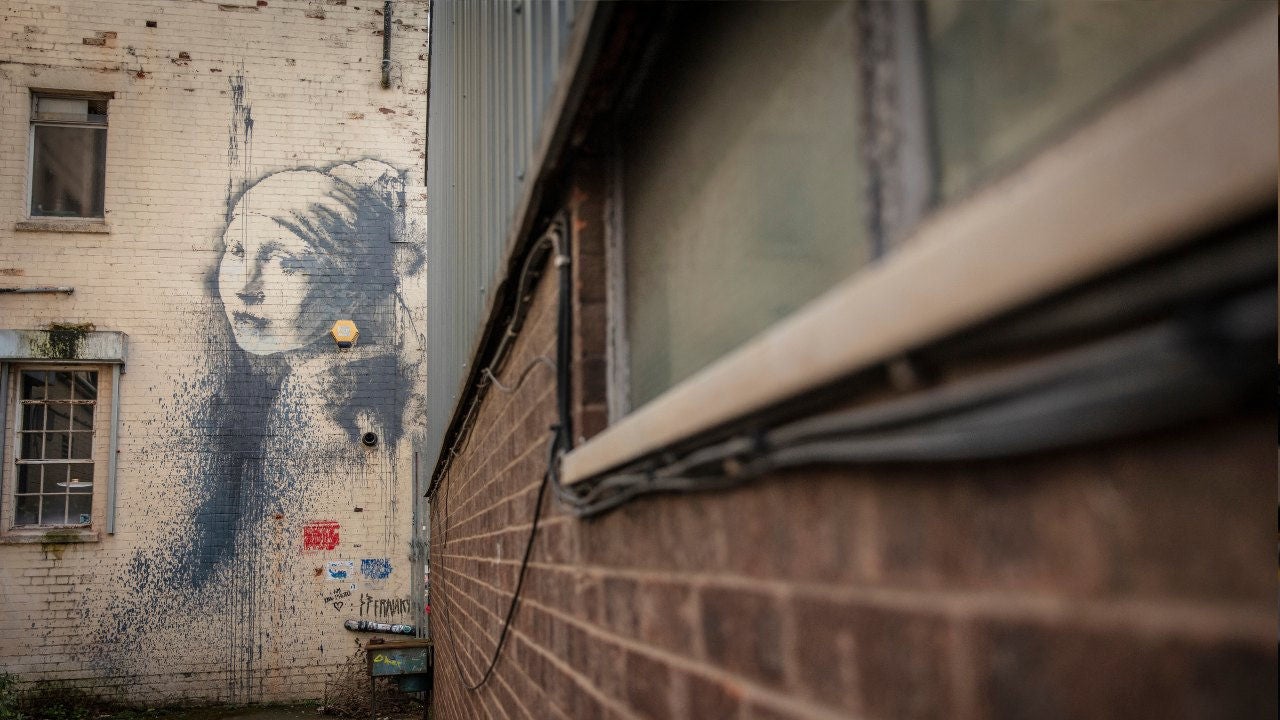
These days, the bronze statue of once-revered transatlantic slaver Edward Colston toppled into the harbor by Black Lives Matter protesters lies stained with red paint in a corner of the M Shed dockside museum. Around the corner from the SS Great Britain ship that once transformed travel to New York, gaggles of tourists now take snaps of the “Girl With a Pierced Eardrum” mural spray painted on a damp wall by Banksy, the city’s most famous — and now apparently no longer anonymous — son. In nearby Southville, the Tobacco Factory that once rolled cigarettes from American leaf is now a popular theater and bar in the fast-gentrifying area whose striking street murals helped put Bristol on Lonely Planet’s 2026 best destinations list.
Banksy's 2014 mural "Girl With a Pierced Eardrum" in a Bristol alley was inspired by the Vermeer painting but with the pearl earring replaced by a yellow security alarm.
Since the 1980s, the city of 500,000 that spawned bands Massive Attack and Portishead has cemented its reputation as a world-class creative hub and a UNESCO City of Film, producing Aardman Animations’ Oscar-winning Wallace & Gromit movies and David Attenborough’s Planet wildlife documentaries.
Now, Bristol has morphed into the best city in the U.K. for startups thanks to its thriving tech ecosystem and deep pools of graduate talent, with the wider South West region home to some 200 fintech firms.
It’s part of a growing wave of cities from Nashville and Salt Lake City to Lisbon, Istanbul and Ho Chi Minh that are fast becoming innovative ecosystems with lower costs and often better lifestyles than the big-name tech hubs. The proliferation of these smaller tech hotspots has allowed the wealth of the tech industry to spread to more locales while also diversifying the ideas and talent that can influence what the next big thing might become. In no place is that storyline more apt than this city.
“Bristol has been very good at reinventing itself,” says Tony Dyer, leader of Bristol City Council, which is run by the Green Party. “We take people as they are, and we provide the type of environment that allows people to be themselves.”
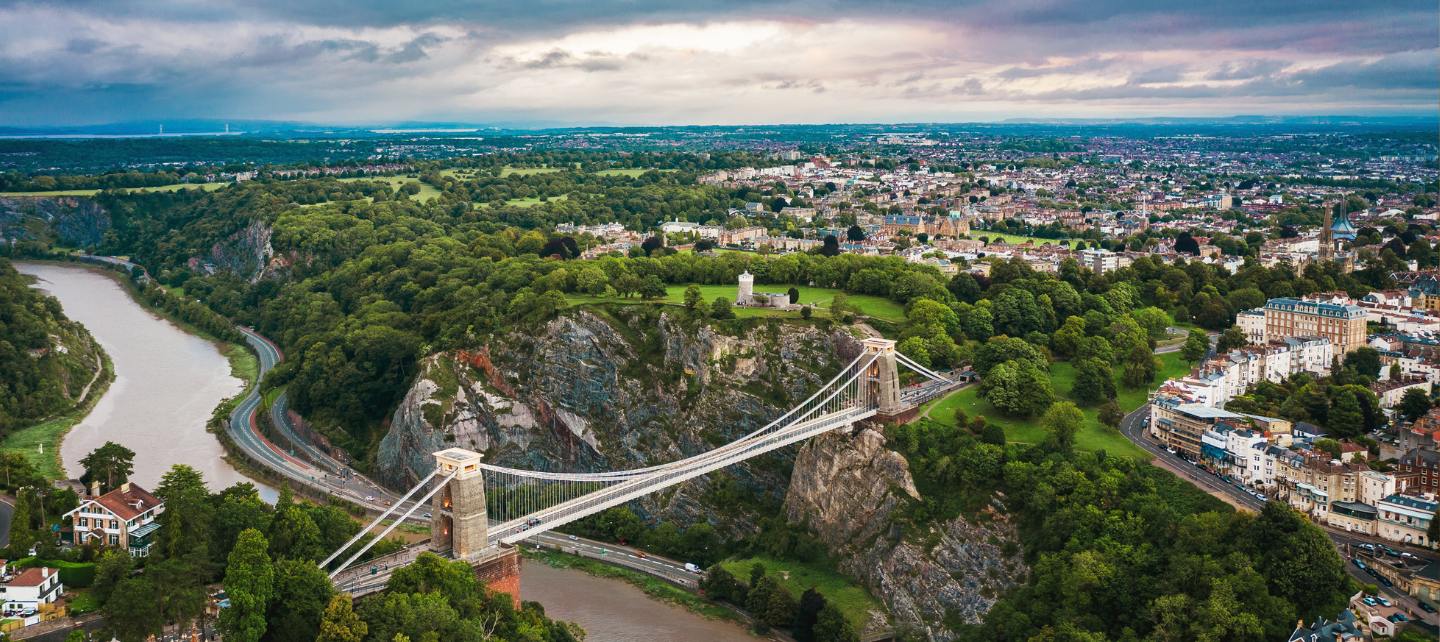
Bristol is home to a thriving street art scene, above, but is surrounded by dramatic natural landscapes, such as Avon Gorge, spanned by the famed Clifton Suspension Bridge, banner photo.
Its new facilities, such as Isambard AI, the U.K.’s fastest AI supercomputer, the Bristol Robotics Laboratory and the Science Creates deep-tech incubators, are helping lay the foundation for future tech industry growth.
But the city’s two renowned universities are perhaps its greatest assets. The University of Bristol and the University of the West of England, with a combined population of nearly 70,000, have long supported the city’s creative, aerospace and engineering industries.
Increasingly, the opportunity to build tech careers in their adopted home is encouraging more graduates to put down roots in the city with its sweeping Georgian terraces, multicultural neighborhoods and open spaces.
In fact, in recent years this city has been dubbed “Silicon Gorge,” after the deep River Avon channel spanned by Isambard Kingdom Brunel’s famous Clifton Suspension Bridge.
“It's a really vibrant, really energetic, positive place,” says Briony Phillips, founder of the Bristol Business Bugle newsletter, “with people who are so generous in the way they support one another and enable business growth to happen.”
For a midsized city, Bristol punches well above its weight. With half the population under 35 and nearly 60% of working people holding a degree, it’s building the skilled talent and high-tech infrastructure to determine its future.
As Iranian student Mohsen Ghotbi headed into the final stretch of his MBA at Bristol’s UWE, he grabbed the chance to get hands-on experience with a tech firm at the university’s adjoining Future Space innovation center. Later, when a full-time job opened up at Silent Sensors, he already had a relationship with the team and was hired in 2024 as an engineering project manager to help develop its smart tires and work with UWE interns.
“Before choosing to come here, I did research into universities and one positive factor was that this is a city active in developing tech,” says Ghotbi in the airy Future Space center.
Established a decade ago on Bristol’s outskirts, Future Space is shaking up university models by putting high-tech businesses on campus so startups can tap into UWE’s resources and talent, benefiting students like Ghotbi.
Future Space founders, who are largely focused on health, advanced engineering, AI and green tech, can rent shared labs and workshops, work with UWE interns, and get the wraparound support they need to build businesses.
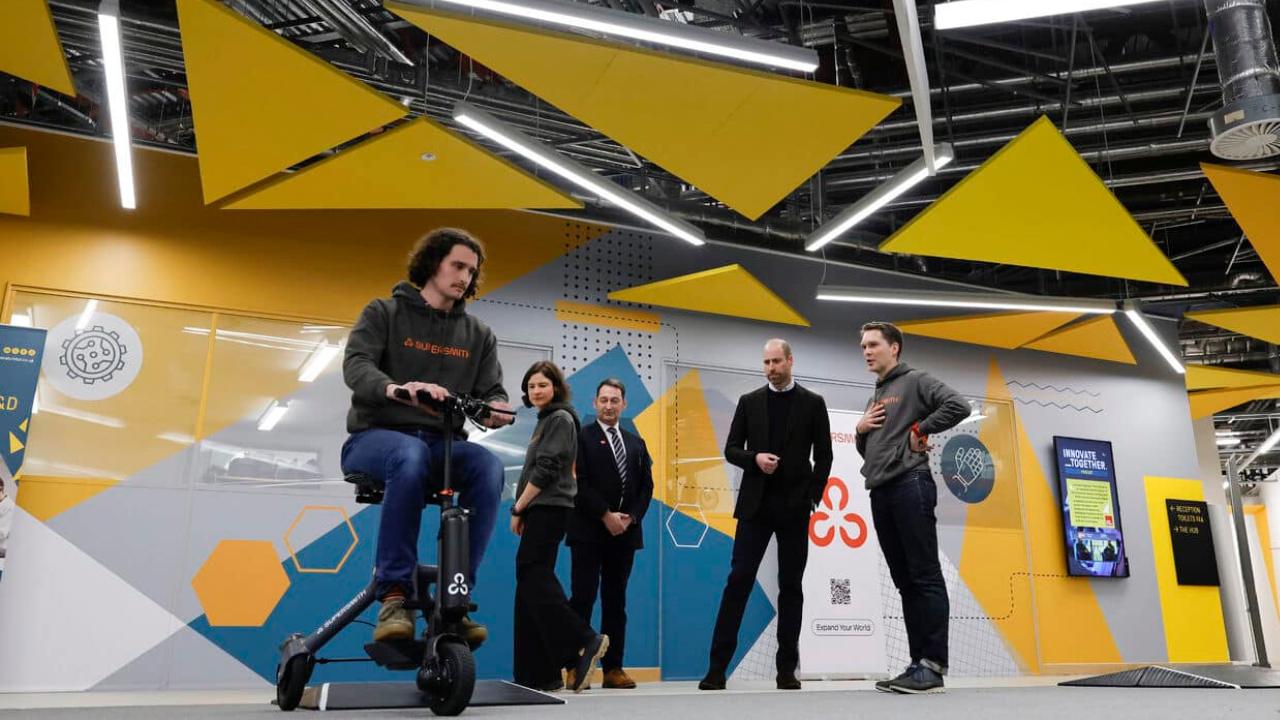
At UWE Bristol's innovation center Future Space, Supersmith founders Tom and Emily Morgan, right and second from left, respectively, show off their self-stabilizing 3Scooter, designed to improve mobility and independence for people living with MS and other disabilities, during a recent visit by Prince William, second from right. (Photo courtesy of Future Space)
Bringing everything under one roof gives UWE students the chance to create their own ventures and helps future-proof their careers by preparing them for the tech challenges and workplaces that are invariably being molded by AI.
“What the best universities are doing right now is recognizing that you can’t tinker any more, it’s about rethinking what a university is,” says Matt Freeman, the center’s director. “That means a model that’s much more commercial, that puts innovation front and center.”
It’s a strategy that’s so far paying off. Around 600 jobs have been created by the 200 companies Future Space has supported since it started.
When Elliott Herrod-Taylor contracted sepsis from a rare spider bite, he was forced to abandon his professional rugby career and opted to go to the University of Leeds where he ended up grappling with the shared bills for his nine roommates.
Uninspired by his degree course, he began devising ways to make it easier to manage the payments. Drumming up a business plan, he eventually got funding and moved to Bristol 10 years ago to set up his fintech company, The Bunch, which helps users turn their household bills into a simple payment.
Now, employing 40 people to handle 20,000 customers, he’s seeing more local funding and support for Bristol companies from venture capital investors who regularly make the 120-mile journey west from London to meet startups.
“There’re some really good incubators and quirky people who start businesses … you’re not having to be in London to get capital anymore. You can easily find good talent,” Herrod-Taylor says.
But the city needs to lure heavyweight investors away from the so-called “Golden Triangle” of London, Oxford and Cambridge if it wants to graduate from being a successful startup nursery to a destination for business growth.
That’s why the UK government’s British Business Bank recently organized its first pitch competition for the city, convincing some 160 investors to leave London to hear 40 founders make their five-minute elevator pitches for funding.
It was a chance to take investors on a whistle-stop tour of the city’s growing AI and tech infrastructure, as the BBB looks for ways to boost the amount of capital available for innovative companies to start and then scale.
"The issue that we then see in the UK is that … when they get to a scale that they need to raise a really, really significant amount of money, we tend to lose them at that point to the U.S. and other markets," says Ed Tellwright, BBB’s senior manager for the South West. “Having that infrastructure here helps those businesses develop and grow and stay.”
Starting life in a refurbished shipping container near Bristol’s Temple Meads station in 2017, cybersecurity firm Immersive Labs moved around the city five times in six years as the startup rapidly expanded. The company that runs cybersecurity drills to measure how companies handle simulated attacks now counts Mastercard as a partner and has expanded to employ 300 people globally with a U.S. office in Boston.
For Immersive’s Bristolian founder James Hadley, his hometown’s infrastructure, international airport and growing tech ecosystem made it a logical place to start and scale up his business.
High numbers of graduates from Bristol’s universities now staying in the city make it easy to find interns and recruit staff to train companies how to manage, respond and recover from audacious AI-powered attacks.
“It was another reason we chose it because you have a lot of tech talent coming out of UWE where we hire people from,” Hadley says.
With threats evolving quicker than academic qualifications, Immersive’s free Cyber Million platform aims to tackle skills shortages by helping people develop the knowhow they need to get cybersecurity jobs.
“Bristol is quite a free-spirited city… people generally aren’t stuck in their ways, they’re keen to help others, they’re keen to learn,” Hadley says. “And I think that adaptive mindset is something that suits a scale up.”
Sitting around a table plastered in yellow Post-it notes at the University of Bristol's Centre for Innovation and Entrepreneurship, four students brainstorm how to highlight emerging global disasters by using AI to analyze social media feeds.
“The idea is to expose humanitarian crises before general news would be able to by using videos people upload online,” says one 22-year-old student.
Thinking creatively to tackle real-world problems and devise solutions is at the core of the University’s four-year master’s program, which lets students combine innovation with one of 14 other disciplines. To help turn ideas into potentially bankable projects, the Centre’s Runway pre-incubator program offers support from mentoring to pitching their projects at its innovation showcase. Over the last four years, it’s helped the Centre’s startups raise some $50 million.
“There’s a lot of problem-based learning rather than just transfer of theory,” says Tom Ellson, the center’s director who previously worked in corporate finance.
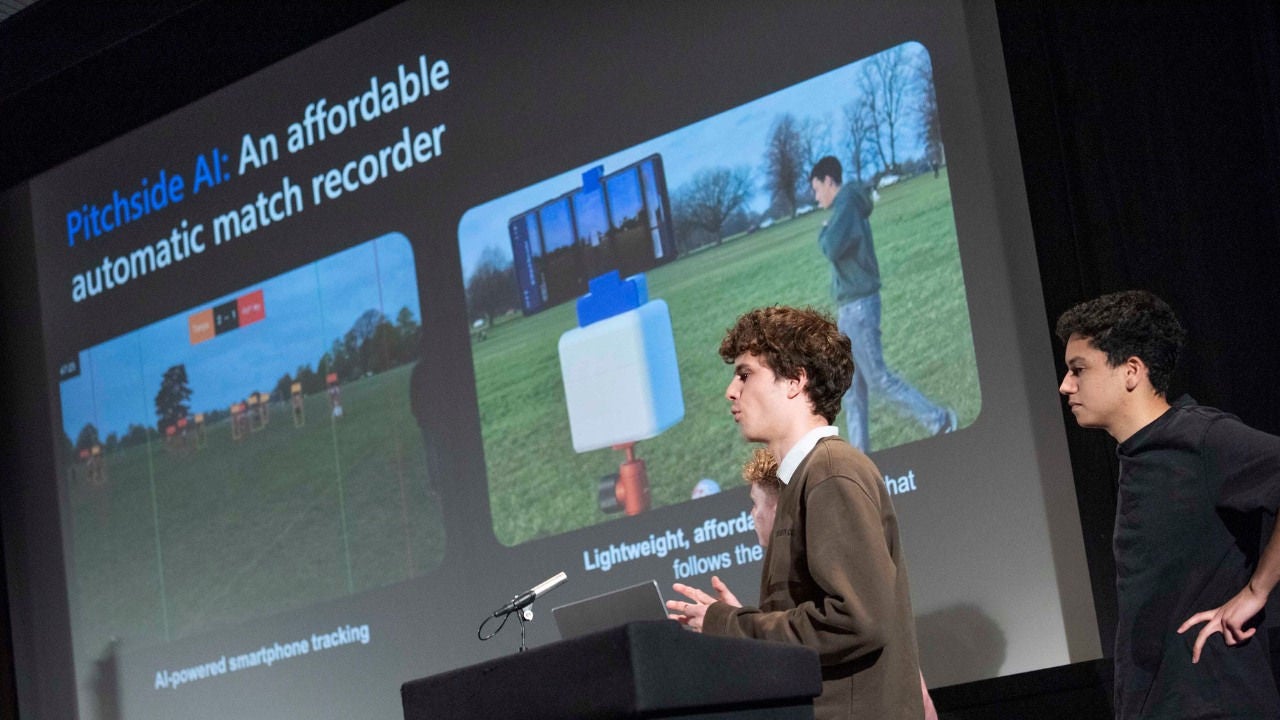
Three founders of Pitchwise — friends who met playing football at the University of Bristol — pitch their AI-powered soccer tracking solution. A pre-incubator program at the university's Centre for Innovation and Entrepreneurship helped them take off. (Photo courtesy of the University of Bristol)
Among its success stories, PEEQUAL, created by a physics student and an anthropology student frustrated at the lines at festivals for women’s toilets, has won financing to build women’s urinals that have now been used over a million times. And student startup Pitchwise is using its funding to develop its soccer app on the Isambard AI supercomputer.
Despite Bristol’s growing ecosystem, some startups still need to look further afield for the financing they need. Kaedim, which worked with Bristol’s Aardman to develop its creative AI tools, has moved to California to scale up.
The Centre, now the fastest growing part of the university, is planning to move to the city’s regenerated Temple Quarter (an area once filled with gasworks, warehouses and workshops) next year. That will bring its startups closer to a critical business sector and make them more visible to investment funds.
“When diversity coalesces, you get much better creativity. You also get people thinking more critically about things,” says Mark Neild, a Royal Navy helicopter pilot turned management consultant, who now leads the Centre’s Runway program. “You've got different perspectives … and it builds.”
Backed by a bank of washing machines, Matter Industries’ Anthony Kolanko picks up a petri dish to point out the small heap of blue microfibers that are shed with each load. Opening one of the cylindrical water filtration units being tested on each machine, he explains how Matter’s self-cleaning technology traps the damaging microplastics being rinsed into waterways.
Soon, giant black-drum shaped filters, like the prototype dominating Matter’s industrial unit, will be shipped to textile manufacturers in countries including Egypt to help cut microplastics, costs and water use in one of the most polluting industries.
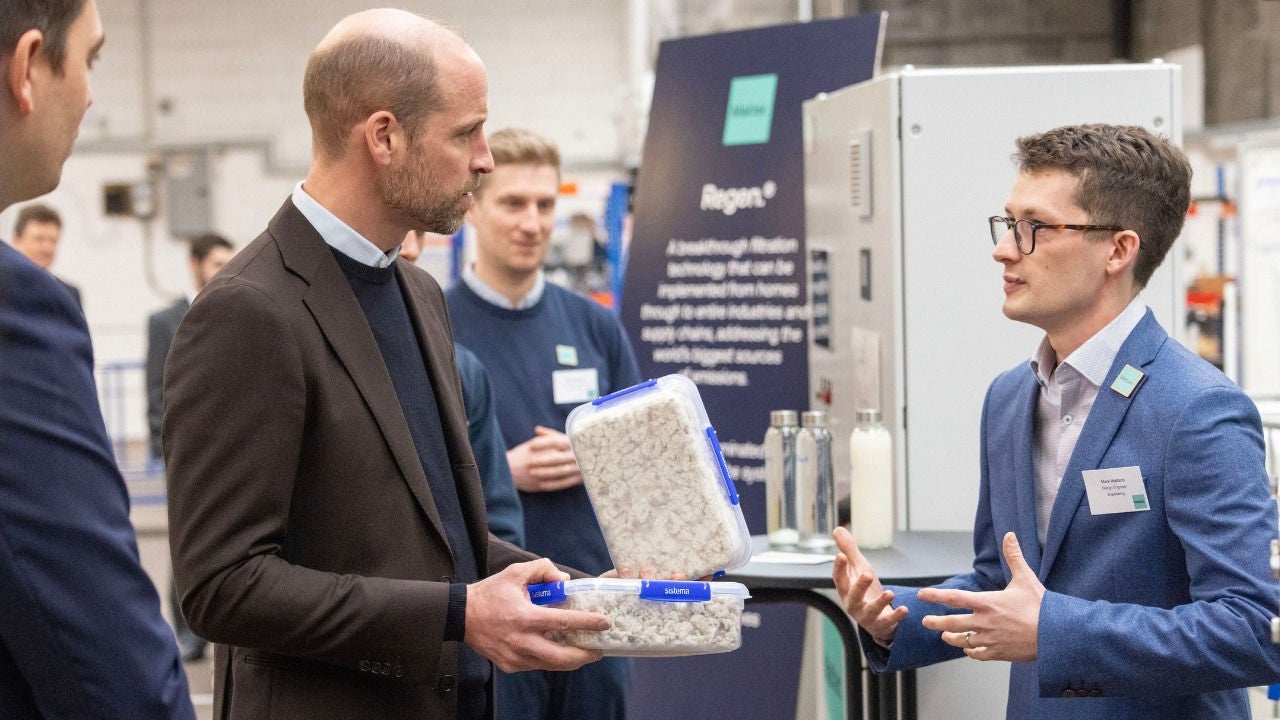
Prince William, left, visited Bristol's Matter to learn more about its water filtration technology designed to capture microplastic fibres released during washing and prevent them from entering waterways. (Photo courtesy of Matter)
Matter was recently recognized as a finalist at the Earthshot Prize awards, of which Mastercard is a founding partner. For Matter, Bristol makes an obvious base due to its strong engineering and environmental credentials and well-qualified workforce.
One of the 200 businesses to emerge from UWE’s Future Space, Matter now employs 35 people and counts Earthshot founder Prince William as a customer. It invites its investors, which include Sweden’s IKEA Group, to its office in the corner of a Bristol industrial estate to see firsthand how its improving global water circularity.
“There’s this real incubator hub vibe for new business, engineering, environmental consciousness. It’s just that young energy as well,” says Kolanko, Matter’s chief revenue officer. “If you have a collection of businesses similar to Matter in terms of energy problem-solving … then it can only bring excitement from people on the outside looking in.”