July 22, 2026
In today’s one-touch digital world, where a ride or a meal can be ordered and tracked real-time, the reality is that payments don’t always reflect the ease of these other digital experiences. The speed of electronic payments are dependent on a country’s payments infrastructure, with some processing transfers only once a day or not processing electronic payments at all at night or on weekends. This delay can create significant uncertainty. That’s why countries are investing in infrastructure to enable real-time payments between bank accounts that reach the payee mere seconds after the payer hits send.
But speed is only part of the reason countries are investing in real-time payments. Here’s a closer look at real-time payments, from how they work to why they matter and where they could take payments next.
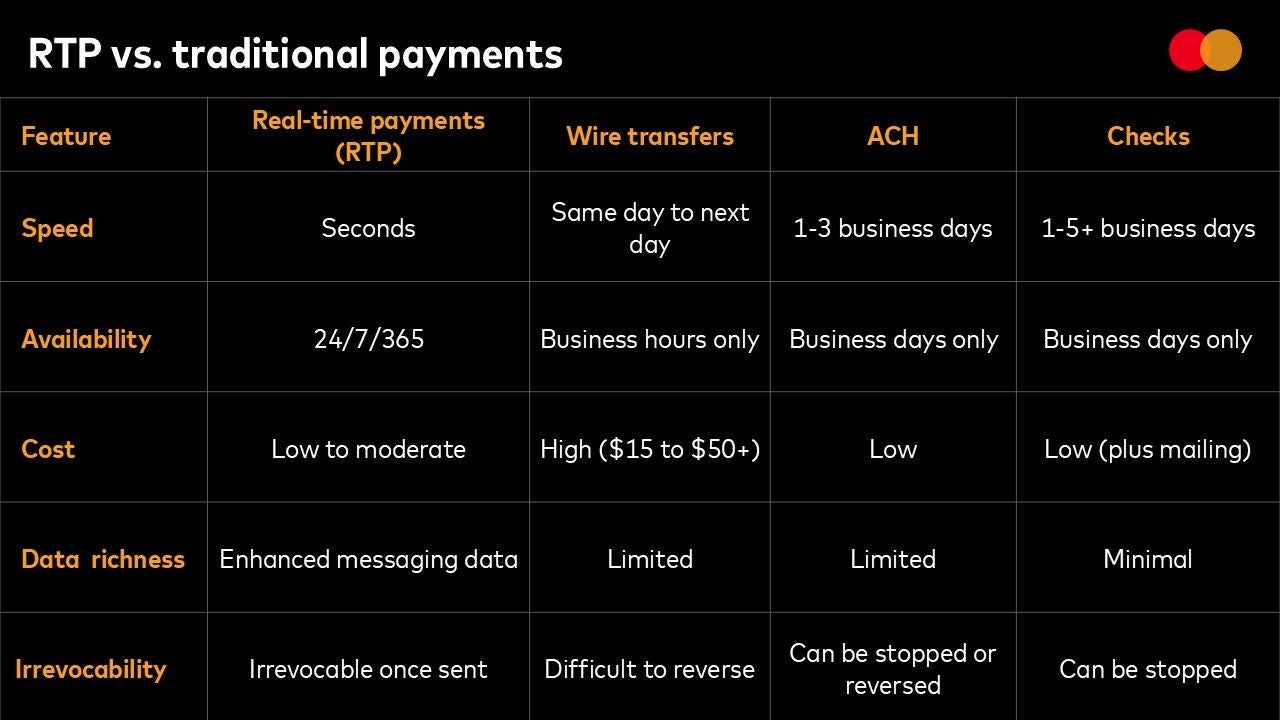
Real-time payments are payments made between bank accounts that reach the recipient within seconds, at any time of the day or week, holidays and weekends included. This improves transparency and confidence in payments, helping consumers, banks and businesses manage their money.
Real-time payments are available in more than 70 countries on six continents. Real-time account-to-account volumes were up 40% year over year in 2024, according to a BCG September 2025 global payments report, and now make up about a quarter of global retail digital payments.
Japan's Zengin system started processing payments in real-time speed in 1973, but it only went 24/7 in 2018. Switzerland followed in 1987, and the pace When Mastercard helped Thailand launch its real-time payments service, PromptPay, in 2016, digital transaction volumes were low. In 2025, PromptPay supported peak daily volumes exceeding 80 million transactions. Year-over-year growth is an average of 10% to 15%. Additionally, real-time payments systems became inter-regional: Singapore's PAYNow linked its platform to PromptPay in 2021, enabling cross-border real-time payments to be sent using familiar domestic payment identifiers, such as mobile number, giving the same simple user experience as domestic payments.
The benefits of real-time payments in terms of speed were underscored by the slow rollout of stimulus checks in the U.S. in the early days of COVID-19. Speed is also key in disaster relief, when brick-and-mortar banks are closed and people depend on cards and mobile wallets to receive aid.
But payment experts will tell you that speed is almost beside the point. Immediate payments with instantaneous clearing and settlement reduces the amount of money locked in processing, improving cash and liquidity optimization for businesses and giving consumers a much clearer picture of their finances.
Real-time payments are also transmitted in tandem with more data formatted to a global messaging standard. This gives businesses the ability to automatically reconcile payments, improving efficiency in the back office and making it easier to resolve errors and reduce processing delays. A 2023 report shows that the average per payment cost of a rejected or repaired payment was $12.10.
And these real-time payments are irrevocable, making it harder to renege on contracts and encouraging other innovations to improve efficiencies, such as payment on delivery.
Some countries also see payments modernization as the path to wider financial inclusion. In addition to real-time payments, Thailand's PromptPay gives all citizens the ability to make and receive payments using their phone number, citizen ID or a QR code, helping connect more unbanked people to the financial world. In addition, the Thai government is also able to provide benefits and tax rebates to citizens quickly.
Fraudsters are always trying to find ways to exploit new technologies. With the introduction of real-time payment systems, new kinds of fraud rose, such as authorized push payment fraud. That's when a fraudster tricks their victim into transferring funds into their account by pretending to be a legitimate payee, such as a business.
Real-time payment systems employ multiple layers of fraud detection and prevention. They include machine learning algorithms, which analyze transaction patterns to identify anomalies and flag suspicious activity in milliseconds; behaviorial analytics, which monitor user behavior to detect unusual urgent requests and fake invoices; and real-time risk scoring, which assigns risk scores to transactions based on multiple factors, enabling instant approval or flagging for review
Some governments are considering legislation to ensure more support for victims. For example, in the U.K., frameworks like Confirmation of Payee have been rolled out to check account details instantly against the name of the account holder and help prevent cases of authorized push payment fraud. The EU has introduced Verification of Payee, a similar requirement, which is live in Euro countries and is being rolled out more widely by July 2027.
Mastercard has developed Consumer Fraud Risk, an AI-powered solution scans multiple data points to alert banks of fraud risk posed by authorized push payment fraud. Consumer Fraud Risk can stop scams before money leaves the sender's account. It’s live in the U.K. and is expanding to other markets.
Near-immediate receipt of payment fundamentally changes how businesses and consumers manage their finances. The enhanced cash visibility enabled by real-time payments enables more accurate financial planning, reduces the need for expensive credit facilities to cover payment gaps, and allows treasurers to optimize working capital in ways that batch processing never permitted.
The end of checks has long been forecast. The U.S. is one of the few countries that remains somewhat reliant on checks, but even there, they have been in decline for decades. In just the last decade, the number of commercial checks collected through the Federal Reserve dropped in half, from 5.7 billion in 2025 to 2.8 billion in 2025.
However, they can be both costly and slow to process. Electronic bank payments and cards are making inroads, and the pandemic lockdowns, which resulted in millions of checks languishing for weeks or months in mailrooms, underscored the need to move away from paper-based payments.
Peer-to-peer payments, in which people directly pay one another from their bank accounts via an app or wallet, have been integrated with real-time payments, raising consumer expectations for payment speed. Many countries have started their real-time payments journey with P2P payments.
Real-time payments can also make it easier and faster for people to pay bills, and can be used for retail payments, like shopping on e-commerce marketplaces directly from their bank account. Further it can be used to make reimbursements — for medical claims or insurance — and government payouts to its citizens easier and faster. In B2B payments, RTP could also be used to streamline supply chain finance, notoriously paper-heavy, which could ease gridlock gridlock in supply chains.
This story was originally published Nov. 9, 2022 and was more recently updated on July 22, 2026, to reflect updated usage figures.