Article

Open banking to open finance: The evolution of financial data

Published: June 17, 2026

template

Financial data sharing is evolving beyond open banking and into a broader, more connected era known as open finance — a shift that’s redefining how you can access, use, and benefit from your financial information.

If you’ve ever tried to piece together a full view of your financial life, you know how scattered it can feel — accounts in one place, investments in another, insurance somewhere else, and maybe a pension you haven’t checked in years. It adds up. 

Open banking helped simplify part of that picture by unlocking secure access to bank account data. But today, financial lives are more complex — and expectations are even higher. People want services that feel connected, personalized, and aligned with their goals. That’s where open finance comes in.

Let’s take a closer look at how financial data is evolving from open banking to open finance — and what’s coming next.


How financial data is evolving

Financial data is expanding fast. What once centered on bank accounts and transactions is extending into investments, pensions, payroll, insurance, utilities, and more. According to our recent research with Financial Times Longitude, consumers are increasingly willing to share this information — as long as it’s secure, transparent, and tied to meaningful value. In fact, we’ve reached a clear tipping point: 76% of consumers are ready to switch financial providers for better digital money management features.

This shift is redefining how financial services operate. With open banking and open finance, businesses and financial institutions can build experiences that reflect more of a person’s financial life, not just a narrow slice of it. And with that, consumers gain access to more personalized, more intuitive tools that help them make smarter financial decisions with confidence.


Open banking vs. open finance

What is open banking?

Open banking allows people and businesses to permission access to their own account and transaction data. It marked a major leap forward for financial services, making it easier to: 

  • See financial accounts in one place 
  • Use budgeting and money management apps 
  • Streamline account opening experiences  
  • Make account-to-account payments through trusted third parties where supported

How is open finance different from open banking?

Open banking has sparked competition and innovation — but it still captured only part of someone’s financial world. In that way, open finance builds on the foundation of open banking by extending data-sharing principles to a broader range of financial products and services.

What is open finance?

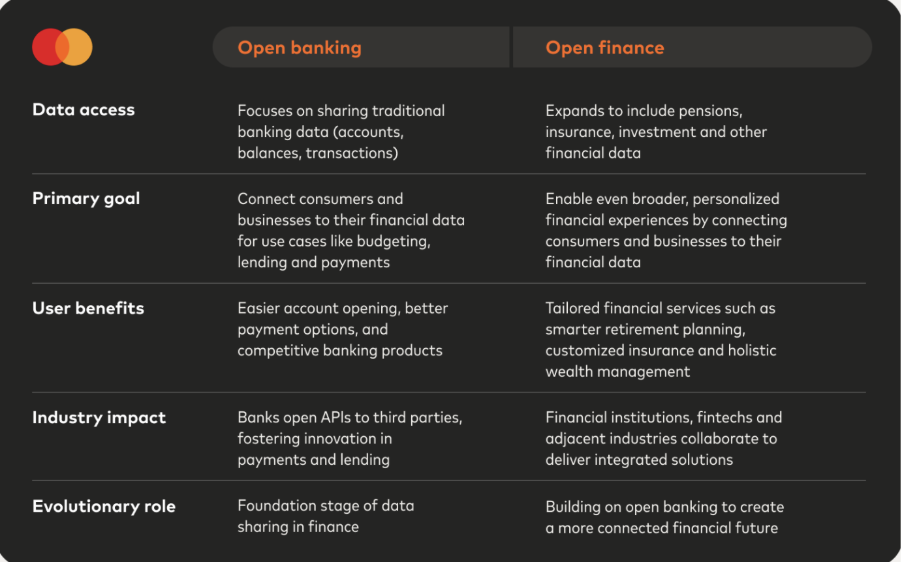
While open banking focuses on securely sharing traditional banking data — such as account balances and transactions — open finance extends this access to a broader range of financial data such as pensions, insurance, investments, and more. 

The result is a broader ecosystem where consumers and businesses can benefit from highly personalized financial services, from smarter retirement planning to tailored insurance products. In that way, open finance is the natural evolution of open banking. 

What is the difference between open banking and open finance?

To understand the full picture, it’s important to recognize that open banking and open finance differ in both scope and impact: open banking focuses on sharing bank account data, while open finance expands data access across to a broader range of financial products and services.

Open banking vs. open finance

Open banking focuses on sharing bank account data — such as transactions, balances, and payment initiation — through secure APIs. It gives consumers more control over how their core banking data is used, enabling services like budgeting apps, account aggregation, and faster payments. 

Open finance, on the other hand, extends those same data-sharing principles beyond traditional banking. It allows consumers to permission access to a broader set of financial data — also through secure APIs — creating a more holistic and connected financial ecosystem. 

In that way, the difference between open finance and open banking comes down to scope: open banking focuses on sharing bank account data, while open finance unlocks access to a much wider range of financial information. 

Open finance brings together a broader set of data types, including: 

  • Investments and wealth portfolios 
  • Pensions and retirement accounts 
  • Insurance policies 
  • Payroll and employment data 
  • Credit and lending information 
  • Utilities and telecom data 

By opening up these additional data sources where supported, open finance enables richer insights, more personalized products, and smoother financial experiences — from automated savings tools to tailored insurance pricing to more accurate credit assessments.

template

Together, open banking and open finance are reshaping the way we think about financial services — empowering consumers and businesses with greater control, choice, and convenience. And as the ecosystem continues to evolve, the shift toward open banking to open finance marks a major step toward a truly interoperable, user‑centric financial future.


What is driving open finance?

Open finance isn’t emerging in a vacuum — it’s being propelled by a mix of technological, competitive, and consumer‑driven trends, including the five drivers below:

Market competition and embedded finance

Financial services are showing up everywhere — at checkout, inside apps, and across digital experiences. As more players compete for customer attention and retention, access to broader, richer datasets becomes essential. To power these embedded moments and deliver seamless financial experiences, providers across the industry need secure, permissioned connectivity. Open finance helps enable exactly that, fueling new competitive dynamics and unlocking more innovative ways to serve customers. 

Consumer demand for personalization

People expect services that feel tailored to their needs — just like the experiences they get when streaming TV, planning travel, shopping online, or using their favorite apps. Not generic. Not one‑size‑fits‑all. Truly personal. Open finance supports this level of personalization possible in financial services. 

Beyond enabling more accurate credit assessments and streamlined applications, open finance can also unlock more personalized card and payment experiences. By giving providers more aggregated, permissioned view of a consumer’s shopping behavior across accounts, open finance allows issuers and merchants to deliver highly relevant card offers, rewards, and spending insights that reflect real purchase patterns.  

And consumers are increasingly open to sharing data when it leads to better, more relevant and personalized outcomes. Our research with Financial Times Longitude shows that 82% of consumers would consent to sharing their data if it simplified loan and mortgage applications, improved approval outcomes, or helped them secure better interest rates.

Technology and API maturity

One of the biggest drivers of open finance is the rapid maturation of the underlying technology. Since the early days of open banking, APIs have become more secure, standardized, and widely adopted — making it easier for data to move safely and reliably between trusted parties. While there is still more progress to be made when it comes to standardized APIs, the technical progress has reduced much of the friction that once slowed innovation, giving providers greater confidence and more of the infrastructure they need to build connected, real‑time financial experiences. As interoperability improves and security frameworks strengthen, the industry is better equipped than ever to scale open finance and unlock its full potential. 

Regulatory changes

In the UK and Europe, progress in open banking and open finance has been largely regulation‑driven. Upcoming frameworks and legislative proposals — including PSD3, the Payment Services Regulation (PSR), the Financial Data Access regulation (FiDA), and the UK Data Use & Access Act (DUAA) are intended to extend consumer rights into open finance and “Smart Data,” strengthening data portability and encouraging cross‑sector innovation.

In Australia, open banking and open finance are enabled by the Consumer Data Right (CDR), which mandates secure data sharing across designated sectors. Launched in banking in 2019 and now expanded to energy and non‑bank lending, the CDR gives consumers control over their data while fostering competition and innovation.

In the United States, the landscape is primarily market led, with consumers connecting their financial data to third‑party apps at scale. In that way, financial institutions, fintechs, and technology providers are shaping open banking and open finance through competitive solutions and partnerships, driving rapid innovation.

Trust and responsible data use

Trust is one of the most powerful drivers of open finance. Consumers want clarity, control, and confidence that their data is being used responsibly — and they’re far more willing to engage when those expectations are met. Building that trust requires strong security, transparent consent, and data practices that put people first. These principles align with Mastercard’s long‑standing commitment to security, privacy, and responsible data stewardship — foundations that are essential for open finance to scale and thrive.


Who benefits from open finance and how?

Open finance benefits for FIs and credit unions

Open finance helps institutions deepen relationships, strengthen risk modeling, and increase customer loyalty by delivering more personalized financial experiences that reflect more representative financial behavior. It also creates meaningful efficiencies in account opening, enabling faster onboarding while still adhering to KYC standards — reducing friction for customers and operational burden for institutions 
Our research with Financial Times Longitude shows that 75% of executives report direct revenue uplift from open finance initiatives — a clear signal that the business impact is both measurable and meaningful. 

Nova Credit is a strong example of this in action. By using consumer permissioned data through Mastercard Open Finance, they help lenders evaluate applicants with thin or no traditional credit history. Their Cash Atlas solution analyzes real-time banking transactions to build a more complete financial profile, enabling lenders to responsibly approve more qualified borrowers. This approach expands access to credit while maintaining the security and privacy standards consumers expect. the security and privacy standards consumers expect. 

Open finance benefits for fintechs and PSPs

There are many ways in which fintechs, businesses, and PSPs can benefit from open finance. With permissioned access to richer, more diverse datasets, they can innovate faster and create more seamless financial services — fueling everything from automated savings tools to embedded lending and smarter onboarding flows. 

A great example is the collaboration between Nexi Group and Mastercard, which is reshaping the payments landscape across Europe through open‑finance‑powered account-to-account (A2A) payment solutions. By combining secure open banking connectivity with innovations like app‑to‑app redirection and biometric authentication, the partnership is making A2A payments more reliable, seamless, and conversion friendly for merchants. 

Early results, including Paytrail’s growth in Finland, show how open finance can unlock better user experiences and expand high value digital payment opportunities.

Open finance benefits for merchants

In Europe, open finance can help create meaningful value for merchants by improving both the checkout experience and the quality of customer engagement. With secure, permissioned access to consumer financial data, merchants can offer more seamless account‑to‑account (A2A) payment options that reduce reliance on traditional card rails, lower payment acceptance costs, and improve conversion through faster, friction‑light checkout flows. 

Beyond payments, open finance unlocks a richer understanding of customer behavior. By aggregating insights across accounts — with consumer consent — merchants gain a more complete view of spending patterns, enabling them to deliver highly personalized offers, loyalty rewards, and dynamic experiences that reflect real purchase behavior.  

Together, these capabilities allow merchants to optimize both sides of the customer journey: a smoother payment experience at checkout and more relevant, data‑driven interactions before and after the sale. 

Open finance benefits for consumers

Despite the immense advantages open finance brings to financial institutions, fintechs, and PSPs, consumers are arguably the biggest winners of open finance. With greater control over their own financial data, they can choose the services that truly meet their needs — not just the ones tied to a single provider. 

According to FT research, people increasingly value personalization, transparency, and control — so much so that 76% of consumers are willing to switch financial providers for better digital money management features. 

Open finance enables financial products that reflect more of a person’s financial life, not just what sits in one account. The result is more tailored experiences, more competition, and ultimately better outcomes for consumers.


How to find the right open finance provider

Choosing the right open finance provider can be challenging, especially as new players enter the market, and capabilities vary widely. To build reliable, scalable open finance experiences, organizations should look for partners with proven security, strong data governance practices, and the ability to operate across markets and regulatory environments. Mastercard is helping support a secure, inclusive, and interoperable open finance ecosystem through: 

  • Secure, permissioned data sharing: Consumers should stay in full control of their data, with clear consent flows and strong protections at every step. 
  • Data categorization and standardization: Mastercard’s advanced data enrichment tools can help providers turn raw transaction data into more meaningful insights — improving decisioning, personalization, and product design.
  • Global experience and ecosystem support: With decades of experience building secure, interoperable data networks, Mastercard supports financial institutions, fintechs, and regulators as they navigate the shift to open finance and scale it responsibly.


What’s next for open banking and open finance?

At Mastercard, we believe open banking and open finance are just the beginning. The future points toward broader open data ecosystems — where people can permission information across sectors, from energy to healthcare to government services. 

The shift toward open finance marks a major milestone in the evolution of financial services. With broader data access, stronger consumer trust, and more advanced technology, the opportunity ahead is significant — for financial institutions, fintech innovators, and the consumers they serve. 

Open finance isn’t just the next step. It’s an important foundation for a more connected, more personalized, and more empowering financial future. 

If you’d like to know more about open finance, download our latest research report with the Financial Times Longitude, or connect with our open finance team to learn how we can help you take the next step 

Contact sales

Talk to an expert to learn how Mastercard can enhance your business through our products and services.

Mastercard