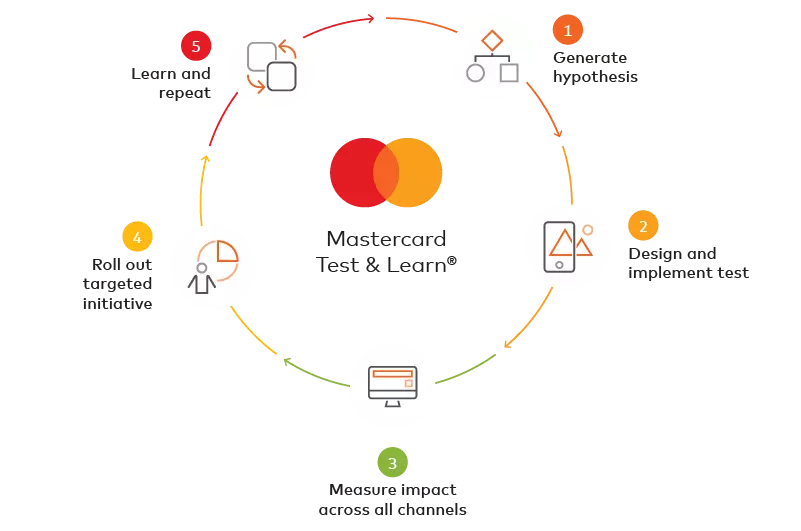
A walkthrough of the business experimentation process from hypothesis to execution.
Published: April 19, 2024 | Updated: October 29, 2025
Data can serve as a window into customer preferences and needs. However, many companies lack the ability to extract meaningful insights from their data at scale. Businesses know they need to make more informed decisions but may not know how. Enter the test-and-learn process.
Just as a scientist develops hypotheses and collects data to assess the validity of their assumptions, leading companies engage in small-scale “business experiments” to make more informed, data-driven decisions.
When businesses introduce testing and learning to their strategic decision-making, they can cut through noise and ambiguity to identify and act on the highest ROI initiatives possible. With this rigorous testing method, scientifically sound experiments reveal the overall incremental impact of an initiative, the most effective aspects of that initiative, the types of customers or markets that respond best and how to target rollout across the organization.
Testing ultimately accelerates innovation by enabling businesses to rapidly explore ideas within a controlled environment without the risk of rolling out an ineffective program to the entire organization.
It can be challenging to identify the true business impact of a new initiative; however, the test-and-learn process helps companies understand what works best and why. Before committing to a full rollout, an intentionally crafted business experiment can reveal:
Based on a Mastercard Test & Learn® client survey, 44% of business initiatives don’t break even. Used by many leading brands, in-market testing empowers business leaders to improve the success rate of their initiatives and understand their overall incremental impact. By mitigating certain risks, companies can feel more confident in their business strategies.
In short, the test-and-learn process helps organizations maximize learnings, minimize risks and stimulate innovation.
The test-and-learn process involves implementing a change for select test groups and withholding that change for matched control groups. For example, a financial institution could send a credit card promotion to select customers only, or a retailer could implement a new store layout in some locations, but not all.
Test versus control experimentation is the analytic gold standard for determining casual relationships. Other analytic methods (e.g., regression analyses) are helpful hypothesis generators, but only a business experiment that observes actual performance can isolate the true causes and effects of an initiative.
In an uncontrolled environment, there are unlimited external factors that can affect performance, making it extremely difficult to isolate the true incremental impact of an action. An internal Mastercard analysis found that 45% of campaigns have natural test vs. control bias, meaning there is great room for improvement in analysis structuring.
Below is a walkthrough of the test-and-learn process, from hypothesis to execution.
The process always begins with creating a testable hypothesis.
Example: A retailer believes that a change to store layout will drive customers to visit more frequently, thus increasing sales.
Important considerations:
What a company must ask themselves before conducting a business experiment:
This step ensures that the test is properly designed and variables are identified in advance.
Example: The retailer identifies highly similar “control” sites where the store layout change didn’t occur and uses them as a performance baseline.
Important considerations:
In a business experiment, an initiative is implemented in some sites (or with some customers) and not other.
Rigorous tracking and monitoring of key performance indicators allows businesses to feel confident that impact is directly related to their initiative and not simply the result of random chance.
Example: Using test versus control methodology, the retailer measures the true incremental sales impact driven by their store layout change.
Important considerations:
Testing answers two key questions: "Did my initiative work?" and "Why or why not?"
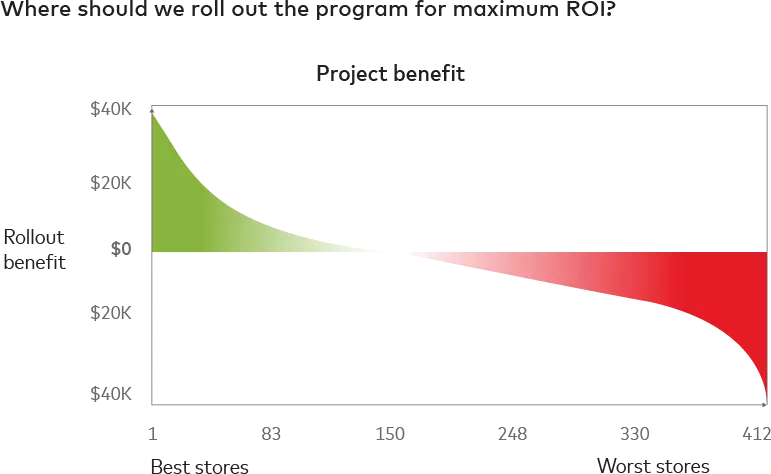
Once an initiative is determined to be successful, a business can roll it out to the sites or customers where it is expected to perform best.
Example: The retailer implements the layout changes in the stores expected to perform most positively.
Important considerations:
Results and learnings from a test shouldn’t just be discarded once it has been run. Ideally, they should be collected so others can refer to them, avoiding repetition, providing future inspiration and contributing to the greater institutionalization of the test-and-learn process within organizations.
Example: Learnings from the retailer’s store layout change test help inform best practices for future layout and merchandising initiatives.
Important considerations:
The test-and-learn process helps businesses optimize new strategies, minimize risk and innovate more quickly. By institutionalizing a testing culture, organizations can better understand the causal relationship between business decisions and financial outcomes, enabling them to action on the most effective strategies possible.
Want to read more about the test-and-learn process? View The essential guide to business experimentation for examples and tips.