What are you looking for?

Promoting sustainability is increasingly becoming vital for corporates because of a changing regulatory environment and interest from investors, partners and customers. Yet even as companies are embracing a broad range of sustainability initiatives, they´ve been lagging when it comes to indirect emissions, or Scope 3, reporting
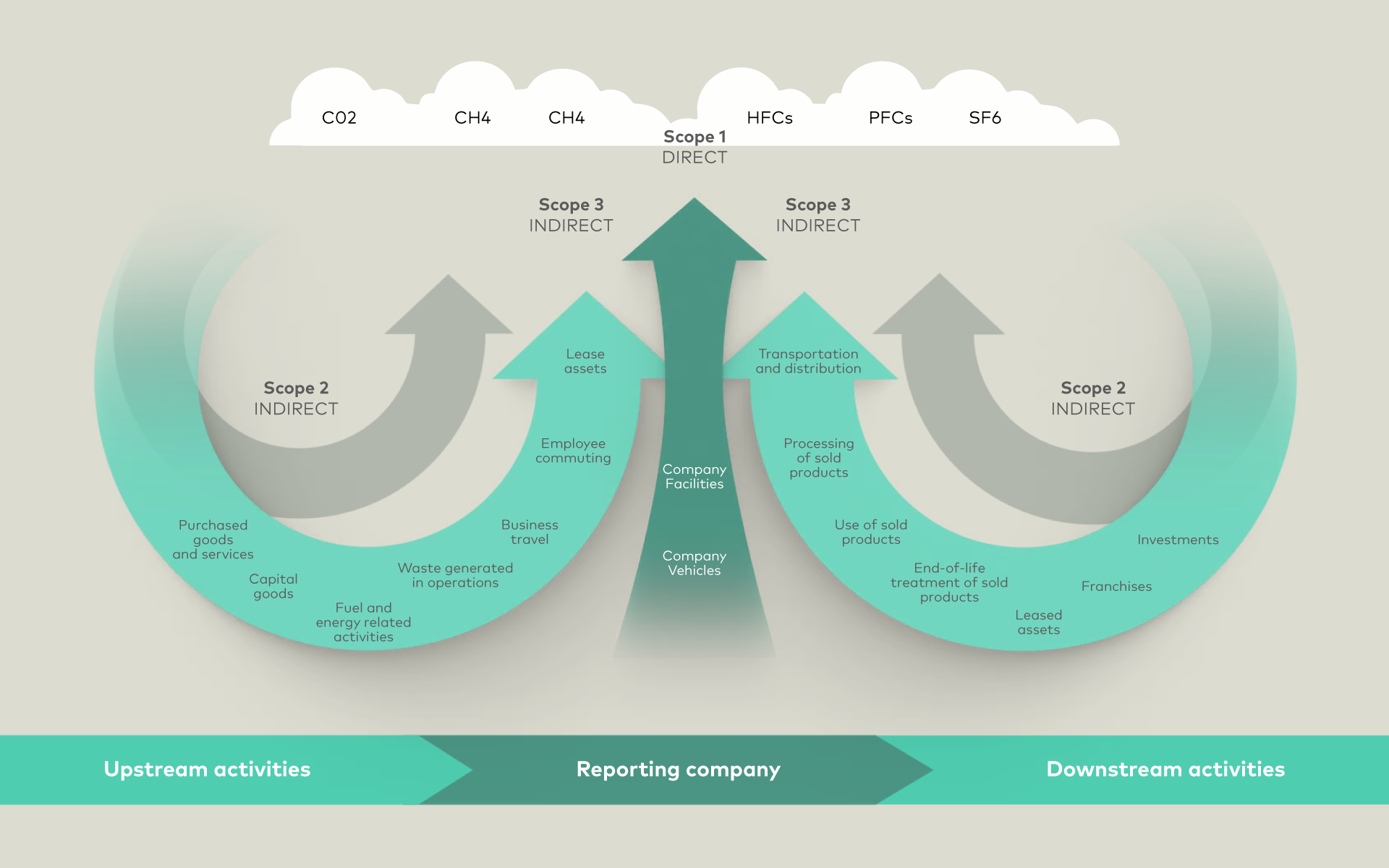
Scope 3 emissions comprise of a broad spectrum of indirect emissions from a company’s upstream and downstream activities, including purchased goods and services and logistics.
Scope 1
emissions are a company´s direct emissions, such as those from its trucking fleet.
Scope 2
emissions result from the generation of the energy a company purchases.
Scope 3
emissions result from a company´s upstream and downstream activities.
75% Of company's greenhouse gas emissions are Scope 3 emissions, on average³
In some industries Scope 3 emissions far exceed Scope 1 and Scope 2 combined.
Scope 3 emissions are both underreported and significant in size and impact. Quantifying and reporting them would represent a step forward in the burgeoning movement toward a net-zero corporate sector. And yet relatively few companies seem to be motivated to do so.⁸
Even if a company wants to report Scope 3 emissions, it can be hampered by the fact that its value chain partners don’t collect the necessary information.
EXAMPLE
A food and beverage company will have to obtain Scope 3 data from all of its ingredient suppliers and packaging partners, and end-of-lifecycle data from its customers.
A bank that lends to a transportation company will need to account for that company’s emissions.
In most jurisdictions around the world, reporting has been at least strongly encouraged and sometimes mandatory in cases where Scope 3 emissions were material. But interpreting what constitutes “materiality” is a subjective exercise, so companies have largely been able to navigate the regulatory waters in a way that makes their own reporting easier.
EXAMPLE
The DAX 40 index measures the performance of 40 of the largest companies on the German stock market. Only half of those 40 companies have reported on more than 4 out of the 16 categories of indirect emissions that Scope 3 comprehends. Eighteen percent of these companies have not reported Scope 3 emissions at all and another 15% have reported on fewer than 2 of the 16 categories.
A market for Scope 3 reporting services is emerging as part of the booming carbon management market and is projected to nearly double in value by the end of the 2020-2026 period. But the companies populating this market tend not to offer comprehensive services. They focus instead on niche Scope 3 sub-categories: some on supply-side/upstream activities, some on downstream activities, some on business travel emissions.
There are several reasons why such reporting service providers have limited focus areas, including the difficulty of obtaining information and the fact that the heterogeneity of the Scope 3 subcategories makes it hard for them to amass expertise. But whatever the reasons, the effect is to normalize partial Scope 3 reporting.
Such a partnership will become vital as carbon accounting becomes more fundamental to company decision-making processes — something that informs and even drives them, rather than a nice-to-have that’s ultimately adjacent to them.
A CFO may well factor emissions data directly into decisions about capital expenditure and M&A, to give just two examples.
In searching for reporting solutions providers, companies should examine how effective they are in collating data from sources both external - vendors and other partners, customers and so on - and internal.
They should also determine how easy it will be to integrate a certain provicer's solutions into their tech stack. Flexibility is key
We increasingly see ESG reporting following a maturity similar to that of financial reporting. Consistent with that, new providers of emission management and reporting services will need to be integrated into company financial reporting systems just as financial reporting service providers were.
Now is the time for companies to prepare their tech stacks for this integration.
There are several reasons why such reporting service providers have limited focus areas, including the difficulty of obtaining information and the fact that the heterogeneity of the Scope 3 subcategories makes it hard for them to amass expertise. But whatever the reasons, the effect is to normalize partial Scope 3 reporting.
Even as governments and companies embrace sustainability, Scope 3 reporting has remained a blind spot, for a variety of reasons. But it may not be for much longer as the regulatory environment changes and as consciousness of how Scope 3 reporting can help in reaching net-zero goals spreads. Happily, there are a number of steps that companies can take to put themselves in a better position to handle Scope 3 reporting challenges and prepare for a greener, more sustainable future.
Mastercard has a broad ESG portfolio, including its Consumer Carbon Calculator powered by fintech Doconomy, the Priceless Planet Coalition, the Data and Services ESG offering and its Sustainability Lab. Mastercard's Start Path program also invests in ESG startups such as Carbon Neutral Club. It enables employees to calculate, offset and reduce their personal carbon footprints through employer-driven engagements. Leveraging the reach of a large network and broad merchant base, Mastercard could play a role in Scope 3 reporting by providing centralized and secure data and deploying a network that enables its easy distribution.
[1] Governance & Accountability Institute 2021 Sustainability Report
[2] Bloomberg
[3] CDP Estimate
[4] Apple 2022 Environmental Report
[5] Google 2022 Environmental Report
[6] CDP Estimate
[7] The number of companies committing to net zero goals has tripled from 2019 to 2022. In aggregate, these companies contribute about $11 trillion to the global economy.
[8] Ibid
[11] European Sustainability Reporting Standards
[12] India GHG Program