Published: June 01, 2022 | Updated: March 30, 2026
There’s a legendary tale from the Nixon era: when his team fed military data into a computer to predict victory in Vietnam, the machine responded that they’d already won — five years earlier. Whether fact or fiction, it’s a reminder of how early simulations could mislead when data and context were lacking.
Fast forward to 2025, and simulations have come a long way. Today, they’re not just for military strategists — they’re becoming essential tools in the fight against cybercrime. And unlike their battlefield counterparts, cybersecurity simulations have long been neglected. But that’s finally changing because simulations prove if security tools and controls actually work and in return reduce breach risk.
It’s not a matter of ignorance that things are only changing now. The cost of building and coding replicas of business systems exclusively to host simulated breaches and attacks has been unaffordable for most businesses until recently.
The upside is that the availability of simulations to assist in cybersecurity testing coincides with recent improvements in cybersecurity risk assessment and management.
Business leaders responsible for maintaining operations and protecting infrastructure should prioritize how to evolve to beat cybercrime by flexibly adjusting to changing threats and quantifying the risks. To ensure this approach is adequately supported, organizations customarily employ a range of testing methodologies:
Vulnerability scanning relies on databases of known vulnerabilities to automatically detect system flaws
Penetration testing, or “pentesting,” relies on manual review by individuals as simulates real-world attacks to test defenses Red teaming employs specialized groups to conduct scenario-based attacks on designated targets, evaluating how well defense teams respond and adapt to these simulated threats.
But all these tests have shortcomings that can lead a cybersecurity solution that appears solid in theory to fail in reality. The automated nature of vulnerability scanning restricts it to a predefined repertoire of threats. Human participation in penetration testing and red teaming is subject to inherent biases and limitations associated with human capabilities. As a result, none of the three approaches can stay fully on top of imminent threats. The tests are also conducted on live systems that need to be interrupted, so continuous analysis is not possible — even in the case of vulnerability scanning, which has limited human involvement.
In this case, simulations can assist with improving predictions of future threats and maintaining ongoing vigilance.
A breach and attack simulation, such as Mastercard's Cyber Front (need a new link when this page launches on MA.com), relies on replicas of business systems to simulate the actual threat landscape. Since it’s not conducted on actual systems, it can be run continuously without the need to wait for vulnerability scanning windows on live systems. As a result, it transforms risk into something visible, measurable, and manageable for organizations.
The system utilizes actual threat samples and methods sourced from current cybersecurity environments to remain informed about emerging threats. The simulation evaluates detection and response capabilities and offers targeted recommendations for mitigation where improvements are needed.
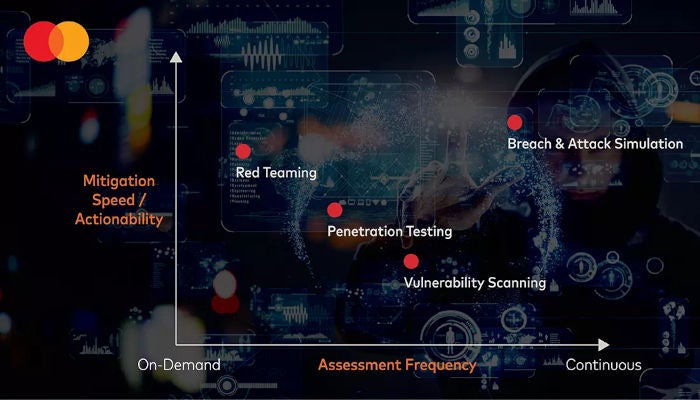
When integrated with advanced cybersecurity analytics, breach and attack simulations enable a continuous feedback loop that enhances strategic decision-making and operational resilience. The simulations provide enhanced data inputs to the cybersecurity solution, and the solution provides data inputs to the simulations to allow for better threat scoring. The main benefits of breach and attack simulations are compared with the three traditional approaches to testing — red teaming, penetration testing and vulnerability scanning:
The position of breach and attack simulations in the top right corner shows it to be an improvement from traditional testing on both axes. For many businesses, a fully automated solution may offer convenience while remaining unobtrusive and cost-effective.
Nevertheless, for prominent businesses handling highly sensitive data, complete automation could theoretically bring some additional risk.
Breach and attack simulations are only as intelligent as the actual threat landscapes that inform them. And that doesn’t prevent humans, AI and machine learning models from coming up with entirely novel ways to conduct cybercrime.
In highly challenging circumstances, where the potential benefit justifies the increased expenditure, periodic red teaming testing may continue to serve a valuable function. In other situations, conducting continuous simulations of advanced cyberattacks enables businesses to address evolving cyber threats more effectively and maintain preparedness in the field of cybersecurity.
For more information on Mastercard’s Cyber Quant, Cyber Front, Cyber Insights, Cyber Crisis Exercise, Risk Recon, Threat Protection solutions here.