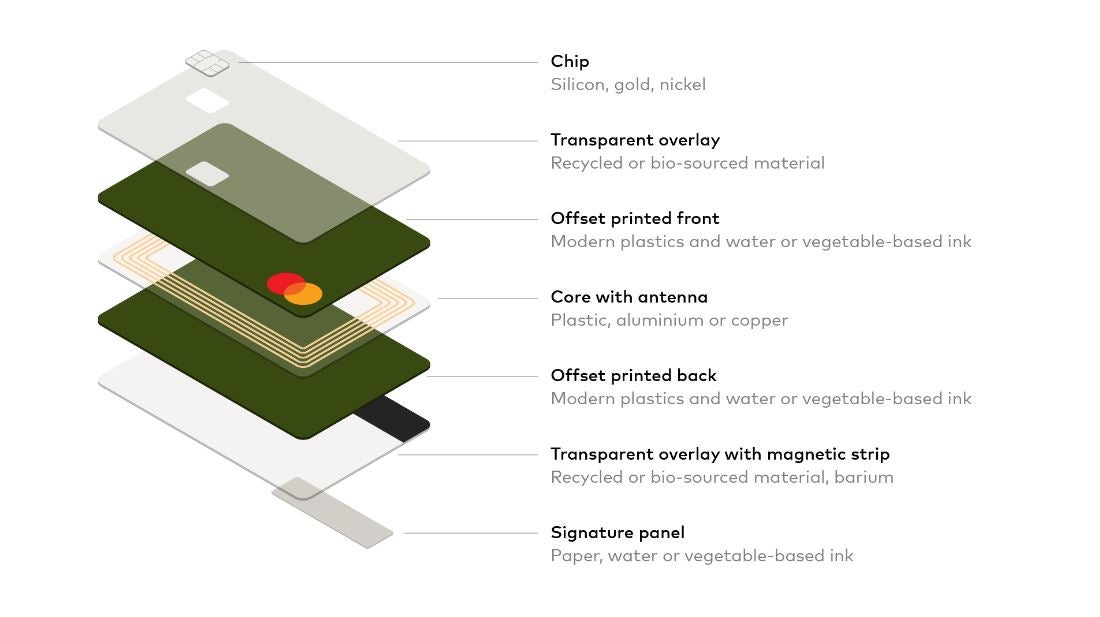
Mastercard established its sustainability efforts more than a decade ago with a focus on financial inclusion, data responsibility and the environment. Through its network it collaborates with partners to bring new environmental innovations and initiatives to market, such as our Priceless Planet Coalition, Carbon Calculator as well as the Sustainable Card.
“Mastercard is committed to advancing climate action and reducing waste by driving our business toward net zero emissions and leveraging our network and scale to accelerate the transition to a low-carbon, regenerative economy,” said Ellen Jackowski, Chief Sustainability Officer for Mastercard.
In 2018, through Mastercard’s Digital Security Lab, the company launched the Greener Payments Partnership with card manufacturers Gemalto, Giesecke+Devrient and IDEMIA to reduce the use of first-use PVC plastic in card manufacturing. Mastercard’s participant banks span more than 80 different countries worldwide. It launched the Mastercard Card Eco-Certification ("CEC") scheme in 2021.
Comments from partner banks:
Taylan Turan, Group Head of Retail Banking and Strategy, Wealth and Personal Banking at HSBC, said:
“Today’s announcement from Mastercard is a huge step for financial services. New sustainable materials, such as rPVC, offer our sector a clear way to accelerate its efforts to build a more sustainable future.
“As part of our net zero strategy at HSBC, we’ve already introduced recycled plastic payment cards across 28 of our global markets and embedded the requirement to use sustainable materials for all debit, credit and commercial cards in our product governance; removing 85 tonnes of plastic that would have ended up in landfill.
“This level of impact couldn’t be achieved without strong partnership; I am so proud for us to be a part of a movement which is gathering momentum across the world.”
Michael Battagliese, Head of Payment Solutions, Senior Vice President at Bank of the West said:
“We believe that conducting business sustainably is simply the right thing to do. That's why we partnered with Mastercard on our 1% For The Planet Checking Account debit cards, which are designed to reduce the impact of first-use PVC on the environment.
“We’re proud to have been one of the first banks in the US to be a part of the sustainable cards program and we’re pleased Mastercard is on a path to make all payment cards with more sustainable materials.”
Helen Bierton, Chief Banking Officer at Starling Bank said:
“This initiative is a welcome next step in the journey to a sustainable future. As one of the first banks to remove first-use PVC from our debit cards, we know how important this is to our customers.”
“We recognise this can only be achieved with strong partnerships and support for the efforts by Mastercard to widen the programme to its entire network.”
Driving a more sustainable future
Tackling the global climate crisis will take all of us. Mastercard can have the biggest impact by activating our global network to create collective action. Through this network, we are collaborating with partners to bring new environmental innovations and initiatives to market, such as our Priceless Planet Coalition, Carbon Calculator and Sustainable Card Program. And we’re partnering across the public, private and social sectors to drive the next generation of climate innovation. Our Sustainability Innovation Lab serves as an R&D center for sustainable digital products and a platform to co-create with partners.
*****
1 rPVC, rPET, or PLA are examples of alternative plastics that are most commonly used in packaging, construction materials, and recycled bottles.