November 19, 2024
Every weekend, as people stumble home from packed bars and clubs in Aarhus, Denmark’s second biggest city, they leave behind a messy trail of cups, burger wrappers and pizza boxes, which clog gutters and drift into waterways.
It’s a costly problem for the Viking-founded coastal city, which has been looking for ingenious ways to eliminate the takeaway garbage it calculates is responsible for nearly half the litter on its streets.
“Our working vision is a city without waste bins,” says Simon Smedegaard Rossau, Aarhus’s project manager for circular systems. “It’s about turning your thoughts a little bit and being ambitious.”
The implications of Aarhus’s pilot expand far beyond its city limits. Takeaway bags, cutlery, drink containers and wrappers now dominate waterway litter throughout the world and have clogged landfills in some cities. As one response, many governments have banned certain single-use plastics, including bags and plates. As many municipalities grapple with their waste crises, city leaders in countries from Japan to Brazil are closely watching the Danish city to decide it they should follow suit with reusable programs too.
These communities are keenly aware that reusable packaging will not take off unless the business model becomes financially viable. The cost of collection, sanitization, quality inspections and redistribution makes it tricky to undercut the price of single-use products (approximately just 15 cents for each throwaway cup) and scale the program, which can help cities cut their emissions as well as waste management bills.
That’s why policies are needed to provide the conditions and incentives to transition to well-designed reuse systems, unlocking their full environmental and economic potential, says Geir Saether, the senior vice president of circular economy for TOMRA Systems, the Norwegian sustainable technology company that partnered with Aarhus to pilot the REUSABLE containers.
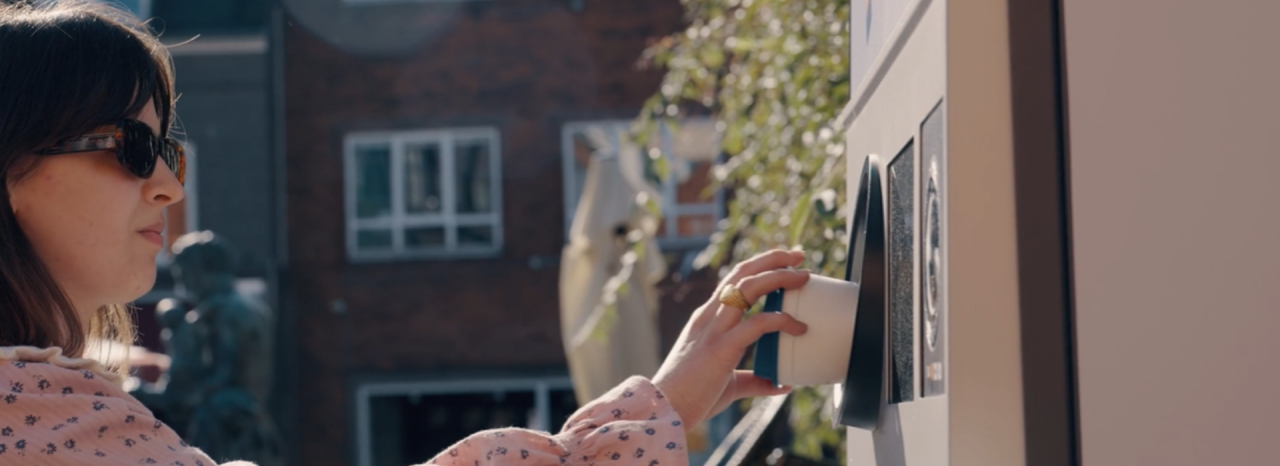
TOMRA was able to adapt its existing bottle and can reverse vending machines to accommodate coffee and drinks cups. For consumers who select the more sustainable reuse option, the 5-krone returnable deposit is added to the product purchase. The deposit is an efficient incentive for consumers to return the packaging, ensuring high collection rates, Saether says.
Keen to encourage people to make the extra effort to reuse, they tried to make the process as painless as possible by installing returns machines in busy spots roughly every 500 yards in the pilot area, where 50,000 people live.
Highlighting Lisbon’s plastic cup ban and Dubai’s move to prohibit all single-use plastic packaging, Saether says measures such as taxes or restrictions on disposable products would encourage stronger take-up of reusable systems. It’s a consideration that could determine if countries or cities choose to introduce broader policies to encourage using similar sustainable alternatives.
Nearly a year into the trial, Rossau says he’s seeing less litter around Aarhus as 88% of cups are now being returned and recycled.
If the three-year trial works in a compact city like Aarhus, it could be scaled up to densely populated cities such as New York, if they can find spots to install the thousands of reverse vending machines they would need.
“We need to make a mature choice to say we need to take a little bit of space here and there to minimize the growing waste crisis we’re seeing in all cities,” Rossau says. “If you’re a city official, you need to ask yourself otherwise, 'Where are we going to put all this waste that’s overflowing our streets?'”