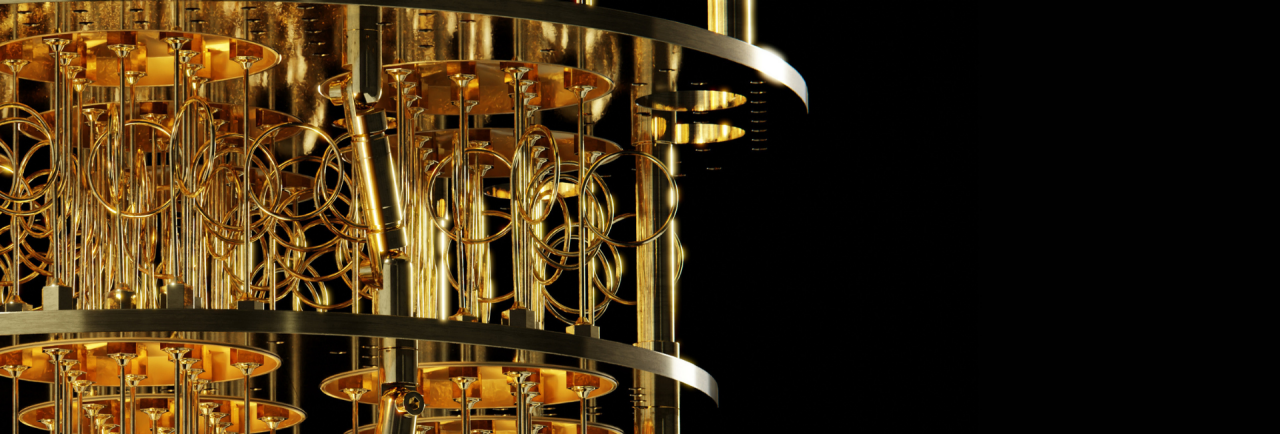
Quantum computers, like classical computers, rely on physical phenomena to encode information as strings of ones and zeros. In your laptop, the physical entity is electrical current, which can be either off or on — 0 or 1. A quantum computer uses qubits, subatomic particles that have been isolated in specialized circuits or vacuum chambers. Like the circuits in a classical computer, qubits are confined to two distinct states (e.g. the direction of an electron’s spin or the polarization of a photon).
But — here’s where it starts to get weird — qubits can be put into superposition, meaning they occupy both states at once, until they are observed, at which point they collapse into a single outcome. (Remember Schrödinger’s cat, alive and dead at the same time?) This added dimension allows quantum computers to conjure all possible solutions to a problem simultaneously.
Quantum mechanics also bestows qubits with a force multiplier, and it’s even weirder: Qubits can become entangled, meaning that their states correlate, either always matching or always opposite. No matter how far apart they are, changes to an entangled qubit instantaneously affect the others, and observing one confirms the state of its counterparts.
These two properties, superposition and entanglement, grant quantum computers exponentially more power than today’s most advanced supercomputers can muster. Entangled qubits in superposition register every possible combination of their states, so each additional qubit doubles the data capacity: Two qubits store four values, three qubits store eight, and 50 store more than a quadrillion.
“That’s what makes them more powerful, that they go beyond conventional ways of processing data,” says George Maddaloni, who oversees the Operations, Network and Employee Digital Experience team at Mastercard and is leading the company’s approach to future-proofing its network against quantum threats.
“In the next 15 years, these computers could crack the foundations of the global cybersecurity infrastructure.”