Mastercard at 60
August 12, 2026
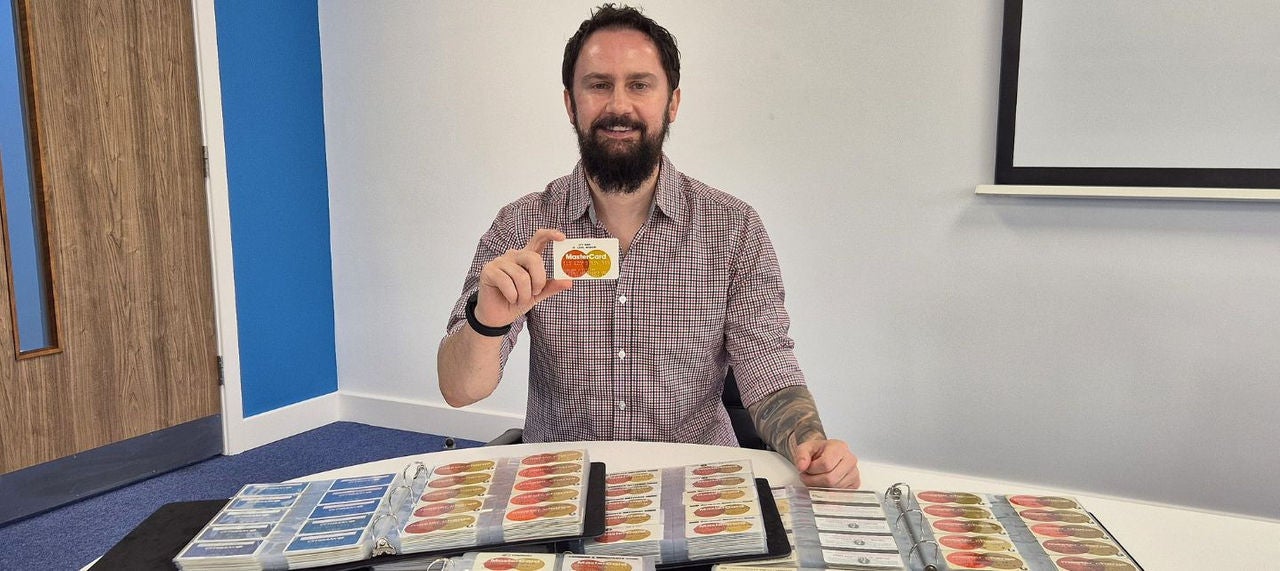
For collector Rich Hudson, it's not about the credit score. It's about scoring the credit cards. (Photo courtesy of Rich Hudson)
For most of his life, Rich Hudson saw credit cards as a convenient payment option that came with perks. He used numerous cards to amass travel miles and points. When one expired, he’d cut it up and carry on.
Then it came time to retire a bank card emblazoned with a beautiful sunset. The 44-year-old British business owner had always admired that one. “Rather than put it in the bin, I think I’ll hang on to it,” he decided eight years ago. And so it began.
“At first I would save my own cards, and it was almost like something I did in secret, because I thought it was a bit strange,” he says. “After a couple of years I thought to myself, ‘I wonder if anyone else in the world does this?’”
An online search surprised him. Hudson discovered the American Credit Card Collectors Society (ACCCS), a small but passionate group of people who enthusiastically buy, sell and trade expired credit cards like sports fans do with baseball cards. From that point on, things snowballed. Hudson now owns more than 15,000 credit cards, stored in neatly categorized binders in his library. Most of them are vintage, many of them Mastercards.
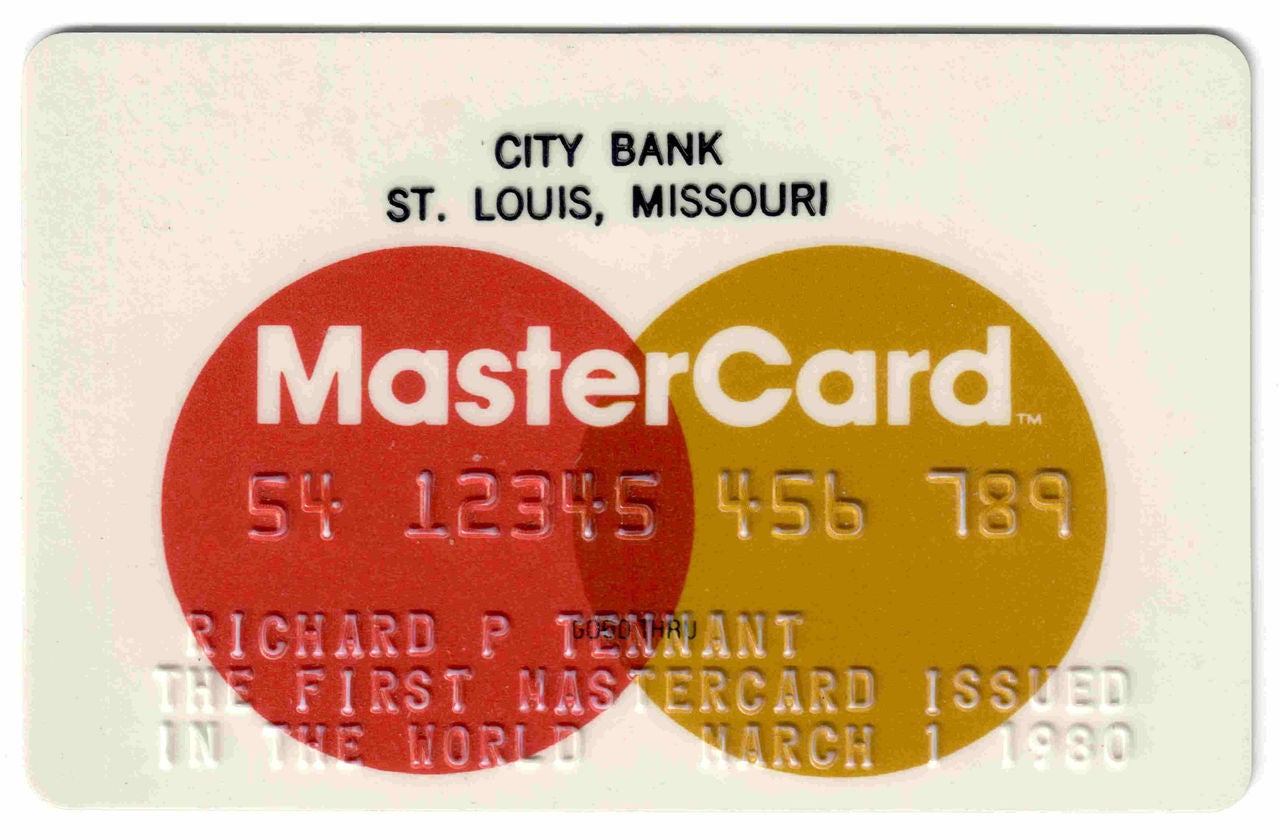
Among the gems in his collection is a card with the familiar interlocking circles issued by City Bank of St. Louis, Missouri. It’s embossed with the name “Richard P. Tennant” and “The first MasterCard issued in the world March 1, 1980.” Tennant, he explains, was head of a St. Louis–based company that handled administrative services for the Interbank Card Association, the bank-card network behind Master Charge, which became MasterCard in 1979 (and eventually Mastercard). He has digital newspaper clippings to back up his research.
Rich Hudson counts this one-of-a-kind Mastercard among his collection. The embossing claims it's the first Mastercard issued in the world — because until then, Mastercard had been known as Master Charge and hadn't yet dropped the capital C. (Even though this card expired decades ago, we changed the numbers in the photo because the first digits of a credit card — the Bank Identification Number, or BIN to those in the know — can be recycled for other cards.)
Hudson and his fellow enthusiasts scour the web and trade expired cards across continents. As with any collector, part of the thrill is in the hunt, and part is in the satisfaction of acquisition. To these hobbyists, credit cards are more than just pieces of plastic. They’re artifacts of commercial, technological and social history — tangible reminders of how people shopped, traveled and paid over the decades.
“I describe [collecting] as an endless jigsaw — the more you learn, the more you realize there’s more to learn,” he says. “Each card is like a time capsule."
Credit card collecting is a cousin of numismatics, the study or collection of coins, paper money or financial tokens. Yet while there are millions of hobbyist coin collectors around the world, the number who collect credit cards appears to be much smaller. Case in point: The ACCCS has around 50 members.
Scott Nimmo, 55, current ACCCS president, got hold of his first vintage cards in the early 1990s, when he was a 20-something working at Sears. “I was interested in retail history, and a relative had saved these cards from local stores that had gone out of business,” says the Nashville, Tennessee–based furniture buyer. When he read about a monthly newsletter called “The Credit Card Collector,” he was ecstatic: “I thought, ‘I can’t believe it! There are other people out there!’”
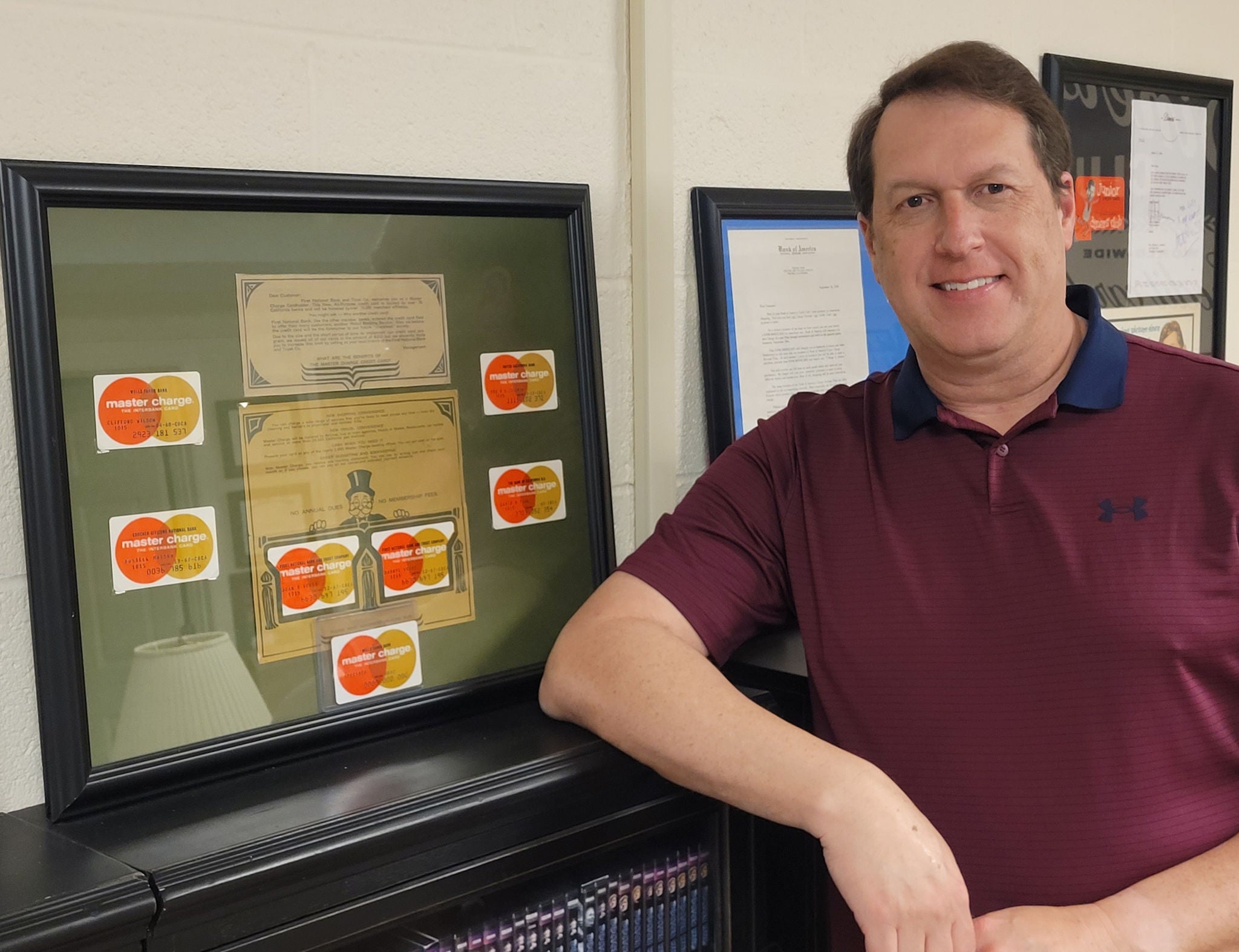
Scott Nimmo, the current president of the American Credit Card Collectors Society, shows off his vintage Master Charge cards. (Photo courtesy of Scott Nimmo)
That newsletter evolved to become the ACCCS in 1993, with Nimmo as a founding member. The club now holds a convention every two years, with 10 to 15 collectors gathering at a U.S. hotel or a member’s home to talk shop and make trades.
Not that trading is limited to conventions. Enthusiasts like Nimmo and Hudson keep a close eye on collectibles sites, such as Colnect.com. “I check eBay multiple times a day,” Nimmo says. They routinely engage with collectors in places including China, Australia and Portugal, home to club member Agostinho Campos Ferreira. Campos Ferreria, an economist, wrote his doctoral thesis on the history of Mastercard in 2021. It’s since been turned into a book that serves as a definitive guide for collectors, “The Origins of Mastercard (and an Overview of a Global Industry).”
While easy-to-find cards might go for a U.S. dollar or two each, rare cards and those with historical significance can fetch thousands. The record was set at a Butterfield & Butterfield auction in 1994 when actor John Corbett, of “Northern Exposure” and “And Just Like That,” reportedly paid $41,400 for a 1973 credit card owned by Elvis Presley.
Nimmo doesn’t need celebrity pedigree. He’s happy to own one of the earliest Master Charge cards, marked with an expiration date of November 1967. The card was issued by Crocker-Citizens National Bank in California, a founding member of the consortium that later became MasterCard International, the Interbank Card Association.
In the ’60s and ’70s, long before the days of credit scores and Know Your Customer legislation, collecting was more like the Wild West. “Early collectors could open cards endlessly and would sometimes have a huge number of cards in their own name,” says Hudson. “This lives on in the hobby today, because you come across the same names on cards over and over.”
He points to his own “fantastic set” of eight historic, first-generation plastic charge cards, issued in series in the early 1960s. “I managed to identify through other collectors where all the cards were in this same person's name, but [they] were distributed across the world, in Europe, America and Asia,” he says. “I had to buy and trade my way to reunite them.”
Some collectors are into co-branded cards, like those issued in partnership with airlines or popular merchants. Others are into card technologies: cards from the 1980s with the first embedded computer chips, for example, or those from the 1960s with the first magnetic stripes. Before the stripes, embossed cards were “processed” using manual imprinting machines, sometimes called zip-zap machines or knuckle-busters, for the damage they could do to checkout clerks’ hands. Those are popular with collectors too.
A forerunner to store credit cards, charge plates were metal tags embossed with the customer’s name and generally issued by local department stores from the 1930s through the 1950s — those fetch even higher prices.
“There’s aways something new to find,” Nimmo says. “There are still cards coming up that I’ve never seen before.” His unicorn — one he’s still trying to track down — is one of the cards issued by New York’s Franklin National Bank in 1952, considered the first-ever general-purpose charge cards.
”It makes me wonder what is still in people’s attics,” Hudson says. “I’m sure there are some very rare and valuable cards out there that people have no idea they’ve even got.”