Published: July 13, 2026
Consumers of financial services are benefitting from more choice today than ever before. This influx of powerful, personalized services has partly been spurred by fintechs and industry innovators developing new tools to help consumers take ownership over their financial lives.
These expanded choices create more competitive pressure, prompting consumers to demand service providers that deliver clear value and reliable support on a foundation of data security they know they can trust. These dynamics are supported by a new report from Mastercard and Financial Times (FT) Longitude, “The state of open finance 2026.” The report shows that, globally, 76% of consumers say they would switch financial service providers in order to access digital features that made financial management easier, and a similar number would switch to gain more transparency into how their personal data is used.
Against this backdrop of rising competition and expectations, open finance is poised to play a crucial role in fulfilling a longstanding financial services goal: transforming fragmented data into relevant, transparent and seamless services that enable economic wellbeing for people around the world. The Mastercard/FT Longitude report sheds light on the industry tipping point where financial services players and consumers are meeting today, highlighting differences across global regions and, as demonstrated specifically in this piece, among key European markets.
The research for the above-referenced report, which surveyed 8,000 consumers across 11 global markets (Australia, Brazil, Denmark, Finland, France, Germany, Norway, Poland, Sweden, the U.K. and the U.S.) makes it clear that open finance and consumer consented data now play a central role in competitive advantage for financial service providers. While 63% of consumers surveyed noticed an improvement to the insights and recommendations from their service providers in the past year, the results were not as strong across all geographies. Respondents in many European countries, including France (51%), Poland (43%) and the Nordics (as low as 34% for Finland), were less likely to report improvements in this area, meaning there is more room for future growth. The U.K. came in above the global average, but far behind the U.S. and Australia, which led this metric.
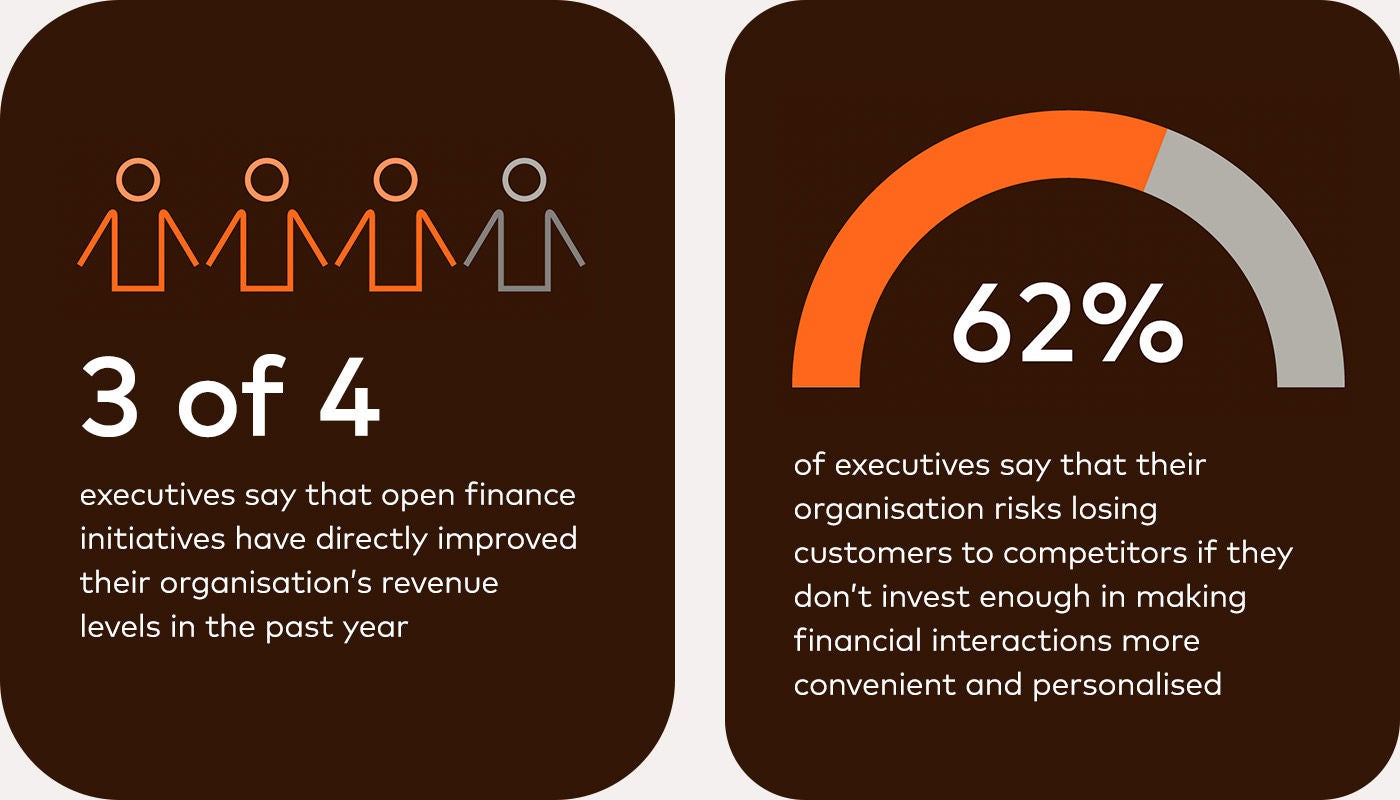
In addition to the consumers surveyed, Mastercard and FT Longitude also polled 300 senior executives across the same 11 markets. The responses from these B2B leaders highlight the positive impact of a more open financial ecosystem, with three-quarters reporting revenue uplift from open finance initiatives at their organizations over the past 12 months. And while 62% of B2B respondents agree that they risk losing customers to competitors if they don’t invest enough in improving financial experiences, those in Europe were more likely (67%) to feel this way, with leaders in Poland showing the strongest agreement at 85%. This shows that financial services leaders recognize the importance of leveraging open finance to secure competitive advantage.
European organizations have been early adopters of open finance, due in part to regulatory requirements. European survey respondents had adopted, on average, seven of the nine top open finance use cases for banks and fintechs, versus the global average of five.
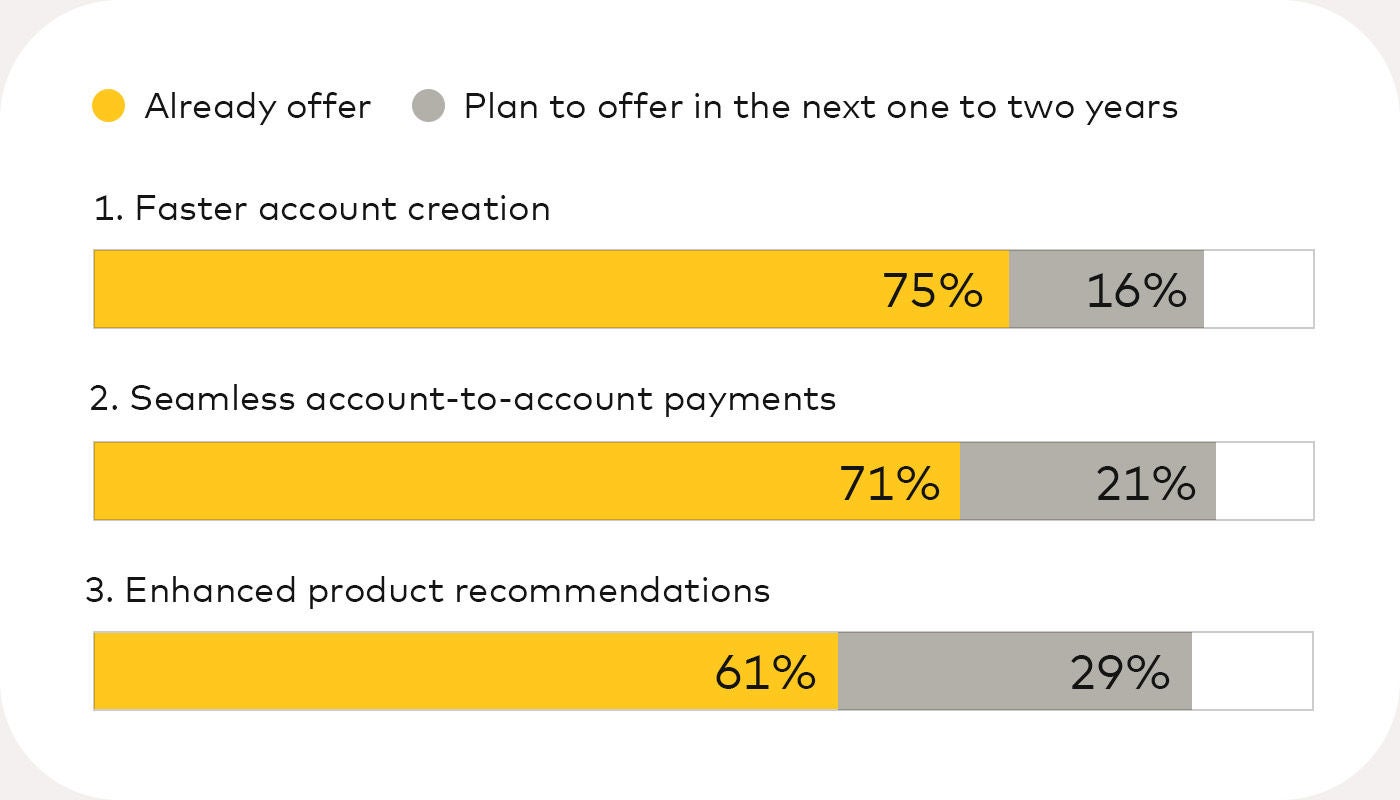
European organizations were above the global averages for the top three most-adopted use cases: faster account creation (75%), seamless account-to-account payments (71%) and enhanced product recommendations (61%). The U.K. notably lagged E.U. countries on account-to-account payments, a likely reflection of consumers’ continued preference for the ease and simplicity of card-based payments.
However, there are opportunities for Europe to advance adoption of other use cases, particularly in using open finance to set up direct deposit and bill payments, and in enabling financial institutions to more easily assess their customers’ financial health. As more providers develop and launch these remaining use cases, organizations that continue to advance adoption should expect to reap further benefits.
Consumers are making bold moves in order to access the features and capabilities that open finance provides. There is no better demonstration of this than their willingness to share consumer permissioned data. Overall, 82% of surveyed consumers would consent to sharing data in order to simplify mortgage and loan applications, boost their odds of approval or secure better interest rates on these products. U.S. consumers agreed most readily at 94%, with those in the U.K. and Denmark coming in close to the global average. But all other European markets were significantly less likely to opt in for this use case, a strong indicator that Europe’s financial service providers need to work harder to build trust and credibility with their customers.
It’s important to highlight that this willingness to share personal data often comes down to transparency. “If a consumer doesn’t know why they should agree to sharing highly sensitive personal financial information, they’ll probably refuse to do so,” Ryan Beaudry, executive vice president, global product and operations at Mastercard, says in the report. “If the context isn’t clear up front, we see significant consumer drop-off at that step.” This could mean, then, that clear communication from financial service providers (FSPs) to consumers about data governance and the benefits of data sharing is even more crucial in the E.U. than it is in other markets. The lesson: When it comes to data privacy in open finance, where there is trust to be earned, there is upside to gain.
Service providers can facilitate open finance adoption by ensuring their initiatives provide benefits that reflect consumers’ demands. First and foremost, global consumers say that saving time is their highest priority; an easier pay-by-bank experience ranks second. In certain European countries (Finland, Germany and Poland), these answers rank in reverse order but remain the top two. Real-time data insights to aid financial management are the second highest priority (after time savings) for consumers in France, Norway and the U.K. Regardless of geography, service providers should aim to reflect these three priorities in their open finance value propositions.
What else can FSPs do to facilitate the shift to a more open ecosystem? Nearly half (47%) of our B2B respondents cite the need to improve data handling standards and the reliability of their organizations’ APIs. This is one area where Jess Turner, Mastercard’s executive vice president and global head of Open Finance and Developer, believes innovation partners make a critical difference. “APIs are hugely important, but if the data quality isn’t good, if the underlying integrations, technology and trust factor aren’t strong with the entities that have the data, having great APIs won’t matter,” she says.
Another 43% of B2B respondents point to simplifying data usage explanations and consumer consent in open finance as a key lesson from their own initiatives. More than one-third recognize the need to be more careful in using consumer permissioned financial data for targeting, specifically with an eye on protecting customer trust, and a similar number express the need to embed security by design in all data-driven projects.
While regulation, including the current and provisional Payment Services Directives (PSD2 and PSD3) and Financial Data Access (FiDA) regulation, will influence the growth trajectory for open finance in the near term, it’s consumers who are truly in the driver’s seat. This may be especially true in Europe, where there is more trust to earn, more ground to gain and a broader spectrum of attitudes and priorities across markets. Obtaining data consent is one of the keys that will help companies unlock doors to an open financial ecosystem. But embedding open finance in larger growth strategies, and tirelessly committing to security by design, are the foundations that will ultimately enable today’s financial services innovators to stand the test of time.
Discover the driving sentiments behind open finance in Europe. From emerging trends to market perspectives, explore the full findings in our report, The State of Open Finance 2026: Unlocking Growth with Data.