Saltar al contenido principal

STORY


36 Hours to Build Trust in Machine-Driven Commerce

google logo

Behind the scenes with Mastercard, XRPL and more than 150 highly caffeinated hackers at the XRP Ledger Hackathon

By John Flowers

When Adarsha Mishra and Hrishabh Ayush met at the AI & Fintech XRP Ledger Hackathon in Manhattan this past weekend, their winning project started with a brainstorming session and a relatable worry: “What if your search history gets leaked and you don’t want to be embarrassed?”

Mishra, a junior at New Jersey’s William Paterson University, and Ayush, a senior at Cornell, teamed up to build what they call Wraps, a sort of incognito mode for AI agents. It’s unlike other solutions on the market, they say, because it proves that no search logs are stored during a transaction. Their project took first place in the Mastercard Agentic Finance Challenge, with a $6,000 bounty, plus bragging rights that go beyond those earned by working for nearly 36 hours straight.

“Together we slept like two hours maybe, max,” Mishra said, laughing.

Wraps was one of 70 submissions by 179 hackers competing in the hackathon, the kickoff to XRPL partner Ripple Labs’ annual Swell conference. Participants left the weekend sprint with demos ready to tout at Swell, which brings together some of the most influential leaders in global banking, fintech and policy.

And everyone, from the hackers to the judges to the sponsors, left with potential solutions to a problem that’s central to the future of agentic commerce: How can AI agents transact autonomously while remaining trusted, controlled and accountable? The challenge for the hackers — and for the broader payments ecosystem — was not about building the most advanced AI model but about proving that autonomous commerce can operate responsibly.


Micropayments, Clarity and Control

Each team was challenged to build an AI agent that can pay a verified merchant autonomously, stay within a predefined spending limit and settle in Ripple’s dollar-backed stablecoin, RLUSD, on the XRP Ledger. Contestants competed for more than $40,000 in prizes from official sponsor Mastercard, as well as Quicknode, Amazon Web Services and Ledger. Odelia Torteman, head of digital assets at XRPL Commons, called the event “a super-unique sandbox environment, second to none.”

Many of the current use cases for agentic commerce involve micropayments used to purchase AI inference, where a trained model puts its learning to work on an assigned task. For instance, a travel-planning agent might pay a small amount each time it asks another AI model to compare flights or hotel options. Those payments are often in fractions of a cent, something the traditional payment structure is less well-equipped to handle.

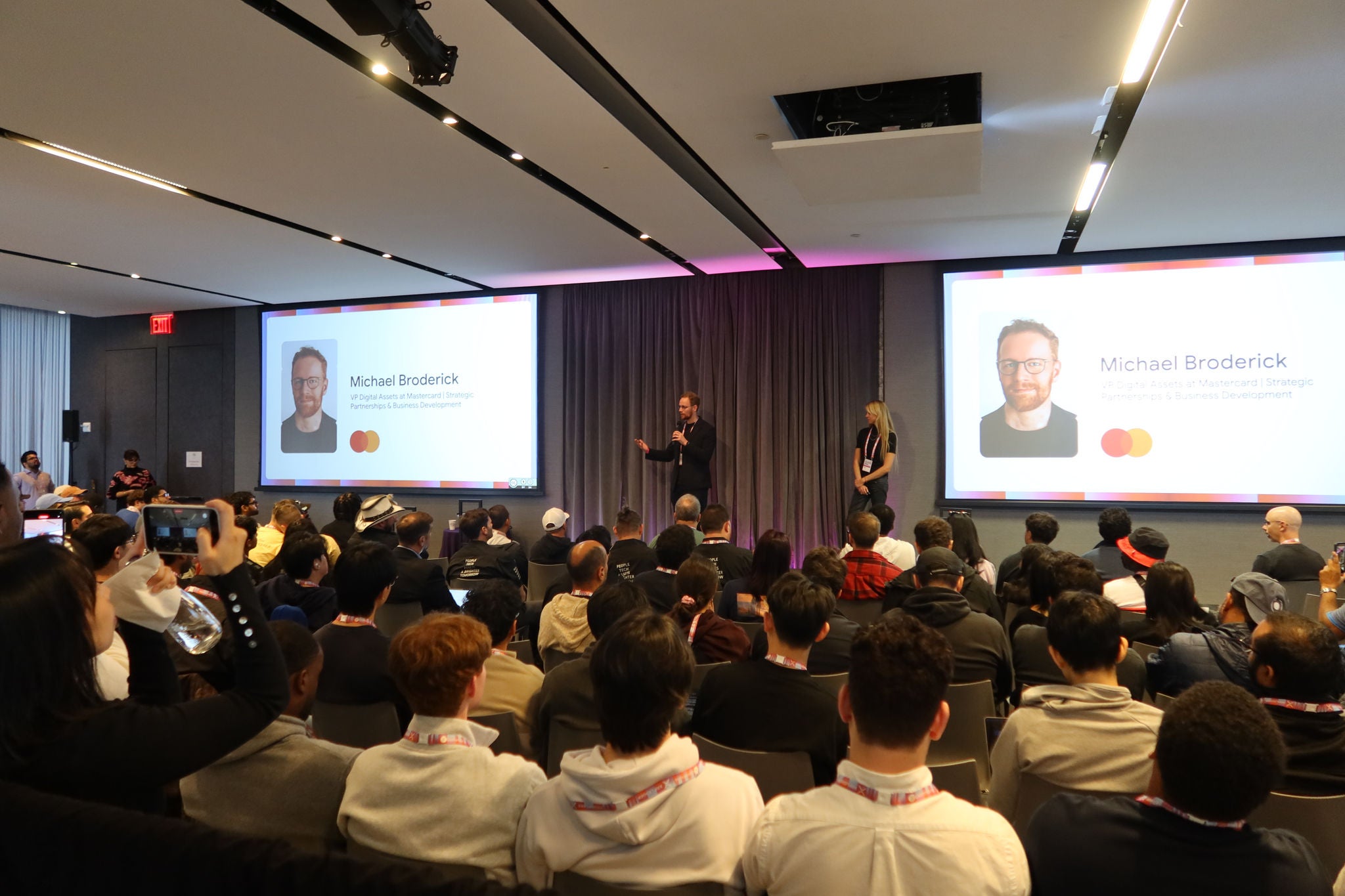
Michael Broderick, Mastercard’s vice president for digital assets and a hackathon judge, said the winners focused more on what he called “the real opportunity” with micropayments. They used Mastercard’s Agent Pay for Machines  to address the question “How do you segment a dollar or segment a cent … for more novel use cases?” Mishra says that using Agent Pay for Machines was “seamless” as they built their award-winning product.

Mastercard judges found two other projects notable, awarding their creators early access to the Agent Pay for Machines payment facilitator. One provides personal agents a new way to catalog merchant websites. The other is essentially a harness that makes it easier to rent the most appropriate agents for different kinds of work. Both projects offer new layers of clarity and control over the agentic commerce experience.

Reclaiming Trust in AI

There is no doubt that agentic commerce is already well under way. AI agents are currently executing more than 500,000 daily transactions on the XRP Ledger, according to Ripple Labs. Plus Ripple says it has recorded more than 10 million payments over internet payment protocol x402, designed for machine-to-machine transactions, on the XRP Ledger — reaching this milestone less than three months after passing a million. Many financial leaders believe AI-enabled agents can help move business transactions into an autonomous digital ecosystem, replacing a process that often demands human sign-off from multiple, often siloed decision-makers.

Getting there is another story. The key bottleneck is the consumer’s trust that the agent will do exactly as intended.

Rashi Goyal, Mastercard’s vice president of product management, blockchain and digital assets, who served as a mentor during the contest, says that for agents to handle payments at scale, users and businesses need confidence in two things: where the money goes and who receives it.

“When I give the agent a budget, how do I ensure that the agent cannot go rogue?” she says. “When an agent contacts merchants autonomously, as a user or a business, how do I make sure that all of these merchants are known, credentialed, verified?”

For example, most agentic payment flows are built to verify the buyer, not the seller. That leaves agents unable to tell a legitimate merchant from a scammer posing as a well-known brand or a store that no longer exists. With Agent Pay for Machines, Mastercard aims to bring the same trust and guardrails that protect its payment network to agents.

Amol Sharma, Mastercard’s director of software engineering and agentic commerce and a judge in the competition, noted that Agent Pay for Machines can not only facilitate payments for a task like website construction; it can also handle the research and construction required for site-building as well. “So the work that would take about two or three hours, or four hours,” Sharma says, “can happen end to end in three to four minutes.”

Building the Agentic Payments Future

The hackathon gave both participants and sponsors the opportunity to explore new ways to make micropayments cheaper, quicker and safer.

“Hackathons like this play a very, very vital part,” Goyal says, “because we’re putting it in the hands of the developers and we’re going to get very honest feedback into what works and what doesn’t work.”

“The reality is that the fracturing of [technology] is happening,” says Broderick, “and agents actually, in many ways, become that interoperable glue that we can take advantage of.”

Broderick also has a bit of advice for businesses that might think agentic commerce is a can that they can kick down the road: “It’s going to start really slow, and then it’s going to be here all of a sudden. I think in 12 months we’ll almost have whiplash looking back to see how far we’ve come with agentic payments. Every company needs to have an agentic commerce strategy.”

Projects like Wraps demonstrate that part of the strategy to make agentic commerce viable rests on features that create a safe environment where buyers can both trust that merchants are reliable and feel like their search histories are not being spied on during transactions.